Bell St, NW1 – Ground zero for Punk rock

screen-shot-2016-12-02-at-11-07-09

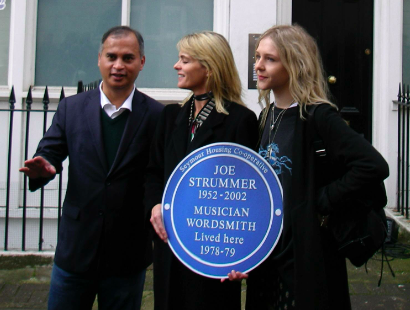
As part of Punk.London, the year-long festival commemorating forty years of punk in London, Seymour Housing Co-op Ltd unveiled a plaque last week on one of its properties, 33 Daventry Street NW1, the squatting location where Joe Strummer lived during a pinnacle creative period between 1978-79.

So it was fitting to hear Don Lett’s, Film Director, DJ & Musician saying “Strummer didn’t need nor did he seek society’s blessing – this comes live and direct from the people!”  A message which was further reinforced by Joe’s wive, Lucinda message on the day of the unveiling in an interview with the local paper, the West End Extra  that “….Joe would have be overwhelmed to have this recognition, and just so happy that the spirit of squatting is still alive via the Co-op….” 

Where the 101ers and The Clash musician, wordsmith and punk icon was honoured with a permanent testament in an area on and off Bell Street, NW1, should also now be acknowledged also as an epicentre of London’s punk scene. 

Everyone knows Kings Road was the fashion Hub of punks forty years ago but what is less known is how the Bell Street NW1 area was the punk HQ of the UK scene. This claim for being London’s punk ground zero has been firmly established by my neighbour Robert Gordon McHarg III excellent research aided by access to Joe’s Strummers archives, in his capacity as their curator.  

In 1976 Malcolm McLaren was living at 93 Bell St with his art school friend Helen Wellington-Lloyd, the “Helen of Troy” character in Julian Temple’s film The Great Rock’n Roll Swindle. The first Sex Pistols press release bears 93 Bell St as the official address. Steve Jones and Paul Cook also lived in Bell Street. The Damned’s Captain Sensible recalled how the band used to rehearse in a church in Bell St. NW1.  43 Daventry Street, off Bell St. was where The Slits hung out and rehearsed, something Viv Albertine mentions in her 2014 book “Clothes, Clothes, Clothes. Music, Music, Music. Boys, Boys, Boys.” Julian Temple filmed Sid Vicious’s “C’mon everybody” and “Something Else” videos in 33 Daventry St. where Joe Strummer squatted from late ’78 until mid-1979. The Clash used the Edgware Road Ice Cream parlour as their office and were interviewed there by then local student Gary Crowley. The infamous story of Mick and Paul spotting Joe in the Dole office, took place in Lisson Grove Jobcentre (still there to this day).  I am sure we will hear more punk rock stories from Gordon’s research in the years to come 

Its incredible to know that one of the icons of Punk Rock – Joe Strummer – lived in a squat along my street when he and the Clash were holding high gigs in the UK, Europe and the US. I’m really proud to see the acknowledgement of how this enclave of Marylebone ( Bell Street ) was a sanctuary to punk rock when it needed space to flourish, showing the importance of providing creative spaces still in Central London. 
 

screen-shot-2016-12-08-at-18-11-01

Competition all the way to Oxford by Rail

fullsizerender-5

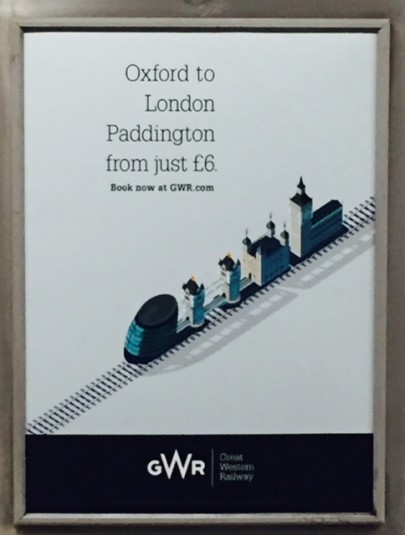
Today we see for the first time in my life time certainly and something unheard of on the rail system, competition between two of London’s rail terminals for the lucrative commuter lines to Oxford. Its not only competition between two of London’s rail terminals but also two rail franchises, Great Western Rail (GWR) at Paddington while we have Chiltern Railways at Marylebone. You can see the aggressive competition by the adverts placed by GWR all along the tube escalator at Marylebone Tube station!!!

fullsizerender-6

From Marylebone you can get to Oxford via Bicester Village and Oxford Parkway and Oxford station in 60 minutes, twice an hour in fast spacious trains. 

Its not only highly competition going on the rails to Oxford now but also on road by coaches by services like Oxford Tube , X90, Megabus as well as National Express! So its no doubt that commuters are getting value for money as we have not only have road vs road options and road vs rail options but now rail vs rail options.  

So well done Chiltern Railways and best of luck in offering up this competition on going to Oxford by rail between Paddington & Marylebone. It is certainly much more enjoyable experience going through Marylebone station and as a terminus it is  a lot more centrally located in London than Paddington and all the other connections that will facilitate for passengers. 

Should l stay or should l go?

screen-shot-2016-12-02-at-11-07-09

As reported in the West End Extra, a blue plaque is being put up at the epicentre of punk where Joe Strummer of the Clash once squatted on this coming wednesday the 7th of December at 12.45pm.

The plaque will be unveiled by members of Joe Strummer’s family and you also hear how this enclave of Marylebone, on and off Bell Street NW1, was ground zero for punk rock.

So come along, if you can.


Barmy Army not as barmy as they make out?

barmy-army-to-bangladesh

As England tour of Bangladesh begins with the first ODI today, on the 7th of October, l’m watching the stands in Mirpur stadium, Dhaka as much as the play on the square. To see if any of the barmy army has turned up for this tour at all ,after all the warnings! As security concerns dominated the build up both the players and fans on the tour rather than the cricket contest. 

It appears the barmy army have not turned up. So the barmy army isn’t as barmy as they make out!!! 

Increase diesel taxes to help save lives

screen-shot-2016-09-09-at-23-45-02

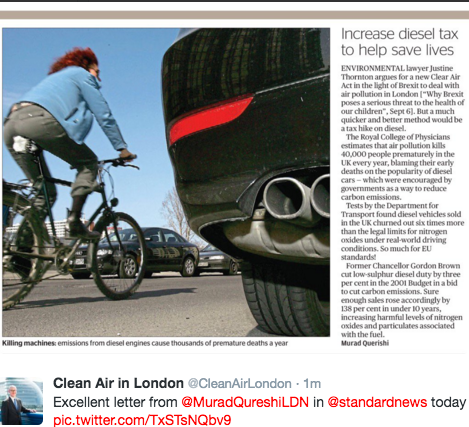
While Justine Thornton QC ( Why Brexit poses a serious threat to the health of our children – 6th September 2016 ) may argue for a new Clear Air Act in light of our BREXIT to deal with the silent killer of air pollution in London, a much quicker and better method would be a diesel tax hike to cut air pollution.  

The Royal College of Physicians earlier this year found air pollution killed 40,000 people prematurely in the UK every year, blaming the early deaths on popularity of diesel cars which were encouraged by government as a way to reduce carbon emissions. 

Tests by the Department for Transport found that diesel vehicles sold in the UK churned out six times more than the legal limits for nitrogen oxide more than the legal limit for nitrogen oxide under real world driving conditions. So much for EURO standards! 

Gordon Brown, the former chancellor, cut low-sulphur diesel duty by 3 p in 2001 Budget in a bid to cut carbon emissions by encouraging motorists to drive diesel cars. 

Figures also show that sales of diesel cars in the UK rose 138 per cent in under ten years, increasing harmful levels of chemicals associated with the fuel thanks to Mr Brown’s decision to cut tax.

So beware false idols when cutting cutting carbon emissions while perversely increasing other harmful chemicals associated with diesel. 

Please see above a copy of the actual letter published by Evening Standard on 9th of September 2016

Whats the government doing to drive us away from diesel?

My talk at the BAQ2016 in Busan, South Korea

My talk at the BAQ2016 in Busan, South Korea

With the New York Attorney General Eric Schneiderman accusing VW of “wilful and systematic” use of emission cheating devices in their diesel cars; Australia also pursuing now a similar path this week; and the South Korean’s threatening not to certifying VW vehicles, when is our government going to drive us away from diesel as well? This is precisely what was being asked of me after a talk l did on “Tackling the impact od Diesel in European Cities” at Better Air Quality Conference in Busan, South Korea. It’s all very well telling us what major cities in Europe are doing but what about the national governments of Europe and the EU of course really doing as the US leads on the issue when it is not actual hooked on diesel cars in the same way as we are in Europe.

The over­ stating of the CO2 global emissions benefits of diesel while increasing local emissions of NOx has been a very European experience. With at least in France it’s PM Manuel Valls apologising for getting it wrong with diesel in an attempt to reduce CO2 as a measure for climate protection at the beginning of the century, something we did as well without the apology and admittance of guilt yet. Furthermore, in recent official probes of Renault emission discrepancies were omitted and green groups have suggested the France state has a conflict of interest, as it has 15 per cent stakes in both Renault and Citroen.

In Germany the government also has a similar struggle with its car manufacturer to the French as their federal government structure does not want to give up diesel tax breaks under strong lobbying by companies like VW, BMW and Audi. While its cities push for city bans of older diesels, its car industry retorts “ it would be fundamental mistake to bad mouth diesel whoever supports climate protection…you can’t forget diesel”

Unfortunately it’s the same with us though with a different type of tax break. Since 2001, there has been a 3p cut in low­sulphur diesel in a bid to cut carbon emissions by encouraging motorists to drive diesel cars. As for the European Union (EU) we can’t expect similar action against French & German car manufacturers as is being undertaken by US authorities quite yet. After all it’s the EU standards which are at fault. Tests conducted by International Council on Clean Transportation (ICCT) show that modern diesel cars emit as much as 7 times the EU limits for NOx in real world conditions. Furthermore, now we going out of EU we can not rely on their directives and commissioners taking action to reverse the harm to Londoners life’s with the silent killer that is air pollution and particular problems with NOx. There is talk of another Clean Air Act like the 1956 Act targeted at NOx but this doesn’t immediately get away from the fiscal incentives for diesel for the car driver we have already.

If we don’t, it risks undermining all our city initiatives to reduce air pollution including those in London by the new Mayor through the Ultra Low Emission Zone (ULEZ). After all the diesel issue explains the lack of progress made in Greater London since 2008.

So maybe we could start with government hiking up diesel fuel duty by getting rid of the 3 p duty advantage for diesel fuel from the beginning of the century. 

Landmark Air Quality conference addresses global air pollution crisis

Undertaking my keynote speech at 17th IUAPPA & 9th CAA Better Air Quality Conference

Undertaking my keynote speech at 17th IUAPPA & 9th CAA Better Air Quality Conference

With air pollution now a global environmental and health crisis, experts from around the world meet in Busan, South Korea recently in a joint meeting of two of the leading international air quality organisations to address the multiple challenges being faced around the globe and ways forward for countries and cities

Clean Air Asia’s 9th Better Air Quality Conference (BAQ) and the 17th International Union of Air Pollution Prevention and Environmental Protection Associations’ World Clean Air Congress (WCAC) brought together nearly 1000 representatives from governments, environmental ministries, the private sector, NGOs, research institutions, academia and civil society, including many of the world’s most prominent figures in their fields, at the landmark event themed “Clean Air for Cities: Perspectives and Solutions”.

The Conference, opened with a stark warning from World Health Organisation Director-General, Dr Margaret Chan that worldwide there is a long way to go in tackling the health effects of air pollution and the toll of premature mortality. Her warning was reinforced by new scientific assessments reported to the meeting, concluded that the toll of premature deaths from air pollution is set to rise through the coming decades before falling.

It is estimated 3 million people die prematurely each year from outdoor pollution and without action deaths will double by 2050. In six major Indian cities 30 – 50% of the air pollution is attributed to the transport sector. To avoid such negative impacts from motorized traffic, but also on road safety and public health issues, sustainable urban mobility must become one of the main occupations of cities.

A further report from the Health Effects Institute (HEI) newest study in China indicates that if no further action is taken, as the Chinese population continues to grow and age, the health impact of air pollution – in terms of deaths from cardiovascular and lung diseases – will potentially increase to 1.3 million deaths annually by 2030.

Saying this the study notes, with currently planned and potential additional actions to control air pollution from PM2.5, a key pollutant, levels in China are projected to substantially decline by 2030. Despite the adverse trend in premature mortality, if China continues to build on the positive actions it has already taken, 275,000 premature deaths could be avoided. These findings held not just for China but for much of Asia., as work suggests that the largest potential for deteriorating air quality is in India, while Pakistan, Bangladesh, Indonesia and Vietnam are also high on the list of countries where premature mortality attributable to air pollution is growing rapidly.

The assessments both suggested that there was major potential from cost-effective measures that could be taken now to improve air quality. urging that while a continuing focus on traffic emissions was essential, other pollution sources, notably residential energy use, industrial emissions and agriculture, should receive more emphasis.

Commenting on the findings, Dr Carlos Dora from the World Health Organisation said: “China and other countries in Asia are now beginning to take vigorous action on air pollution, but these results highlight the scale and urgency of the challenge they face. Recent work by the World Health Organization indicates that in many cities air pollution is still getting worse, and almost as many people today rely upon polluting wood, biomass and coal fuels for cooking as they did a decade ago.”

A global response to the challenge is now being articulated, with the first World Health Assembly resolution on air pollution and health in 2015; a road map for its implementation in 2016; and air pollution featuring in four of the Sustainable Development Goals adopted by the UN last year. This opens important opportunities which now need to be carried through to national and local action. By making urban air quality a health and development priority, cities can improve air quality, reduce health costs from air pollution-related diseases and enhance worker’s productivity life expectancy and well-being.

During the conference the international NGO Clean Air Asia launched a English version of “China Air 2016– Air Pollution Prevention and Control Progress in Chinese Cities” with information about 161 Chinese cities’ implementation of the country’s declaration of war against air pollution – “Air Pollution Control and Prevention Action Plan”, which mapped out the nation’s air pollution prevention and control efforts until 2017.

The report showed the air quality of Chinese cities improved in 2015 compared with the previous year. The annual mean concentration of PM 2.5 , PM 10 , SO2 and NO2 was generally on the decline in 74 cities as compared with 2014, decreasing by 14.1%, 11.4%, 21.9% and 7.1% on average, respectively. But it is still common for Chinese cities to not meet standards, especially in the winter when heavy pollution was more frequent.

The report showed that, most of the cities which did not make desirable progress are located in Henan, Shandong and the north eastern part of China, which have less experience and weaker ability about air pollution prevention and control compared to developed regions. The report suggests the central government provide systematic and comprehensive capacity building to cities with weaker air quality management ability besides putting pressure on them.

Hopefully soon this bi-annual air quality conference will be hosted in China and China can build on the progress being across the whole of Asia. 

Finally please find a link to my presentation as a key note speaker on Tackling the impact of diesel on European Cities. 

What about permanent home for @Olympics ?

IMG_3972As your Big Read article suggests but does not quite conclude, the trouble with the Olympic Games is that they need a permanent home (“The high price of Olympic glory”, August 1).
 
For myself certainly, the best bit of the Olympics held in London in 2012 was actually beating Paris for the nomination on July 6 2005 in Singapore, illustrating the best in the rivalry between Paris and London. Even those who didn’t support the London bid enjoyed that spectacle!
 
There is no better place for a permanent home than where the Olympics originated in ancient times: Athens. In 2004, the city hosted a reasonable Games for all of us who went to watch the supreme efforts of the athletes on show. It is also ideally located for Asia, Africa and rest of Europe to get there.
 
Of course the only objectors to that will be the International Olympic Committee members, who probably enjoy the prime ministers and presidents of rival cities grovelling to them every four years for the right to stage the Games. But as your article suggests, we may be coming to end of all that now.
Here is the link to the letter in the FT letters page. 

NIGHT TUBE – Noise complaints around the tube

NOISE COMPLAINTS - Night Tube

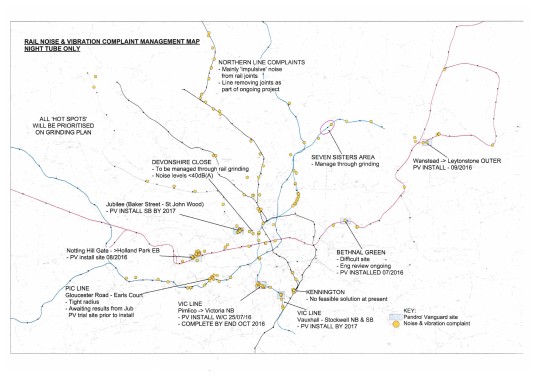
Last night at a consultation meeting with residents of Baker Street tube station & TfL took place at their offices behind the station, to discuss tube noise issues. The above map was presented of all the rail noise and vibration complaints made to TfL along the tube system. Each yellow stop, indicates a point of noise complaint along the tubes. 

From what l have heard and seen, the problem is by far the worst in the Baker Street neighbourhood, though what l heard from residents in Notting Hill Gate last night did make me wonder. Nonetheless, it did not appear that all instances of the problem had been recorded by TfL particularly on their map above. 

For example l had previously meet up with residents in Walthamstowe with my ex-colleague Jennette Arnold AM and their long standing complaint was not registered at the end of the Victoria Line in North London. Please check the map. 

Whilst the immediate emphasis is on the Victoria & Central line providing a night service on Friday & Saturday night by the end of August, you will need to get registered into TfL list of complaints for them to acknowledge the problem at all.

If you are not on it, get in touch with them immediately.

It is clear that a lot of it won’t be sorted out before the night service has began but those with noise complaints living above or along the tube lines need to make their representations asap. 

Air pollution crisis at City of Westminster schools

Walking to school is when a lot of pupils our exposed to poor air

Walking to school is when a lot of pupils our exposed to
poor air

In the Mayor’s of London lists of 440 schools breaching EU toxic air limits, City of Westminster schools feature strongly with 6 of the top 10 primary schools with the highest breaches and the top secondary school affected by breaches in the borough. Furthermore, the schools are located in all parts of the Borough – Paddington, Marylebone, Pimlico & Covent Gardens – affecting children in both richer and poorer parts of the borough.    

iIlustrating well how central the City of Westminster is in tackling the air pollution crisis in London. It will need the borough working very closely with the Mayor of London on particular hotspots like Marylebone Rd where we have a concentration of schools affected by NO2 annual mean over 60 ug/m3, along the boundary of the congestion zone. I trust we can see particular initiatives along the Marylebone Road, which tackles the worst affected primary & secondary schools in the whole of London.  

So on the 60th anniversary of the Clean Air Act, closer working between City of Westminster & Mayor of London to reduce the exposure of children in the schools worst affected by air pollution would be useful.   I will certainly be writing into the Mayor’s consultation on his Ultra Low Emission Zone ( ULEZ ) with this and many other suggestions. 

For the lists of all primary and secondary schools affected by poor air quality over the EU toxic air limits in London, press the primary and secondary words above.