Author Archives: Murad

How green are London’s Olympics looking so far?

The various bodies involved in delivering the event have long aspired to providing "the greenest Olympic and Paralympic Games yet" and planned for sustainability, but judgments of their success depend a lot on how greenness is defined and how broadly those judgements are made.

Organisers LOCOG have taken a bit of stick over the 4,000 mostly fossil-fuelled BMWs that will be shipped to the capital to cart officials and dignitaries between sporting venues and their hotels using the road network’s dedicated "games lanes," in some cases with personal chauffeurs.

BMW is "proud" to be the enterprise’s "automotive partner." But Caroline Pidgeon, the Liberal Democrat London Assembly member who chairs its transport committee, has said that only electric vehicles should have been considered and Green Party AM Jenny Jones, who is also her party’s mayoral candidate, thinks more of the VIPs should use public transport as we mere mortals are being urged to do.

The choice of Dow Chemical to fund the Olympic stadium’s decorative wrap has prompted widespread protest and the recent resignation of a member of the watchdog Commission for a Sustainable London 2012. Meanwhile, the dark cloud of air pollution continues to float above the build-up to July’s sporting jamboree. All those gas-guzzling BMWs seem unlikely to help.

There is, though, a happier tale being told as well. Jenny’s Jones’s fellow Green assembly member Darren Johnson wrote in Business Green last spring that some of the "greatest achievements" of the Olympic Delivery Authority (ODA), which has been responsible for building the Olympic Park, have gone largely unrecognised. He praised the ODA’s work in "reducing the embodied carbon of construction" by, for example, making the main stadium lightweight by reusing gas piping and re-designing the aquatic centre’s temporary stands to reduce its use of steel.

The London Assembly’s Liberal Democrats applaud the widespread re-use of materials throughout the construction period, including for the park’s own combined cooling heat and power plant. They point out that the land the park has been built on was previously heavily contaminated and is now home to large quantities of greenery. The Environment Agency announced on Monday that the clean-up work is complete.

There has been political approval for all of the above, and for the improvement of the waterways that flow through and around the park. Labour assembly member Murad Qureshi is among those supporting a cross-party call for volunteers to help with tidying up the Lee Navigation canal in advance of July. He’ll be keeping company with Tory mayor Boris Johnson’s environment director and an environment minister at the launch of a campaign led by environment charity Thames21 at Hackney Wick on Wednesday.

But Qureshi also points to the disappointment of the games missing their renewable energy targets – it was announced last April that it will manage only 9% instead of their 20% target. Plans to build a wind turbine at Eton Manor were dropped in 2010. "It’s a real pity, because that would have symbolised very visibly what can be done," he says. (Darren Johnson has since persuaded the ODA to indirectly offset this by insulating homes around the Olympic Park).

Any green audit of the games would have to take into account everything from re-surfacing the local towpaths for walkers, cyclists and runners – I live nearby and am all three – to fundamental questions about the whole concept of the Olympics being held in a different place every four years, with all the draw on Earthly resources that entails. Qureshi would like serious consideration to be given to finding a permanent home for the Olympics. Alas, Greece, the obvious romantic choice, has a decaying stadium on its hands and other matters on its mind.

For London 2012 just avoiding that terrible fate will be a green triumph for a kind. But will it be as great it should have been?

Click here to view article

Big Waterways Clean Up 2012 launched


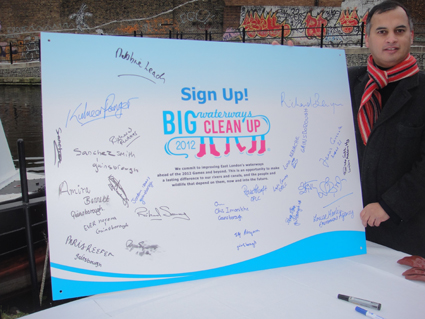
Murad encourages volutneers to sign up at the launch

 Despite it being a bitterly cold morning, the steely determination and commitment of the Thames 21 volunteers and others, was even more apparent at the launch of the Big Waterways Clean Up 2012  (BWCU 2012)launch this morning.  This is a campaign borne out of a collaboration between the London Waterways Commission (which I am proud to chair), the Environment Agency, British Waterways, Mayor of London, OPLC and a host of other partners. The idea is to build upon the existing efforts to clean up the canals near to the Olympic site by extending this to more of East London’s waterways.

The launch was attended by myself including Richard Benyon, Parliamentary Under Secretary for Environment and Fisheries and Kulveer Ranger, the Mayor’s Director for the Environment.  More importantly, there were volunteers, young and old including children from the local primary school, Gainsborough, all willing to give up their valuable time to help clean up their local waterways, not only in time for the Olympics but beyond into the legacy period.

The campaign aims to recruit no less than 4000 Londoners in more than 80 events to transform over 50 waterway locations along 30km of rivers and canals, all before the Olympics! The events will include waterway litter-picks and tree planting (full timetable can be viewed on the BWCU 2012 website). This morning, we were able to collect several bags full of rubbish from the waterfront which include plastic bottles, crisp bags and other plastic debris. London’s waterways are a vital, yet sometimes forgotten part of the city’s landscape. If we all do our bit to keep our rivers and canals clean, then the benefits would be huge, not only for us but also the local wildlife.

I wish the campaign every success and would encourage anyone to get involved, sign up and rediscover their local waterways as some of the most valuable and rewarding spaces in London.

Directly elected Mayor for the City of Westminster – Why not?

Cllr Barrow, leader of WCC – But who knows him? I suspect if he was a directly elected mayor people would know him

In last Friday’s Evening Standard my colleague Councillor Paul Dimoldenberg was quoted as saying that the City of Westminster leadership poll amongst the majority Tory group councillors as an insult to democracy

He is quite right to point out that a city which has some 250,000 inhabitants won’t have a say but the 48 Tory councillors in a ballot will at the end of the month, only one of whom opposed the discredited “nightlife tax ” policy. The latter showing quite well how out of touch the majority group was on this issue and why l feel the City needs to consider having a directly elected Mayor, as a means of reconnecting with residents again. What better mandate can you give someone then being directly elected by your residents as leader of the council then through the members of the majority political group in the council. Between elections it would then be up to the Mayor to keep in touch with locals in a way that a council leader does not have to do so.

In many ways the City of Westminster is unique in the governance of London similar to the City of London though much more credible in local government terms, having also the seat of government, monarchy and the vast majority of embassies based within its boundaries. Lets not also forget its residents, wildly diverse and  living in a host of urban villages like Pimilico, Marylebone, Paddington and Queens Park as well.

Interestingly on the 3rd of May, a number of local authorities are having ballots on whether to have a directly elected Mayors in their councils up and down the country with the full approval of the Department of Local Government & Communities (DLGC). Indeed we already have a number of councils in London which already have this arrangement including Newham, Lewisham and Hackney. So l say, if it can work for them why not the City of Westminster? 

More interestly in the Council’s Community Governance Review consultation, the option of a directly Elected Mayor is not put up as an option even though it is incorporated withn the Localism Act for 2011. I think its only right that those responding to this review with its extended deadline now till the 17th of February ask the council why this is the case and get some explanations?

What l am sure about, is that if we had a directly elected Mayor of the City of Westminster, it would be hotly contested. As it would have a profile like no other Mayor of a local authority in London, rubbing shoulders with royalty, diplomats and central government.

London not quite the electric car capital of Europe

Paris launches an electric car hire scheme

The Mayor announced with much fanfare at the C40 Climate Change Summit 2009 inSeoul, how he was going to make London the “electric car capital of Europe”.  His aim was to get 100,000 electric vehicles (EVs) in use on London streets as soon as possible, served by 25,000 plug points and 1,000 electrical vehicles in the GLA fleet by 2015.  As Chair of the Environment Committee, I had the opportunity to examine how the Mayor has done in reaching his own target for electric vehicles to see whether London has succeeded in charging ahead with the electric vehicle revolution we were promised.  The report was published yesterday attracting much media  interest.

 Undoubtedly, there are a number of worthy environmental benefits to be gained from having more electric vehicles on the road.  They do not emit dangerous tailpipe pollutants and they produce much less noise on our roads.  However, we do also need to look at the life-cycle carbon costs for an electric vehicle and ensure that the electricity powering them is derived from a renewable energy source.  This would, without doubt, strengthen the environment case for electric vehicles. 

Yet, despite the obvious environmental benefits, generous government subsidies and perks such as free parking, we still only have 2,313 electric vehicles registered in London, a mere 0.08 per cent of London’s 3 million fleet and way off the Mayor’s original target of 100,000.  At the current rate, it will take the Mayor 665 years to reach his original target of 100,000 EVs on London’s roads!

So, the reality is that it’s been much tougher to deliver than envisaged.  However, lessons can be learned from other cities and towns which are pushing on with their own electric vehicle revolution.  As part of our investigation, we visited Paris and also Sunderland in the North East of England.  What we learned was that a clear strategy is needed to ensure that the locations chosen for the charging points are appropriate for electric vehicle users.  One particular area which was highlighted during the trip to Sunderland was their work to ensure there are sufficient rapid chargers available at key points on major roads to help ease drivers’ “range anxiety”.  This would make electric vehicles much more appealing to longer distance drivers.  The progress in the North East has also been helped by having a Nissan plant producing electric vehicles in Sunderland, although interestingly, they are designed in London.  Nissan’s presence and investment has done much to enhance the North East’s Low Carbon Economic Area status.  We also learned that, in both Paris and the North East, figures for EV charge points per population are better then London’s, therefore, it is not surprising that both regions are making very good progress with their own EV targets.  For example there is 1 charge point per 6000 in London compared to 1 for every 349 Parisians.

If EV ownership does not take-off soon, adopting the Parisian approach may be a good alternative.  They recently launched their Autolib EV car hire scheme.  This is designed to diversify the transport on offer inParis and surrounding towns and it’s estimated every 3,000 electric vehicles will see 22,500 polluting cars withdrawn from the roads.  In the past, we’ve followed Pariswith their Velib bike hire scheme with our very own version. We may do well to follow their lead again but this time with a version of their EV car hire scheme forLondon.  I believe we should all be watching the progress of the Autolib in Paris with great interest.

Mystery of London’s dust suppressants

Route of the dust suppressant along Marylebone/Euston Road

One of the short term measures used by the Mayor in response to EU threats of legal action and massive fines against the UK Government are dust suppressants.  This is, in essence, a form of glue applied to roads in priority locations around London with the aim of reducing the amount of dust particulates in the air around roads.  Transport for London themselves are clear that the dust suppressants, less commonly known as Calcium Magnesium Acetate (CMA) is only a short term measure aimed at improving London’s air quality.  However, for many like myself living near these priority locations such as the Marylebone Road and Euston, we’ve been slightly mystified when and exactly where these trials have been taking place.  Following a number of questions to the Mayor, we now have some clarity and we know that the Marylebone/Euston stretch is treated during the first corridor of treatment between the hours of 9pm-6am daily.

Many, including the campaign group Clean Air for London  quite rightly argue that these trials are merely dealing with the symptoms of poor air quality in London without taking the tough decisions to deal with the route causes.  Black cabs for example are one of the biggest polluters, the roll out of hybrid buses could be stepped up and only today, a report by the Environment Committee; “Charging Ahead?”  highlights the fact that the Mayor has a considerable distance to go if he is to deliver on his aim to see 100,000 electric vehicles on the streets of London as soon as possible.

So, we may have established the route taken by the dust suppressant trial, what is less clear is where exactly the Mayor is taking us with his air quality strategy for London.

London slow to become the ‘electric car capital of Europe’

Boris Johnson‘s plan to make London the electric car capital of Europe is making "slow" progress, with a promise to put thousands of the cars on the city’s roads likely to take centuries to achieve at current rates, according to a report published on Wednesday.

Nearly three years ago, the mayor of London told fellow international mayors in Seoul that he would ensure 100,000 electric vehicles were in London "as soon as possible". But the London assembly’s environment committee found that since Johnson’s announcement, only 588 extra electric cars were registered in London. There are now 2,313 electric cars in the capital, just 0.08% of the city’s total 3m cars.

<iframe allowfullscreen=”” height=”234″ width=”460″ frameborder=”0″ src=”http://www.youtube.com/embed/4thb3FhP78A”></iframe>Murad Qureshi on Boris Johnson’s progress on electric vehicles

While the authors said there has been "visible progress" since Johnson’s electric vehicle delivery plan in 2009, they warned that progress has been poor on charging points and the GLA’s own car fleet.

The mayor set a target of 1,000 of the authority’s cars being electric by 2015, but only "around 49" ““ the GLA failed to give a precise figure ““ are currently electric. On charging points, there are now 400 across London, with a target of 1,300 by next year, with most of those in Johnson’s Source London charging network, launched last year. But an earlier target of 25,000 by 2015 has already been dropped, the report notes.

Murad Qureshi, the committee’s chair, said: "Currently progress is slow and we are concerned that it could take many years before we see any environmental benefits from the mayor’s ambitious plans. If the mayor wants to encourage more Londoners to drive electric vehicles, he must demonstrate that the charging network is adequate and fits with the way people will actually charge their vehicles. It is unclear at the moment whether it is delivering value for money given the sums already spent on it."

The report made clear that it welcomed electric cars and that they could deliver environmental benefits. If take-up of private electric cars in London failed, the committee said, Johnson should consider adopting a similar model to Paris’ Autolib electric car hire scheme, which opened last year.

The committee monitors the mayor’s environmental programmes, and comprises two Labour assembly members, one Green, one Liberal Democrat and three Conservatives.

“¢ Get the Guardian’s environment news on your iPhone with our new app. You can also join us on Twitter, Facebook and Google+

Click here to view article

China attracted to investment in London

Hope this is not a bad omen for Chinese investment into Thames Water


Gung Hey Fat Choy to you all.

As we have been  celebrating the New Chinese Year of the Dragon in the West End today at another end of the West End, we have just recovered from Oxford St flooding chaos.  How these two events related?

Well now the Chinese are investing in our infrastructure with the purchase of 8.7 per cent of Thames Water holding company by China Investment Company (CIC), l just hope Oxford St flood is not a bad omen. As its part of water and sewage infrastructure that Thames Water has in London that the Chinese have just brought a major stake into.

This all apparently happened soon after a trip before Davos by George Osborne, kowtowing in Beijing to sell our infrastructural projects to Chinese authorities who seating on huge trade balances and saving of their own people are looking at investments around the globe.  So not surprisingly the Chancellor hailed China’s state-run investment fund’s decision to buy a share of Thames Water as a ” vote of confidence in Britain” as a place to invest, so soon after his trip. The reality is that the CIC stake in Thames Water had been  negotiated over many months but it made for a good news story in the FT weekend for the Chancellor, last weekend.  

 Who knows what else had been offered to the Chinese for them to invest into our infrastructure but l won’t be surprised if HS2 and even Boris fantasy island had been as well. HS2 would clearly be something the Chinese authority would feel comfortable investing into with their vast experience of delivering similar schemes on mainland China. It may well be that the Chinese are in the future more then just the banker of such future ventures but actually delivering and running these services, once its got the planning approvals.

So we certainly have to watch this space but its clear as hell the Chinese are here to stay for the long run with such investments and its clearly just an indication of the future sharpe of things to come, with their preference for low risk physical assets that carry steady returns.  

Churches wot done it – Bless them!

Westminster church goers said NO to proposed weekend & evening parking charges

 
Following Cllr Colin Barrow’s tip toeing exit from office as leader of Westminster Council, rumours are rife about who can actually lay claim for his departure.
 

Very few council leaders are subjected to the sort of onslaught which beset him following the fiasco over the proposed parking charges in the West End. Pretty much everyone, cross party, locally and nationally were against the idea.  I’m sure even the Pope would have had a word or two to say if asked; which brings me nicely to my point.   Because, contrary to popular belief it was not the well run Evening Standard or the flurry of other media campaigns which dealt the final blow. I’m pretty clear it was the churches. Had the ex council leader not messed with the Sunday worshippers, then he may just have got away with it. Thank goodness he didn’t!

This whole episode reminded me of my days as a councillor a few years back when I attended a centennial dinner to mark the formation of the City of Westminster. During the event, I noticed a very strong clergy presence from places like Westminster Abbey & Westminster Cathedral. When l asked why this was, l was politely told that before the Council came into being, the churches ran things for 400-500 years in the City. You only have to look at the primary schools in the borough, to be reminded of their past roles and continuing presence. So, well before the local press, businesses and celebrities jumped on the evening and weekend parking band wagon, it was the churches and their congregations which mobilised to fight the cause.

If there is a lesson to be learned for local politicians, it is, don’t dare to take on the churches on such matters although the whole of Westminster has much to thank them for; bless them.

Vote brings Boris bikes close to the Palace of Westminster

Westminster City Council’s planning committee last night (Thursday) backed an application by Transport for London to build a station in Abingdon Street at the junction with Great College Street.

The idea had attracted support from some enthusiastic MPs and the Conservative Party deputy chairman Michael Fallon, who said it was “frustrating” that there had been no bike hire docking points built close to Whitehall and the Palace of Westminster.

Any MPs wishing to travel by the Barclays Cycle Hire vehicles have had to walk for at least 10 minutes to racks in Horseferry Road.

The committee gave unanimous backing to the plan, against the advice of city council officers.

In 2010 Labour London Assembly member Murad Qureshi criticised the council for having rejected more docking stations than any other authority but Robert Davis, cabinet member for the built environment, said: “The only reason that we may have refused more applications than elsewhere is because a greater number of applications were made to us”.

Click here to view article

Coup attempt foiled in Dhaka,Bangladesh.

Just when we thought Bangladesh was safe from the military coming back into power as it clearly appears to be in Pakistan, we hear confirmation of the rumours that have been going around over the recent christmas break of a coup attempt.

Senior military officials made their annoucement today and ably reported by Bdnews24.com that middle ranking officers attempted a coup of the civilian government of Shiekh Hasina, Awami League on the 22nd of December.  Many of them were members of the banned Hizb ut-Tahrir Islamist group. We also hear allegation of non-resident Bangladeshi (NRB) involvement as well by the senior officers of the Bangladesh army. More strangely, a bizarre facebook page exists amongst the middle  ranking officers threatening to bring change very soon. To make things more tense politically, it was noted that Khalida Zia of the BNP opposition during recent demonstrations had made suggestions that army officers should be freed from arrests and court marshall.

It appears Bangladesh can never sleep quietly from the threat of mutineers, assasins & war criminals.