Author Archives: Murad

Murad Qureshi calls for Londonwide compost heap

Murad Qureshi AM, Labour’s environment spokesman on the London Assembly, has called for London’s autumn leaves to be used more strategically after it emerged that many of them are disposed of like ordinary litter.

Leaves swept from streets are considered likely to be contaminated with other rubbish. However, Murad believes that a more strategic approach to promoting composting by councils could see more of this kind of natural waste used to good advantage.

"A good amount of autumn leaves could be usefully made into compost", Murad claims. "It seems too many local authorities are sending the leaves they collect to landfill, which is a big waste. The Mayor, as official Chair of the London Waste and Recycling Board, needs to take a creative approach to natural waste like leaves and garden refuse. There is the potential for some innovative ideas to be looked at. If the boroughs could be encouraged to co-ordinate their leaf collections and deal with them in a way that reduces waste it could benefit everyone. Boroughs could develop their own compost supplies or we could even look at a Londonwide compost heap!"

The London Waste and Recycling Board looks at ways to strategically reduce the use of landfill. Murad added: "According to reports, England and Wales’ local authorities are paying £1.5million a year on putting leaves in landfill. I believe there must be ways to reduce this and if this could provide good quality compost for the capital’s gardeners then that would be a winner for everyone."

Have the Mayor’s actions on air quality undermined Olympic bid?

Murad Qureshi, Labour’s environment spokesman on the London Assembly, has expressed concern that the city’s bid may have been undermined by Boris Johnson’s regressive environmental decisions. This follows comments from Professor Frank Kelly of the Kings College Environment Research Group indicating that London may have to ban cars and reschedule events during the 2012 Games to provide good conditions for athletes.

The International Olympic Committee’s evaluation of London’s bid expressed concern about London’s "increasing levels of ozone pollution" but said that "legislation and actions now in place, such as the ‘low emission zone’ and ‘congestion charge’, are aimed at correcting that trend and ensuring all air pollutants are within World Health Organisation and EU target levels by 2010".

Since this evaluation was made, and Boris Johnson was elected Mayor, London’s measures to tackle its poor air quality and ozone pollution have been rolled back. The Congestion Charge Zone will be halved in size and the third phase of the Low Emission Zone, which was due to prevent the most polluting vehicles from entering Greater London, has been delayed by two years.

Murad Qureshi, Labour’s environment spokesman on the London Assembly, said: "It is bad enough that over 3,000 Londoners die prematurely every year because of the state of our air. The last thing we want is for this still to be an issue when the world comes here in 2012, as we saw in Beijing and Athens. If the Mayor continues along the road down which he has started, this sadly could well be the case."

A recent London Assembly report into the city’s air quality found that it could be responsible for up to 3,500 premature deaths and 12,000 children being hospitalised for respiratory failure. It has been reported that the Government is considering countermanding the Mayor because his actions may have undermined their fight against an EU fine of £300 million for its poor air quality.

Notes  

Murad Qureshi is Labour’s environment spokesman on the London Assembly and Chair of the Assembly’s Environment Committee.

Professor Kelly made his comments in an interview on November 11th.

The IOC’s evaluation of London’s bid can be found here: http://multimedia.olympic.org/pdf/en_report_946.pdf. The section on London’s air quality is on page 67/68

The London Assembly’s report in the state of London’s air, Every Breath You Take, can be found here: http://www.london.gov.uk/assembly/reports/environment/air-quality-report-200904.pdf

FOOTBALL THE BEAUTIFUL GAME

srtrc_launch
With Leroy Rosenior and Zesh Rehman at the SRtRC launch

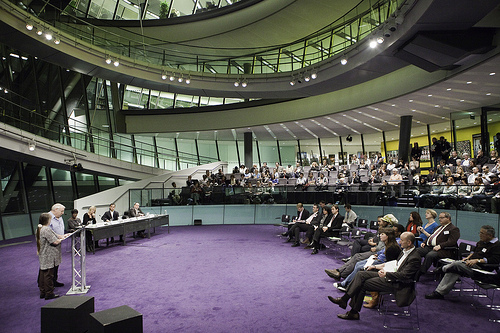
I was very pleased to host the launch of Show Racism the Red Card’s new campaign office in London and the South-East at a well-attended event in London’s Living Room at City Hall on Wednesday night. I look forward to SRtRC bringing their successful anti-racist work with young people here from their base in the North East.

Most fans judge players by the colour of their jersey and not their skin, yet we are in danger of the seeing the beautiful game taken over by the likes of the English Defence League, who are misusing football to incite hatred. SRtRC’s campaign promotes the true spirit of football – respect, multiculturalism and diversity.

This will be well reflected at the World Cup next year in South Africa, as well as illustrated every weekend up and down the country in the Premiership and Championship games. And remember London won the 2012 Olympics on this basis as well.

On the back of this launch, l am glad to see that the Islam Channel and Eastern Eye have also picked up on the issue.

CLIMATE CHANGE AND BANGLADESH

whitechapel-gallery2

On the evening of 29 October, l went to the Whitechapel Art Gallery in London’s East End to participate in a roundtable discussion hosted by the European Action Group on Climate Change, which brings together Bangladeshi people living in Europe to campaign about the impact of climate change on their original homeland. This is clearly an issue that we can all get together on and lobby for action both by the UK government and by others among the conference of the parties in the lead-up to the Copenhagen meeting in December.

In the discussion I reiterated what l have said before, namely that l was pessimistic about Copenhagen but optimistic about the role of cities in acting together across the world. I pointed out that after the Bush administration refused to sign up to the Kyoto agreement on climate change many cities across the United States went ahead and signed on their own behalf.

With 50 per cent of humanity living in cities now and 75% of all emissions coming from cities, in the end it is the actions they take that will make the difference. Rapidly growing cities such as Dhaka need to find ways of contributing to action to tackle climate change, as it is crucial for their own survival – for, if the Tibetan glaciers melt, then the majority of cities right across Asia will be without a reliable water supply and suffer severe floods.

On the back of all this interest, the London Assembly’s Environment Committee has agreed to work with Oxfam on a London Climate Hearing, which will be held on 26 November at 6.30pm in City Hall.

I also hope to be involved in organising other events on the impact of climate change in Bangladesh, for example with Frank Dobson MP, either before or after the Copenhagen conference. So watch this space if you are interested in opportunities to participate in this discourse on an issue that will be decisive for our future.

BACK TO THE EIGHTIES: UB40s FOR AMs?

mqt-in-chamberReading Tribune last week, l was intrigued to see that I could soon be out of a job (“Conservative government could scrap London Assembly”, October 16). According to ConservativeHome, in the event of a Tory victory in next year’s election, Cameron and Osborne’s slash-and-burn approach to public spending could well result in the Assembly being abolished and replaced with a part-time body composed of councillors from the London boroughs. It is scarcely accidental that among the most enthusiastic advocates of this proposal are Tory council leaders like Hammersmith & Fulham’s Stephen Greenhalgh.

This is the man who has strenuously opposed the Thames Tideway Tunnel on the grounds that construction work will cause disruption to the use of green spaces in his own borough. The first major improvement to London’s sewerage system since it was put in place by Joseph Bazalgette after the Great Stink, the Tideway Tunnel is an urgent necessity from the standpoint of the environment and public health, with tens of thousands of tons of raw sewage currently being discharged into the Thames after every heavy rainfall.

But London-wide infrastructural projects are of little concern to parochial Tory politicians like Greenhalgh, who start from their own narrow local authority perspective rather than from the overall interests of Londoners. It is not difficult to imagine the obstruction that a body dominated by individuals with this sort of mind-set would have raised to Ken Livingstone’s campaign for Crossrail or indeed his bid for the Olympics.

At the same time, with the increasing powers vested in the Mayor’s office, you do need a full-time elected Assembly to hold the Mayor to account between elections. Major decisions over transport and policing that affect the lives of 7.5 million Londoners require rigorous scrutiny, which could not be carried out effectively by a part-time body. Without the efforts of the London Assembly, madcap ideas like Boris’s fantasy island in the Thames Estuary would be allowed to go ahead unchecked.

It is not as though the Assembly fails to provide value for money. Londoners get 11 committees scrutinising the work not just of the Mayor and the Greater London Authority but also of the quangos running many aspects of Londoners’ lives. l would like to think that people who have experience of Assembly Members consider us hard working. The constituencies that AMs represent cover two or three boroughs and five or six parliamentary seats, while for those of us elected on the party list the whole of London is our constituency.

The proposal to scrap the London Assembly shows how little things have changed in the Tory party. Slashing public spending and attacking democratic government in the capital – if the Tories get elected next year it will be back to the ’80s for Londoners.

Published in Tribune, 23 october 2009

HOW TO MAKE CITIES LEAD FIGHT AGAINST CLIMATE CHANGE

Cities are now the center stage in the battle against climate change, contributing as they do about 75 percent of carbon dioxide (C02) emissions across the globe. This at a time when more than 50 percent of humanity lives in cities and towns, a figure that can only increase given the scale of urbanization in the developing world.

In the lead-up to the UN climate change conference in Copenhagen in December this provides us with plenty of food for thought on city-level strategies to deal with global warming. The cities have good reason to address the problem in order to improve the local environment for their residents.

What is happening sooner than expected is that the mega-cities of the developing world are already rivaling or even exceeding the CO2 footprint of major cities in the developed world, both in terms of total output and per capita.

The UN-backed Bangkok Assessment Report on Climate Change 2009 found that the Thai capital emitted 43 million tons of CO2 in 2005, lower than the figure for New York (58 million tons) but almost the same as London (44 million tons). In per capita terms, Bangkok residents were responsible for producing 7.1 tons of CO2 per year in 2007, the same level of emissions as New Yorkers and significantly higher than Londoners (5.9 tons per capita).

Transportation, electricity generation, solid waste and waste water account for about 90 per cent of the emissions in Bangkok.

The transport sector alone is responsible for 38 per cent of the yearly CO2 emission, reflecting a massive expansion in the use of passenger vehicles. The number of motor vehicles registered in Bangkok rose from 600,000 in 1980 to 4,163,000 in 1999, a sevenfold increase, and by the end of 2007 the figure had reached 5,614,294.

Let us not forget how vulnerable developing cities are to climate change. Bangkok gets its water supply from the Chao Phraya and Mae Klong rivers, both of which are fed by Tibetan glaciers, as are almost all the rivers of mainland Asia. So a rise in temperature, resulting in the further melting of the glaciers, would increase the likelihood of floods in Thailand.

The double-whammy for Bangkok is that it is also vulnerable to a rise in the sea level. Almost 55 percent of the city would be vulnerable to floods if the sea level rose by 50 cm, and 72 percent would be threatened by a rise of 100 cm.

So it is clear that Bangkok is primary example of a developing world city that needs to adapt to and mitigate climate change, not only as part of an international strategy to combat global warming, but also because of the immediate threat to its own residents.

The measures to be implemented by Asia’s growing metropolises to cut their CO2 emissions and improve the quality of life for residents include investing in public transport in order to achieve a modal shift away from private vehicles, appropriate road pricing to deter vehicles from entering city centers, as has been adopted in Singapore and London, and better public information on travel options as well as education on the health costs of poor air quality because of increased use of private vehicles. Similar measures need to be implemented in the energy and waste management sectors.

In Copenhagen, alongside the formal procedures of the conference of the parties, which are predominately nation states, there will undoubtedly be a lot of focus on what cities can contribute to humanity’s battle against climate change because the environmental impact of the world’s major cities is much greater than that of many nation states.

Indeed, capital cities in the developed and developing worlds both often dominate their national economies, with Bangkok acting as the economic hub of Thailand’s economy in a way that is not dissimilar to the role of London in the UK economy.

This does suggest that major cities should also be made into parties to the conference, legally bound to any future agreement and commitments. There could also be instances where cities and their regions may agree to many of the changes that their nation states’ representatives reject. This is what happened in the US when the Bush administration refused to ratify the Kyoto Protocol, which many American cities and regions, such as San Francisco and the state of California, signed.

While opt-outs should be discouraged, this more flexible approach could be useful in any developing nation that refuses to sign an international agreement on the grounds that the developed world has failed to accept its responsibilities.

Published in China Daily, 22 October 2209

BANKERS OF THE OLYMPICS

olympics-stadiumYesterday we had the Olympic officials in front of the London Assembly to update us on progress towards the 2012 Olympic Games. Brian Coleman and myself took the opportunity to put it to representatives of the Olympic Delivery Authority that salaries and bonuses for senior management at the ODA were excessive, particularly at a time of major cutbacks in the public sector. I accused them of being the “bankers of the Olympics“, spending taxpayers’ money on generous bonuses for themselves while others are having to live with the consequences of the recession.

An examination of the ODA’s accounts for 2008-9 (pdf here pp.76-7) reveals that its chief executive earned a basic salary of £384,000 and its chairman £250,000 (for a three-day week), while salaries for the ODA’s seven directors were between £192,000 and £282,000. (This compares with the prime minster’s annual salary of £195,000.) In addition the chief executive received a bonus of £209,566, while the directors got between £38,000 and £48,000 each. Total bonuses came to £2.1 million, up from £1.7 million the previous year, out of a total wage bill of £19 million for 202 staff.

Now l have been supportive of holding the 2012 Olympics in London right from the beginning, but clearly some people are doing very well for themselves out of it. In tough times for all of us, they need to show more restraint.

‘Boris Island’ throws Tory airport plans into chaos

Labour’s environment spokesman on the London Assembly, Murad Qureshi, has called on the Tories to come clean about their aviation plans after a report for Boris Johnson said his idea to build a new airport in the Thames could go ahead after the general election.
 
Nationally, the Conservatives say they will halt airport expansion in south east England. But Boris Johnson today threw their plans into chaos as his proposal to build a new, four runway airport in the Thames Estuary moved a step closer. A feasibility study about to be published will reportedly say "a further airport is required by or before 2030" and assumes that "agreement to the next the stage is given from 1st June 2010" – potentially days after the next general election.
 
Murad Qureshi, Labour’s environment spokesman on the London Assembly, said: "The Tories need to come clean about their airport plans. They say they don’t want any more runways but their most senior elected member would build four of them and a whole new airport in the Thames.

"It would be devastating for the environment, an expensive, logistical nightmare and has the potential for dangerous bird strikes. David Cameron needs to tell us whether this is fantasy island or Tory policy."
 
In a blow to the business case for a new airport, a seperate City Hall report published in April found that, "New airport capacity placed far from Central London may not be appealing to airport users and will not see high use of public transport, particularly if new capacity is also sited far from existing urban centres outside London." 
 
Ends
 
Notes
 
More information about Doug Oakervee’s feasibility study can be found here: http://news.bbc.co.uk/1/hi/uk_politics/8312924.stm
 
The GLA’s report into airport choice in Greater London can be read here: http://www.london.gov.uk/mayor/economic_unit/docs/wp_35.pdf
 
Aviation minister, Lord Adonis, today told the BBC’s Politics Show that the Thames Estuary airport idea was "pie in the sky" and that the government doesn’t regard it "as any way credible".
 
Shadow transport minister, Theresa Villiers, told the House of Commons on 28 January 2009 the Thames Estuary airport was "not an option that we are looking at at the moment". But Conservative MP, Bernard Jenkin, told the BBC’s Politics Show that Ms Villiers "was not ruling it out". Jenkin said that if the Tories "could prove that this was fundable and financeable" and could "win hearts in minds in north Kent and south Essex constituencies" then "this idea will be properly in play".

Mayor’s poor leadership ‘could harm Londoners’ health’

Labour’s environment spokesman on the London Assembly, Murad Qureshi, has welcomed Boris Johnson’s u-turn on charging polluting vehicles to enter London, but has expressed anger at the unnecessary two-year delay the Mayor’s dithering has caused.
 
Boris Johnson this morning performed a u-turn on his contentious decision to suspend the roll-out of the Low Emission Zone (LEZ), the next stage of which would have charged the most polluting vans and mini-buses to drive into London from October 2010. The Mayor had announced in February that the third phase of the LEZ would be suspended but today admitted it was a "useful" means of tackling air pollution and will go ahead after all in 2012 – two years later than originally planned.

Labour’s environment spokesman, Murad Qureshi, said: "This is another embarrassing u-turn for Boris, even if it is a welcome one. Because of the Mayor’s failure to take a firm decision, Londoners now have an unnecessary two-year wait to breathe more easily. We know thousands of people die prematurely every year in London because of our poor air, so this is a two-year wait we can ill afford. Boris’s dithering means van drivers have been messed around and Londoners’ health could suffer – it’s hard to see who gains from this type of weak leadership."

BORIS, THE QUEEN VIC AND THE BBC

boris-in-the-queen-vic2

Now I’m not one for watching EastEnders (it’s enough to put you off living as, quite honestly, if that’s a reflection of real life who would want to live?). But does this fantasy of an East End in which the ethnic diversity bears more of a resemblance to Havering than to Tower Hamlets really need Boris Johnson having a cameo role to provide authenticity?

It’s certainly a coup for Boris, being portrayed as a pretty straight guy on such a popular show. But since when has it been in the BBC’s remit to influence the public’s perception in this way? As the Labour group on the London Assembly has pointed out, the guidelines on political impartiality that apply to the BBC’s current affairs programmes should also apply to a mass entertainment programme like EastEnders.

The BBC claims the Mayor’s office is “politically neutral”, which ignores the fact that the London mayoralty has become one of the most hotly contested elections in the UK. Perhaps the BBC’s drama department needs to check with the politics department for confirmation!

The fact that EastEnders previously refused publicity for a genuinely non-political GLA recycling initiative under Ken Livingstone, on the grounds that the material featured the Mayor of London logo and was therefore too political, underlines the absurdity of the Beeb’s argument. The Beeb should always be even-handed and consistent when dealing with political figures, not turning down some and promoting others.

The Beeb claims Boris’s presence is based on the recent narrative of the pub owner Peggy Mitchell contesting some local election. If that’s the case, then why not give the local election commissioner a walk-on part?

Of course, that wouldn’t generate the same level of attention as a high profile figure like Boris, which was certainly one motive for the decision to feature him on the show. Nor do the Beeb want to stand in the way of actor power, as it appears the offer of a role to Boris was the result of a personal approach from Barbara Windsor. More fundamentally, perhaps, the BBC are probably anticipating a Cameron victory in the next general election, fear a possible Tory attack on the licence fee, and want to curry favour with their future political masters.

Whatever the explanation, when you add this latest scandal to the BBC’s evident willingness to give free publicity to fascists, you can only say that it knocks one more nail in the coffin of the right-wing myth about the BBC’s supposed “liberal left bias”.