In its response to a Government consultation on night flights[1], the Assembly’s Health and Environment Committee says if these flights cannot be stopped, then at the very least, planes arriving overnight should approach from the west of London, when weather allows, to reduce the number flying over the capital at night.
Currently, more than 70 per cent come from the east due to a more favourable wind direction.[2] The Committee says if planes landed from the opposite direction when weather conditions allow, only around 40 per cent would fly over the capital, making the split more equitable.
The changes would reduce noise disturbance for around 110,000 people in areas like Isleworth, Richmond and Hounslow, but increase it for 15,600 living to the west of the capital in parts of Windsor, Datchet and Stanwell Moor.[3]
There are an average of around 15 flights landing each night at Heathrow between 11.30pm and 6am, most of which are flights from the Far East landing after 5am.
The Committee also suggests the Government should aim to significantly reduce the overall noise “˜footprint’ from Heathrow night flights including the area where noise levels exceed 40 decibels, in light of health concerns expressed by the World Health Organisation.[4]
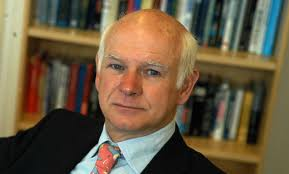
Murad Qureshi AM, Chair of the Health and Environment Committee said:
“We want to see the end of Heathrow night flights because it is unacceptable that thousands of Londoners are unable to get a good night’s sleep because of planes flying over the capital.
“But if they must continue, then landing more planes from the west of London would at least share the noise burden more equally.
“The Government must tackle this problem and reduce the misery faced by local people whose sleep is disturbed night after night by planes coming into land at Heathrow.”
In its response, the Committee states it is opposed to any removal of the current voluntary curfew around night flights and is in favour of a mandatory respite period.
It also suggests investigating whether reducing scheduled daytime movements at the airport would create the necessary flexibility to avoid extra night flights because of delays and backlogs.
Notes for Editors:
1. The current night flights restrictions have been in force since 2006 and run until October 2014. The Government has put forward options for new rules from October 2014 onwards and is currently consulting on these. A second stage of consultation, which will contain firm proposals, is expected to be put forward later in the year.
2. The alternation pattern at Heathrow had been intended to produce a 50:50 split between easterly and westerly operations at night but in practice 72 per cent have been westerly ““ which means arrivals approach over London. See Annex H of the Government’s Consultation document.
3. For maps of the affected areas, see Figure 5 of Annex H of the Government’s Consultation document.
4. The World Health Organisation published a study in 2009 noting that when average noise levels are above 40db at night time, adverse health effects are observed.
5. The Committee’s full response to the Government’s consultation.
6. See the Committee’s previous work on London airports, including reports Plane Speaking (2012) and Flights of Fancy (2010) , plus consultation responses on the Government’s Draft Aviation Policy Framework (2012) and Regulating Air Transport (2010)
7. Murad Qureshi AM, Chair of the Health and Environment Committee, is available for interview. See contact details below.
8. As well as investigating issues that matter to Londoners, the London Assembly acts as a check and a balance on the Mayor.