People in Glass houses

glasshouse

It’s an often repeated mantra that people in glass houses shouldn’t throw stones. So it came as a something of surprise that, during what is usually the quiet summer season in politics, London Mayor Boris Johnson has twice popped up making interventions in the debate on the capital’s energy market.

Over the weekend the Sunday Times ran typically bullish comments from the Mayor, with Boris making a “veiled attack on David Cameron’s energy policy, warning that the lights in London could be dimmed or go out because of a failure to invest in Britain’s energy infrastructure”. Then on Wednesday Boris launched his £1.3tn vision for London in 2050, which – predicting a 20 per cent increase in overall energy demand in the city by 2050 – made a number of significant pronouncements, including suggesting reforms to the regulatory system the roll out of a detailed Energy Infrastructure Plan to ascertain London’s future energy needs.

While it is obviously welcome that the Mayor is lobbying central government for greater action on energy capacity, and taking steps to plan ahead for future decades, I was left with an abiding feeling – that this is all a bit rich coming from Boris. So while the Mayor criticises his peers down the river at Westminster, let’s quickly look at the Mayor’s own record against some of the key targets he is trying to meet.

At the core of the Mayor’s Climate Change Mitigation and Energy Strategy is the 60 per cent target reduction in carbon emissions (from 1990 levels) by 2025. This is a clear goal that applies across key sectors spanning London’s economy, energy supply, transport and buildings, with particular emphasis on programmes like home and workplace retrofitting. Yet the recent assessment of London’s carbon emissions by the London Assembly’s Environment Committee, which I chair, found that the Mayor is missing his own milestones and “could do better” on CO2 cuts. Emissions data for 2011 showed a reduction of 11 per cent compared to 1990, missing the overall milestone for that year of 13.5 per cent.

This is not surprising when you consider that targets have been missed in key programmes like home energy efficiency and decentralised energy. On home energy efficiency, Boris is aiming retrofit 1.2m homes, but figures show that he had only retrofitted 100,000 by 2012 (against a target of double that). Similarly, Boris has set himself an end goal of 25 per cent of energy use in London’s buildings coming from decentralised sources by 2025, but expects to miss his 2015 target on this count. The Mayor’s record on workplace retrofitting was only marginally better, while the only bright spot on the horizon was better in buildings and transport, with energy efficiency of new buildings ahead of target and traffic being reduced by 11 per cent since 2000. Even here though, greater numbers of low-emission vehicles would have helped, and neither the 100,000 electric vehicles nor the 25,000 promised plug in-points have materialised.

Admittedly, the national picture hasn’t helped – with Green Deal take up proving paltry and an environment conducive to low carbon provision not being delivered either. But while the Mayor can express his concerns about black-outs to the Prime Minister, he clearly could have done more to make sure that alternative sources of energy in London had come to fruition. The old adage states that people in glass houses shouldn’t throw stones, and I find it a bit rich for Boris to take pot shots at the Prime Minister on energy policy when he is missing his own crucial targets in this area.

This has been published in Business Green today on their website.

Water freight in Old Oak Common site for HS2?

Water Freight along the Grand Union for HS2 works along Old Oak Common

Water Freight along the Grand Union for HS2 works along Old Oak Common?

With the HS2 Hybrid Bill being given the nod at the first reading in the House of Commons, we do need to have a look at how to limit its impact during construction particularly at key junctions like Old Oak Common in London W12 where we would see a considerable amount of construction and by implication lorry movements to build materials into the site while taking soils out of it.

One way to limit such adverse impact in the local environment for residents like Wells Rd, is utilising the canal that passes through the middle of the site for the movement of materials and soils. Yes we are talking about water freight as shown in the above photograph with  loaded barges (120 tonnes) running between Old Oak Common and an entrance off the M25 like at Bulls Bridge near Hayes. This would save Londoners having the misfortune of numerous lorries going into Central London and the adverse impact that will have on air pollution and noise.

The Freight group of the London Water Commission member submitted a Regents Network HS2 Petition, which helps keep the idea above water for consideration on the HS2 works being proposed in Old Oak Common. Lets hope its not forgotten about as an option and when compared with lorries, HS2 don’t forget its clear advantages for not just local residents but Londoners in West London.


Westminster petition’s HS2 Bill


HS2 - 2nd

Because of the purdah before the local elections in May 2014, it was not publicised that Councils like City of Westminster had petitioned the HS2 Hybrid Bill Environment statement after a resolution was passed in the last full council of the previous term.

The council wants to ensure that adverse impacts from the scheme in Westminster & Central London are minimal in two critical aspects the route alignment and  in Queens Park ward and the Salusbury Road ventilation shaft.

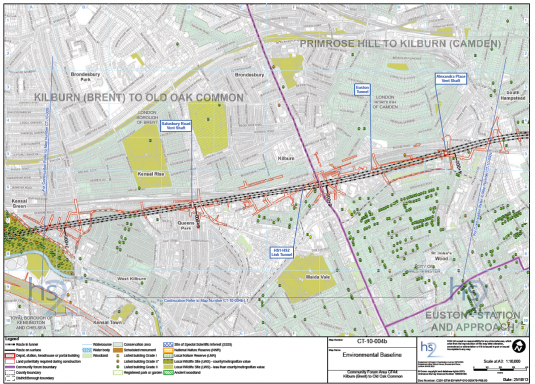
On the first matter, the Council doesn’t consider the route proposed through Westminster within Queen’s Park Ward is the best route. It passes through a predominantly residential area, with a number of listed buildings and Conservation Area which are known to have history of structural problems and the experience of noise, vibration and subsidence problems could lead to blight. So the City Council proposes the route should be realigned slightly to the North so that it passes under the existing West Coast Main Line. In this respect, please refer to the diagram above.

As for the ventilation shaft, the City Council is concerned with the visual intrusion and the impact during the construction and any associated impacts on the surrounding residential area. And does not think it adequately proposes alternative locations for the shaft. This can be visually seen in the diagram below.

More importantly is some ways its very concerned about the transportation effects in the City resulting from the Euston Terminus. Firstly the suitability of the provision of the necessary integration of services to get passengers to and from Euston including the Underground, bus and taxi passengers, For example the Environment Statement recognises 17 per cent increase in passengers boarding the tubes at Euston and focuses on additional journey time but doesn’t not look at the adverse impact to passengers of overcrowding. Clearly this is a push for Crossrail 2.

Secondly it is also concerned about road closures associated with the construction and operation of the proposed Euston terminus would result in diversion of traffic, leading to the increase traffic flows and pedestrian severance on some roads in Westminster. It is considered a significant adverse effect on air quality along for example the Edgware Rd ( A5) as material are excavated with no mitigating measures proposed.

Thus the Council welcomes the provision of HS2 station at Old Oak Common given the interchange and redevelopment opportunities this will provide with the Great Western Main Line, Crossrail 1, Heathrow Airport, the North London & West London line to lessen the impact on Central London, particularly at Paddington. Clearly the City of Westminster accepts that Old Oak Common provided more and better interchange options to passengers than Euston. Now that’s saying something!

Premier Corner

Call to protect Universal Postal Service

Campaigning successfully against Crown PO closures in Pimlico

Campaigning successfully against Crown PO closures in Pimlico

Recently, NW1 postcode residents like me were sent a letter by Royal Mail explaining in a roundabout way that our delivery service was going to be reduced and become less reliable. This message does not bode well for the future considering it’s a Central London postal district where we have plenty of business mail just less than a year after the privatisation of the Royal Mail.

Since the botched privatisation of the Royal Mail by Vincent Cable, the postal service has become more expensive and service levels in London have dropped, through no fault of postal workers I hasten to add.

Postage costs were increased before privatisation to no doubt make the sell off a more attractive proposition in the run-up to its IPO. There was a further increase of a few pence on both first and second class mail in February of this year, so that in recent time we have had 20 per cent increase in price. The prospect of future price rises also exists, as the service has the power to increase prices as much as it likes.

As for quality of the delivery service, the reality is that we are seeing a growing number of service providers like TNT who are being criticised for poor service, including reports of large amounts of mail dumped in Central London neighbourhoods like Bloomsbury were TNT bicycles loaded with confidential letters were left unattended. We have also had similar cases in W9 & W10 delivery services with TNT again the culprit where the local MP Karen Buck has suggested they need to “get a grip” on things.

Poor service by others places even more pressure on the Royal Mail with much of the dumped or mis-delivered mail placed in Royal Mail post boxes for correct delivery. The absence of standards for TNT and other competitors is undermining the overall quality of postal services and having a knock-on effect on universal postal services.

The universal “one price goes anywhere” postal service is an important one and is made possible by the Royal Mail using its revenues from urban areas to cover the higher cost of delivery in rural areas. The growth of direct delivery competition, particularly in urban centres like Central London threatens the fundamental principles of cross subsidy at risk, threatening the viability of universal postal services and thereby impacting on cities just as much as rural communities. The loss of the universal service obligation would be disastrous for these communities. The quality of the service in Central London is also being affected, as the direct deliveries cherry pick the best bits of the Royal Mail like the business traffic and delivery service levels drop.

We should not forget the impact also on employment standards with TNT employing people on zero hour contracts and below living wages and expecting to employ up to 20,000 in 2018 from its present 1,000 base. This model of employment is replacing decent jobs with precarious employment on inadequate pay, putting a burden on public finances via benefit support and reduced income tax revenue. Such reductions in terms and conditions are damaging not only to the people it employs but also the quality of postal services, making it even more difficult for the Royal Mail to deliver its performance targets.

One final word on the Royal Mail privatisation. At the time of its sale, some 70 per cent of a poll in the Sunday Times was against its privatisation.  The service has been in public ownership since the reign of Charles I and became a cherished national institution, suggesting many were happy with the service and its values. However, last week the BIS Committee at the House of Commons reported that Vince Cable’s botched sale of the Royal Mail cost the tax payer £1 billion. Now OFCOM have a statutory duty to protect the universal postal service over and above any competition considerations but so far have shown an unwillingness to step in. If OFCOM are not minded to protect the principle of a universal postal service than maybe we should consider its return to public ownership? The government still has a 30 per cent stake in Royal Mail, something to build on for full public ownership.

This blog was published in a Forum piece for West End Extra in the week of 25th of July 2014.

Mayor’s revamp of local policing has “gone the wrong way”

london-metropolitan-police-275284149-173318The Metropolitan Police Commissioner Sir Bernard Hogan-Howe today conceded that the balance of the Mayor’s neighbourhood policing teams had “gone the wrong way” and is being reviewed, while Boris Johnson admitted that the local model needs to “be improved”. Following the restructure, Westminster has lost 435 Police Officers (27%) and 296 PCSOs (78%) while London has recorded the third lowest police visibility rate in the country.

The Mayor reorganised Safer Neighbourhood Teams a year ago, replacing the old ‘123’ structure (one Sergeant, two PCs and three PCSOs per ward) with a model in which each ward had just one dedicated PC and PCSO, with ‘flexible’ neighbourhood teams overseeing these wards.

At a meeting of the Police and Crime Committee today, after questioning from Joanne McCartney AM, the Commissioner stated that he believed there was a need for “more dedicated officers” in wards. The Deputy Mayor for Policing and Crime, Stephen Greenhalgh, also admitted that the Met’s contact points, which Boris promised would provide an “equivalent or better service” than police counters, were “not being well used”, and that a full review of the contact points will be conducted. Figures released this week showed that contact points dealt with just an average of 1.3 people per week.

Commenting on the session, Murad Qureshi AM, said:

“I have long been calling for the Mayor to come clean and admit that his cuts to neighbourhood police teams have resulted in less visible police in our local communities. While this admission is welcome, we now need to get on and put a plan in place to reinstate dedicated officers to our neighbourhoods.

“I am also pleased it was recognised that contact points are not providing an acceptable service for Londoners. Since 2010 we have seen a reduction of nearly 5,000 uniformed officers across the capital, coupled with the withdrawal of dedicated officers from local neighbourhoods. A rethink is clearly needed.”

Ends

Notes

  1. Murad Qureshi AM is a Labour London wide Assembly Member.
  2. The MPS has the third lowest proportion of officers that are deemed ‘visible’ in England and Wales 2013-14, at 52%. (Value for Money Profiles, HMIC, November 2013, p 43).
  3. A webcast of yesterday’s session can be viewed online here.

Mayor ” could do alot better” on Carbon Reduction Targets

At the core of the Mayor’s Climate Change Mitigation & Energy Strategy is his 60 per cent target reduction in carbon emissions from 1990 levels by 2025. Under my chairmanship the Environment Committee produced a report card on progress of this carbon reduction target, and gave the Mayor a score of 4 out of 10, as we are missing the Mayor’s our milestones and this looks set to continue to do so.

Particular concern is the retrofitting of homes with a score of 3 out 10, with the Committee recommending the Mayor lobbies the government more strongly and increases his support for domestic retrofit in London. Further recommendations include action on local and low carbon energy, especially solar and on supporting businesses to reduce their energy bills.

So the Committee is disappointed with the progress being made on carbon reduction targets,as the Mayor misses targets on emissions from homes, decentralised energy generation and retrofitting work places, by big margins. So the Mayor must try much harder in these areas, get more out of government and give more help to the boroughs. Whilst transport emissions are fairly close to their 2015 target, we urge TfL – the capital’s biggest energy consumer – to take proactive action and negotiate more vigorously for low-carbon energy, as it generates more of its own electricity.

No sectarian violence, we are Londoners

sunnivsshia

Ian Morris’s attempt in the ES to explain 1400 years of Muslim history in 500 words neglects to mention that, theological speaking, in Islam you are meant to have a direct relation with god without any intermediary.

The history of the Sunni/Shia split is intrinsic to Islam and whilst we should attempt to understand it, our primary aim should be to stop the sectarian violence of the Middle East reaching our own shores. This would involve stopping the likes of Anjem Choudury and his mob pedalling anti-Shia rhetoric and also Sheikh Al-Habib doing the reverse by inciting anti-Sunni sentiments. We should not only react to the actions of these divisive factions, we should be proactive in our approach to stopping them.

The sectarian nature of the violence is also a very good reason not to get involved in direct action in the Middle East.


Road Danger in Westminster

Road DangerpngAt last nights Westminster Living Street AGM, l was reminded of this slide in a presentation made by Jeremy Leach at one of its previous meeting.

The geographical spread of pedestrian & cyclist fatalities in the City of Westminster is shown well, illustrating particularly the black spots like the West End and Oxford St which are not surprising but what really stood out was the Edgware Rd, a shopping area used by residents of the City.

The City has also by some margin the highest number of pedestrians killed and seriously injured (KSI) of any borough in London, with nearly a quarter of them occurring on the Transport of London (TfL) Road Network like the Edgware Rd. Its something l will concentrating on myself over the next year or so.

Progress whilst painfully slow for 20 mph in the City of Westminster is at least making progress in the City of London, where it should be in place on the 20th of July. We trust officials in Westminster are watching the lead taken by the City Corporation. In the meantime, we need campaigners like Westminster Living Street at the vanguard of changing the culture of our street life.

So best of luck for the officers, Chair & Secretary elected last night for another year of campaigning.

Mayor admits “serious worries” over super sewer costs

Super Sewer

The Mayor of London today admitted that he and his team are “seriously worried” over the potential cost of London’s proposed ‘super sewer’ to Thames Water customers. When pressed on the issue by Murad Qureshi AM at today’s Mayor’s Question Time, the Mayor revealed he is looking “very carefully” at the financial terms of scheme.

Thames Water plans to establish a separate company that will own the tunnel, and this company is expected to be owned by a collection of sovereign and pension funds. Investors in the scheme will receive generous returns reported to be between 14.7% and 24.1%, paid for by an 11% increase in water bills, up to £80 per year, over the next ten years.

Responding to Murad Qureshi raising the issue, the Mayor said (we) “need to be extremely wary of the system by which this is being financed and run……it is down to Ofwat and the government to see that (excessive burden on consumer bills) does not happen”. He closed by stating “I am seriously worried there is no disincentive built in to cost overruns”.

Murad Qureshi AM, Labour Londonwide Assembly Member, said:

“The delivery of the new ‘super sewer’ will be one of the biggest infrastructure projects undertaken in London this decade. And at a time when people across the capital are struggling with the rising cost of living, it is crucial that Thames Water customers are not treated as cash cows to entice investors.

“The Mayor clearly shares my concerns over rising costs, but his statement that this is a purely matter for Ofwat and the Government will do little to put Londoners at ease.”

Ends

Notes

  1. Murad Qureshi is a Labour Londonwide Assembly Member.
  2. The details of the returns to investors were modelled by Bloomberg New Energy Finance in their Water White Paper. 

For more information please contact Research Support Officer Nikki Salih on 0207 983 4400. Number not for publication.