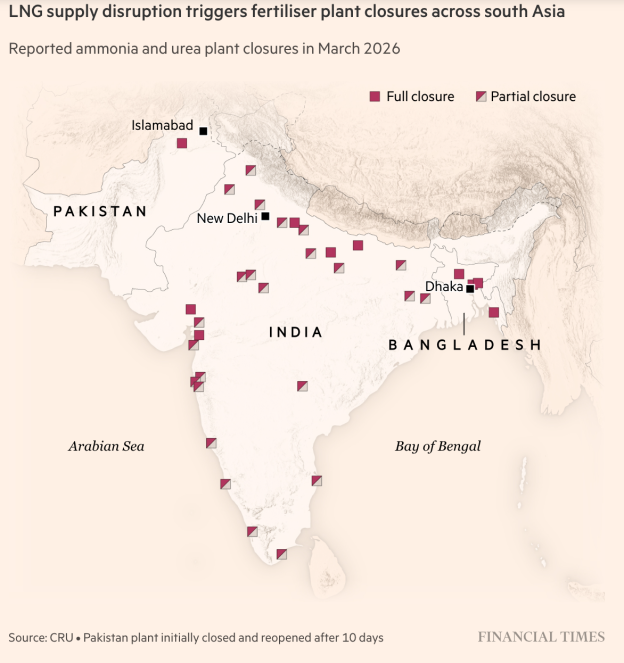
The current crisis in the Strait of Hormuz, as analysed in the FT and by organisations like the FAO and IFPRI, presents a “systemic shock” to agri food systems that mirrors the structural vulnerabilities seen during the 1943 and 1974 Bengal famines. While those historical famines were driven by wartime inflation and supply chain collapses, the present risk stems from the Strait’s role as the world’s primary “fertiliser and energy artery.”
The primary risks identified in the FT “Big Read” analysis and related reports include:
1. The Fertiliser “Double Whammy”
Unlike 1943, where the failure was largely administrative and logistical, a modern famine risk in South Asia is tied to chemical inputs.
-
Production Halt: The Gulf region accounts for 30% of global nitrogen fertiliser trade and 45% of sulfur exports (essential for phosphate fertilisers). A blockade halts these shipments during the critical March/April planting season.
-
Cost Surge: Middle East urea prices jumped nearly 20% in a single week. For farmers in Bangladesh and India, these costs can make planting the “Boro” (winter) rice crop—which is currently underway—prohibitively expensive or impossible.
2. Geographic Vulnerability (The “Bengal” Factor)
The FAO specifically identifies Bangladesh, India, and Sri Lanka as the most vulnerable.
-
Import Dependency: These nations rely on the Strait for both finished fertilisers and the natural gas required to run domestic fertilizer plants. India has already had to scale back domestic production to 70% capacity due to fuel shortages.
-
Yield Collapse: If the disruption persists for more than three months, a “yield shock” is predicted. In 1974, floods triggered the famine, but in 2026, the trigger is a man-made “input drought” that could lead to a massive drop in rice and wheat harvests.
3. Energy-Induced Food Inflation
The “Big Read” piece highlights that food security is now inseparable from energy security.
-
Fuel for Irrigation: High oil prices (up 15% since the conflict began) increase the cost of diesel, which powers the water pumps essential for rice cultivation in the Bengal delta.
-
Logistics: With 70,000 tons of food aid already stuck and shipping costs rising by up to 25%, the price of “getting food to the plate” is skyrocketing
| Risk Factor | 1943/1974 Bengal Famines | 2026 Hormuz Crisis |
| Primary Cause | War/Colonial policy (1943); Floods/Inflation (1974) | Geopolitical blockade of energy & fertilizer |
| Food Availability | Sufficient grain existed but was hoarded/diverted | Global stocks are sufficient, but inputs (fertilizer) are missing |
| Economic Shock | Hyper-inflation of rice prices | “Systemic shock” where energy costs drive food prices |
| Outcome Risk | Mass starvation in rural Bengal | Acute hunger for an additional 45 million people globally |
The FT analysis rightly warns that while global food stocks are currently “sufficient,” the crisis is a race against time. If the blockade lasts through the 2026 planting cycle, the transition from a “price crisis” to a “supply famine” becomes a mathematical certainty for import-dependent nations in South Asia.