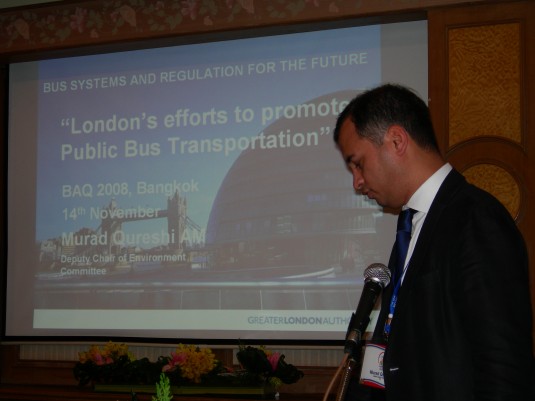
Last month the Better Air Quality in Asia (BAQ) biennial conference was held in Bangkok. It highlighted one of the most pressing issues for the mega cities of Asia – the need to improve air quality while urbanisation increases apace and along with it energy consumption and vehicle growth. Air quality in Asia is certainly improving but is still far above World Health Organisation limits. Particulate matter (dust) is the main pollutant of concern while ozone is increasingly becoming a problem.
While the BAQ conference was taking place, one particular Asian capital faced some very severe air pollution problems – Delhi with its winter “fog”, which came early this year. One of the first things that strikes visitors to India is the low-lying soup that hangs over its capital, as the early morning moisture mingles with fumes and dust to form a cloud that lasts all day. As a result, Delhi has been ranked as one of the worst polluted cities by the World Bank.
This fog often delays flights at the Indira Gandhi International Airport because of the poor visibility, which at the peak of winter falls to just 50 metres. Hospitals are also recording an increase in patients with respiratory problems, with doctors prescribing oxygen nebulisers for young children suffering “bad air” asthma attacks. We even find professional Delhites leaving the city to spare their children from pollution-related illnesses.
India’s fast expanding economy and growing prosperity have led to an increase in the number of cars that clog Delhi’s roads. Delhi is now estimated to have 5.5 million cars, an increase of over 57% in eight years. This steep rise in car use has rolled back the gains achieved by introducing compressed natural gas (CNG) vehicles, particularly among buses and motorised rickshaws. The problem also faces cities like Kolkata and Dhaka, where similar gains from CNG have been made, only to be negated by the huge growth in car ownership.
The Central Pollution Control Board of Delhi has suggested two explanations for what it calls “the smoke phenomenon”. While it maintains that levels of sulphur dioxide and carbon monoxide have fallen considerably over the past eight years (though the latter is still above the prescribed level), it argues that adverse meteorological conditions mean pollution is not dispersed and collects at lower levels. Secondly it suggests that a rise in particulate matter has been registered, put down largely to construction work for the Commonwealth Games and Delhi Metro.
We in London have faced similar problems. It is over half a century since the Clean Air Act of 1956 cleared London skies of smog. Faced with major air pollution – and in particular, the Great Smog of 1952, which killed some 4,000 people in London – the government of the day applied mandatory Smokeless Zones to British cities. Within just three years, the use of coal disappeared from our larger cities and Londoners breathed more easily. So effective legislation can make a big difference.
Asian cities have two central challenges to be considered. First, how can cities realise their economic and social development goals while at the same time minimising the use of fossil fuels, directly associated with air pollution? And if fossil fuels are used in the future, how can their combustion be carried out in the most clean and efficient manner? Moreover, we need the right mix of technology and demand management in reducing air pollution.
Advances have been made in technologies like fuel economy, energy efficiency and the use of cleaner (low sulphur) fuels in the last 20 years, which allow for considerable reductions in air pollution levels. But there is a danger that reductions achieved through these cleaner technologies will be offset by the rapid growth in the number of emission sources, as we have already noted is the case in some south Asian cities. Cleaner technologies will need to be combined with non-technological, demandmanagement approaches of which the most obvious is investment in public transport.
Murad Qureshi AM
Deputy Chair of Environment Committee
London Assembly
London
Published in the Economic & Political Weekly, India’s premier journal for comment on social affairs and research in social sciences (pdf here) and in China Daily.
 It remains a continuing scandal that, nearly six years after it was first introduced, many embassies in London are still refusing to pay the Congestion Charge. Their justification for this stance – that the Vienna Convention on diplomatic relations frees them from the obligation to pay taxes – is an entirely spurious argument, since the CC clearly qualifies as a user charge rather than a tax. Refusing to pay it is no different from refusing to pay the charge for driving across a toll bridge, for example, and no embassy anywhere is claiming they are exempt from that.
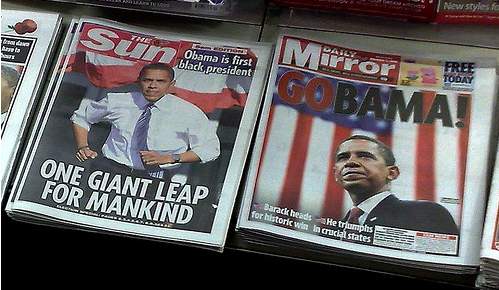 Last night’s landslide victory for President Barack Hussein Obama was not only a victory for people of colour but also for people with foreign-sounding names.
 While all the focus in recent times has been on financial markets and bailing them out, at City Hall on the 23rd of October I chaired a meeting of the London Markets Symposium, looking at the future for London’s street and wholesale markets. We had over 200 attendees and the newly appointed Chair of London Food, Rosie Boycott, on the platform, stimulating a very thorough discussion of the issues.
 Having leafleted against the British National Party with Unite Against Fascism during the recent by-election campaign in Hampstead Town, I was pleased to see that the BNP candidate received a derisory 29 votes, a mere 1% of the poll. You might have thought that after this humiliation the BNP would have got the message that they are not welcome in north London, yet they are contesting the Kentish Town by-election on October 30 in another attempt to gain a foothold there.