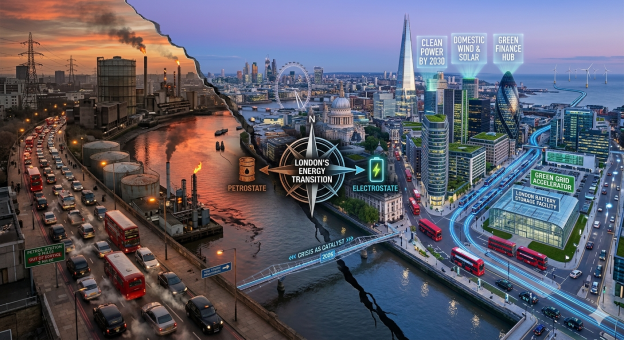
The closure of the Strait of Hormuz (which began on March 4, 2026) has triggered what the IEA calls the “greatest global energy security challenge in history.” For a city like London, this crisis has transformed the shift from a petrostate (fossil-fuel dependent) to an electrostate (electricity and renewables-led) from a long-term climate goal into an immediate survival strategy.
As of April 2026, London is accelerating this transition through several specific levers:
1. Hardening the Grid for “Electrification-First”
With Brent Crude surging past $120 per barrel and Qatari LNG exports stranded, London is pivoting to protect its power supply from global price shocks.
- Great British Energy (GBE): The recently established publicly owned company is fast-tracking investments in offshore wind and grid storage to decouple London’s electricity prices from the volatile international gas market.
- Strategic Storage: Unlike oil, which is currently “stranded” in the Gulf, London is investing in large-scale battery storage and “Vehicle-to-Grid” (V2G) trials. This allows the city to use the batteries of thousands of EVs parked in London to stabilize the grid during peak demand.
2. Transitioning the Transport “Lifeline”
The crisis has caused acute jet fuel and diesel shortages, leading to flight cancellations and high shipping surcharges.
- EV Infrastructure Surge: To bypass the “petrol pump” crisis, London has accelerated the rollout of ultra-rapid charging hubs. The goal is to make the city’s logistics and transit entirely independent of Hormuz-sourced oil.
- The “Zero Carbon Accelerator”: The Mayor’s office has redirected emergency funds to this initiative to speed up the electrification of London’s bus fleet and delivery vans, ensuring essential services remain functional even if fuel reserves run dry.
3. Decoupling Heating from Gas
A harsh 2025–2026 winter left gas storage at only 30% capacity just as the Strait closed. London is now treating gas boilers as a national security risk.
- Heat Pump Subsidies: The “Home Upgrade Grant” and “Warmer Homes” programs have seen a massive influx of funding to move Londoners away from gas boilers toward electric heat pumps.
- District Heating: Plans for waste-to-energy and large-scale heat networks are being fast-tracked in central London boroughs to provide communal, non-fossil-fuel heating.
4. Economic Pivot: The “Electrostate” Financial Hub
London is positioning itself as the global capital for Transition Finance.
- Innovation Zero 2026: This major summit in London is currently focusing on “Resilient Supply Chains,” specifically securing the critical minerals (lithium, cobalt, copper) needed for an electrostate.
- Green Bonds: The City of London is seeing record issuance of green bonds to fund the “Clean Power by 2030” mission, effectively moving capital away from traditional “petro” investments that are currently locked in geopolitical turmoil.
Comparison of the Two Models (2026 Crisis Context)
| Feature | Petrostate Model (Pre-Crisis) | Electrostate Model (2026 Strategy) |
|---|---|---|
| Energy Source | Imported Oil/Gas (via Hormuz) | Domestic Wind, Solar, and Nuclear |
| Price Driver | Global Geopolitics/War | Technology & Infrastructure Costs |
| Vulnerability | High (Supply Chain Chokepoints) | Low (Decentralized Grid) |
| Economic Base | Fuel Extraction/Trading | Battery Tech, AI Grid Mgmt, Green Finance |
While the immediate impact of the closure is painful—with inflation rising and jet fuel rationing—London’s policy response in 2026 suggests that this “oil reckoning” is acting as a catalyst to permanently sever ties with the old petrostate architecture.