Poor air quality at the Olympics 2012 yet to be tackled

Eco Halo over Trafaglar Sq changing colours over the Olympics could be a way of telling people whether we have poor air quality

During the last Transport Committee of this term, l got an opportunity to ask a few questions about impact on air quality with all the transport preparations for this summers games in London. Unsurprisingly l got some very defensive responses from TfL and LOCOG, particularly when l questioned their claims in the previous weeks press releases.

Firstly air quality has been the biggest environment issue during the last two Olympics in Beijing and Athens, so its right to emphasis this issue. Now by TfL’s own Environment Report for 2011, its not meeting their own NOx and PM10 goals for the past few years. So for example, levels of NOx are above TfL’s own target for the third successive year. As for PM10 emissions these have exceeded TfL own targets for the second year running despite having fallen considerably under Ken. Quite honestly whos to say TfL will meet the targets over the Olympics when they can not reached their own targets for pass few years.

The reality though is that the IOC is only concerned with ozone ( check page 67/68) during the games which has not been mentioned at all in the TfL material sent out to convince us its on top of this issue. So TfL have fundamentally misunderstood what the concerns over the Olympics is actually though we should not forget NOx and PM10 and its impact to residents of London. Moreover during the Olympics, the second biggest hotspot for poor air in London is going to be Heathrow where we have been reliable informed that by BAA its expecting 50 per cent more taxis each day, 7,500 rather 5,000 taxis daily which as we all know disporportionately contribute to poor air quality. This makes me thing  if TfL has not appreciate this in the second hotspot of London who is to say it will do any better in Central London and its suburbs.

So l really do think, its should be back to the drawing board for TfL to get a handle on this critical issue over the Olympics. It certainly won’t be the greenest games ever, if we do not get on top of poor air quality during the games.


Can Heathrow cope during the Olympics?

Stats presented at the last meeting of the Heathrow Airport Consultative Committee


Interestingly over the weekend, it was reported in the FT that the “Airlines want Olympic priority”, suggesting that the airlines are not confident that Heathrow will be able to cope during the Olympics and thus want priority for their flights.  This is despite being told by BAA at the last Heathrow Airport Consultative Committe(HACC) meeting that Heathrow aims to deliver a great experience for all passengers during the games with some major investment made by them.  When I questioned LOCOG & TfL at last week’s Transport Committee meeting, they also, seemed to be assured of Heathrow’s ability to deliver.

Heathrow is the “official port of entry” for the games where over 80 per cent of games traffic will pass through.  The key challenges will be the volume of passengers and bags as well as the logistical complexities during the Paralympics.  The net result will be an increase of 7.2 per cent of passengers daily and a 9 per cent increase in direct passengers alighting at Heathrow as opposed to being transfer passengers.  The increase in traffic for baggage passing through will also be on a similar scale with some athletes and media expected to have as many as 4 bags each.

These are worrying statistics for local residents given that the next trial period of operation freedom (where restrictions on landings and take-off are relaxed) will take place during the games period as well.  This is something the airlines themselves are aware of so it makes all the more surprising that  they have approached the Department of Transport (DoT) about their concerns. What could the four major airlines in the letter be referring to when asking the DoT for “measures to improve airspace resilience” other then operation freedom over the Olympic period? Something is clearly not quite right here and poses some serious questions of what has already been presented to HACC and reassurances given to us at last weeks Transport Committee at the London Assembly.  

The Heathrow experience will also be the last experience in London for many of our overseas visitors, including the vast majority of athletes, media and foreign fans descending into our city.  However, we shouldn’t forget that there are other London airports like City airport, it has the added benefit of being much closer to the main Olympic site which would also negate the need for passengers to travel acrosss London to the main venue in Stratford. So with bigger plans and the operation of mixed mode trials at Heathrow, West London residents should not be expected to bear all the brunt. Other London airports should alos be utlised wherever possible. Perhaps we should consider channelling our dignitaries through City airport instead of Heathrow? 

Boris’s air quality failures are no longer funny – we need action not bluster

4 years of Boris has seen worsening air quality in London

One of the broken promises which Boris Johnson’s Progress Report to Londoners (pdf) conveniently forgot to mention is his poor performance relating to air quality in London.  The report looks back at his 2008 Manifesto (pdf) but it fails to highlight the true extent of his failure on what has become a critical public health issue for the capital.

 In 2008, he claimed:

“We are passionately committed to improvingLondon’s air quality. We must act to deal with the estimated 1,000 deaths per year caused by air pollution.

“The ‘polluter pays’ principle that lies behind the Low Emission Zone is fair. We believe the LEZ is a step in the right direction.”

 In fact, during his term, the estimate for premature deaths as a result of poor air quality has gone up to more than 4,000 deaths per year – 20 times the figure for road fatalities. What does this mean for Londoners’ health?

• For those who die prematurely, their life expectancy may have been shortened by up to 11 years;

• It’s made life more difficult for those with respiratory and heart conditions;

• And for young Londoners growing up along the hot spots, it can cause their lungs not to develop fully.

Furthermore, the House of Commons environment audit committee have suggested (pdf) that poor air quality is the second biggest public health risk after smoking and is linked to 1 in 5 deaths inLondon.

 While Boris may have declared a passionate commitment to improvingLondon’s air quality, he has failed miserably to deliver on his promise.  He cancelled the six-monthly inspections of black cabs (only to reinstate them after being advised its was a bad idea) and delayed the roll-out of the Low Emission Zone (LEZ) in phase 3 to light goods vehicles in order to keep the white van man happy in the suburbs.  His recent short term measures like the dust suppressant trial along major routes have yet to be noticed by local residents, although strategically placed to duck impending European Union fines; the stopping of idling engines has yet to be enforced outside the rail stations along Marylebone Road and Euston Road; and we’ve only seen one green wall put up which alone will have little impact. 

The problem is not confined to centralLondoneither as poor air respects no borough borders. Diminishing air quality in centralLondonis something which is spreading to the suburbs including areas like Putney,Neasden Laneand Brent.  Overwhelmingly, he hasn’t even begun thinking about the second hot-stop of poor air quality inLondon, which is around Heathrow airport.

So as we reach the end of this Mayoral term, the legacy we are left with is positive regression forLondon’s air quality.Londonis now four years behind on delivering a strong, effective and serious programme designed to clean up our air.  Instead, we’re left with the usual Boris of yet more charm, bluster and hot-air – this is not funny.

Read my article here in Left Foot Forward

Coming out against all Estuary airport proposals & not just the Mayors

Map showing all the various airport proposals in and around Thames Estuary

 Having come out against the Mayors Thames Estuary airport proposal today as a joint signatory of a letter to the editor in the Telegraph today, l should add l am actually against both the present proposals today in the Estuary and by implication the historical proposals also made in the Thames Estuary

Interestingly we have had proposals for an airport in the Thames Estuary since the 1940s. The one that had the most substance was put forward by the PLA on Mapling Sands as their ideal site in the early 1970s but died a death when the 1974 Labour government did not back it. (Location number 3 on the map above.)

Previous to that for historic reasons, the Isle of Sheppey has been proposed to be considered as the Third London Airport in the mid 1960’s, only to be rejected in favour of Stansted by an Interdepartment Committee. ( location 4 on the map.) Before that even we had Cliffe in Kent considered as a successor to Croydon as a London airport after WWII, only for it to lose out to Heathrow. (location 1 on the map.)   

Now we are left with two proposals in the Thames Estuary, one of course from the Mayor in the Shivering Sands proposed in 2008 (location no 5 on map) and finally the other from Fosters in the Grain with his Thames Hub idea (location no 2 on the map.)  

And whilst the Mayors & the Foster proposal is hanging around, we have Southend (London) International airport off the A13 in Essex. Though its not on the map above, its  just recently changed hands and is expanding its flight facilities for Easyjet ready for the Olympics. At least this one is on land and is actually happening with private backing while the others lie around as just pipe dreams for their respective backers.

International Women’s day let down by London Games

Saudi Arabia’s Jeddah United train before a friendly basketball game in Amman, 2009. Photograph: Ali Jarekji/REUTERS
 
What better way to have marked London’s commitment to International Women’s Day then for the London Olympic Authorities to have refused Saudi Arabia  a place in this year’s games unless and until they halt the unjust discrimination against women who are refused a place on their national team.
 
The Guardian recently highlighted the plight of Saudi female athletes who are unjustly curtailed by their own government as both women and girls are denied the right to participate in sport.
 
London has disappointingly failed to follow the example set by Sydney in 2000 which banned Afghanistan from competing and regardless of any number of fireworks, sponsorship deals and other corporate hallabaloo which will no doubt ensue with this year’s games, it is the legacy of the games which will be most remembered.  The legacy of a games that plays host to all male teams is not one which I am proud to pass on and neither should Lord Coe.

Murad Qureshi AM Condemns Callous “Remploy” Decision

The

Acton factory provides high quality services to the electronics’ market and offers employees a unique working environment in which they can fulfil their potential. It is one of 36 plants in the UK set to close as a direct result of the government’s decision to substantially reduce funding to Remploy and comes at a time of economic hardship and high unemployment.

Murad

said in Ealing. The type of working environment offered by Remploy is particularly suited to some people who can do very productive work in a supported environment. Whilst I am supportive of improving access to work for all, the reality of the current economic climate is that there will be little prospect for those who lose their jobs finding new employment if the closure goes ahead."

End

Murad Qureshi

is a London-wide Labour Assembly Member

For more information please contact

Notes

<dir><dir></dir></dir> Nikki Salih, on 020 7983 4400."this announcement is a body blow to some of my most vulnerable

Appeal to use canal to transport Crossrail tunnels

Bosses of the proposed east-to-west rail link have applied to use thousands of large articulated lorries over the next 14 months.

Fears have been raised by local councillors about the safety implications of such a move and now a number of waterways bodies have criticised Crossrail for failing to use the canal instead of blocking the roads.

In a planning report to Westminster Council, the London Waterways Commission said: “Crossrail threatens severe congestion in west London that can easily be averted using the canal.

“This is an opportunity for using water transport. However, without proper consideration and based on inaccurate reports, the contractor has dismissed this option as being unviable.”

The commission claims transporting the tunnel segments by canal is “perfectly feasible”.

British Waterways says the canal is a “serious option for moving bulk materials” and Crossrail has been informed that it is “a viable option”.

This opinion is supported by the Inland Waterways Association which says it is “concerned about the way in which the option for the use of waterborne transport is dismissed”.

It says the proposed lorry routes are “already congested” and using the canal would save residents from “a substantial number of additional and unwanted lorry movements”.

The tunnel segments are to be transported to Crossrail’s Westbourne Park site on Great Western Road.

London Assembly member Murad Qureshi said he was always worried that the canal option had been dismissed too quickly.

He said: “The lorry option is clearly the cheapest but it is to the detriment of the local community.”

However, a Crossrail spokesman said the canal option had been investigated but is “not practically possible”. She added: “Crossrail is removing all excavated material from its western tunnels by rail and river meaning that at least 50,000 lorry journeys will not be needed.”

“There is not enough rail capacity at Westbourne Park to also transport the concrete tunnel segments from Old Oak Common.”

Last week project bosses confirmed independent bed maker Big Table, which is also located on Great Western Road, would no longer need to be bulldozed to make way for Crossrail.

Click here to view article

Iran war could potentially dominate London election

Now if there is one issue that could explode onto the arena of the GLA election on the 3rd of May, is if all the talk of war actually results in a pre-emptive strike against Iran before the date of the election.   

Having been elected on the London Assembly for the first time in 2004, where by far the dominant issue was the Iraq war at the time, we have already seen in the short life of the GLA how a global issue can dominant an essentially London election about issues like transport fares, policing of London and building more housing. Then it cost labour 2 seats in the London Assembly and l only just got in myself on the night, while Ken was against the intervention in Iraq got back in with reasonable margin of  comfort.

Interestingly while some in the press like the Telegraph have highlight the significance of the Obama & Netanyahu meeting earlier in the week, others like the Economist have been alot more caution. Its leader last week suggested the case for the wars success is hard to make. If Iran is intent in getting a bomb, an attack would delay but not stop it. Indeed, using Western bombs as a tool to prevent nuclear proliferation risks making Iran more determined to build a weapon – and more dangerous when it gets one. While the ES suggested last night that diplomacy has along way to go yet, advising Cameron to use his influence on Obama on this front.

So what do are present mayoral candidates say about this all? Interestingly the present  Mayor, Boris Johnson did write a column in the Telegraph with the header” We must not let Bush wage war against Iran” which says it all. So I reckon the question now would be whether he would say the same thing about Benjamin Netanyha. Logic tells us that by the same token he should be saying ” We must not let Netanyahu wage war against Iran ” but as we know there is nothing logical about the present incumbent of the Mayor of London! While with Ken we can expect him to say something in line with his previous sentiments on Iraq war on any further intervention in Iran.  And as Phillip Stephens says in the FT very well today in his article, Don’t play politics with the bomb. He says instead of banging drum for war, Mr Netanyahu should be making peace with Palestinians. Clearly while it might not yet be dominating the London elections, its clearly dominating the pages of our broadsheets and thats no bad thing at all, as we hear warnings against any pre-emptive strike.

Threat of drought in London the key environment concern


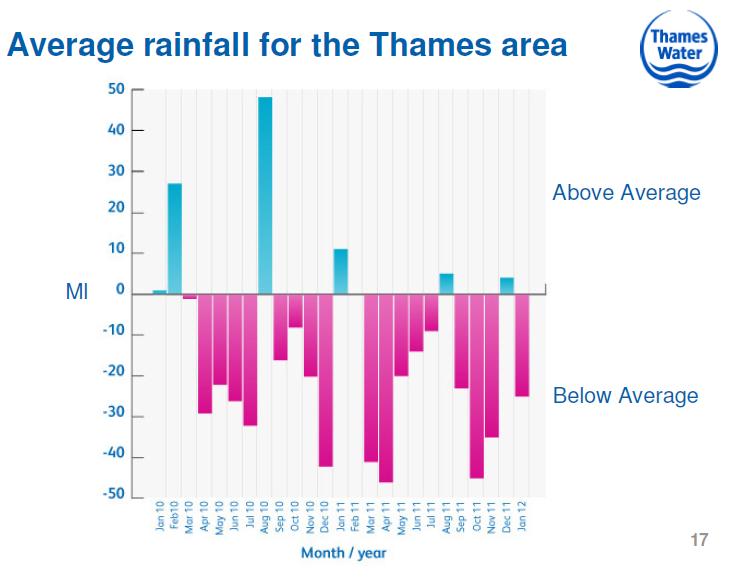
 At thursday’s Environment Committee we got an update on the drought situation from both Thames Water and the Environment Agency. It was appriopriate that we started the meeting with this item given we were discussing future environmental priorities for Londoners, as l can not see anything more urgent then the water running out from the mains!

The diagram above really tells the story of below average rainfall for the past two years in Greater London and immediately beyond in the South-East as well, with only 6 months of above average rainfall since January 2010. While the remaining 18 months do not just show less  average rainfall but considerably less. So this problem has been building up for sometime and highly unlikely we’ll have the same equivalent amount of rain during the spring to avert a drought during the summer.

This also follows a recent site visit to Beckton where we saw the desalination plant ( also known as the Thames gateway Water Treatment Works) first-hand which will undoubtedly kick in during the forthcoming summer season to provide up to 7 per cent of the short fall of water anticipated we were informed by Thames Water.  If we don’t see some major rains over the spring, hosepipe bans by water authorities will almost certainly be applied. As well as a major communications strategy to inform us to consumer less water when we wash ourselves, use the toilet more efficiently &  making sure our washing machines are fully loaded, as some of the measures we can take in individual households. But lets not forget that water companies like Thames Water need also to deal more effectively with water leakages in their upgrading of the system under the streets of London. Where we have seen some problems not just in terms of the road works and its impact on keeping London moving but incredibly the regulator OFWAT not permitting them to undertake the works required.

And finally we will no doubt hear further arguments for the metering of water and major initiatives like moving water from the North down to the South. So water issues are likely to dominate the environment agenda in London for now.   


Crossrail lorry movement “stitch up”

On Carlton Bridge,Great Western Rd above canal where Crossrail tunnel segments could go into Westbourne Park

 With the additional lorry movements application withdrawn by Crossrail before the 1st of March town planning meeting and the operational approval of the right turn at Great Western Road along the Harrow Road (otherwise known as the Prince of Wales junction) from the 10th of March, this can be seen for it was always now – a stitch up against the canal option to move the tunnel linings from Old Oak Common to Paddington.

It was clear something was afoot right from the outsight, as the application was only accepted by the City of Westminster on the last working day before christmas eve in 2011 when it had been with them a few months by then.  Furthermore the contractor BFK confirmed that no effort had been made to cost and entertain other options like canal and rail other then lorries along the Harrow Rd at a Paddington station liason Meeting on the 23rd of January when l questioned them about this all.  Looking at their Environment Policy statement and contrasting it with the reality, gives some comical lines about what contractors will say to get big public contracts. For example, BFK is committed to maximising benefits and minimising adverse impacts to the environment and neighbouring communities in delivering Crossrail projects; assess the potential environmental impacts of all operations, and remove or mitigate these risks throughout the design and construction phases; have minimal impact on the environment through our construction activities; and communicate with parties, including the public in an open and honest manner. None of this was done or achieved by BFK in this instance, as it doggedly pushed the lorry option as the only way to move the tunnel segments to the Westbourne Park portal.

The Council was due to consider the planning application for the route B – via Chepstow Rd  on the 1st of March but the officers were going to recommend refusal. Therefore Crossrail through BFK have withdrawn this application.  
 
However, whilst the residents through Notting Hill Gate & Bayswater and in particular residents of Chepstow Rd have a reprieve, all the lorries will now travel along the Harrow Rd route. Moreover the City of Westminster are going to say yes to the right turn into Great Western Rd on the basis that if they said no, Crossrail would use smaller but twice as many lorries, going round the Elgin and Chippenham junction. Westminster are clear that Crossrail already have the powers to use the Harrow Rd through the Crossrail Act.
 
However, none of this answers why the canal option was not properly explored earlier. Indeed Crossrail have had decades to prepare for this eventuality and could have easily specified this as part of the tunnel contract. And no-one has been able to give us any straight answers on how they think these lorries aren’t going to add congestion to an already busy trunk road, adversely affecting all local residents and businesses. That apart, how can justify small cars not being able to do the right turn when much bigger vehicles like HGV and buses can do?
 
So while a victory has been scored with Crossrail’s climb down on the Big Table, the harsh reality is that the neighbourhood particularly along the Harrow Rd is going to live with alot of unnecessary lorry movements for a number of years.