Action needed to halt London’s silent killer

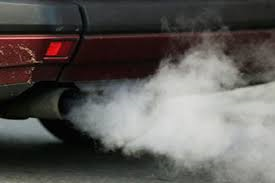
ULEZBoris Johnson today confirmed he will not accelerate the introduction of an Ultra-Low Emission Zone in London or take any further steps to improve London’s air quality. In his weekly Telegraph column the Mayor accepted that the capital’s air quality is bad and kills 4,300 people each year, but failed to speed up the delivery of the ULEZ which will improve air quality. London Assembly Labour Group Environment spokesperson, Murad Qureshi AM, has again urged the Mayor to bring forward both the Ultra-Low Emission Zone and the retrofitting of London’s 8,000 buses to make them less polluting.

Last week the Mayor indicated the smog episode wasn’t as bad as people had claimed, telling ITV London “I’m urging people just to have a little balance here, I cycled this morning and it seemed perfectly fine to me”. Under current plans the Mayor’s Ultra Low Emission Zone will not be introduced until after he has left City Hall. The Mayor also prioritised purchasing a few hundred of his new ‘RouteMaster’ buses, rather than retrofitting the entire fleet. 

Murad Qureshi AM, London Assembly Labour Group Environment spokesperson, said:

“Today the Mayor admitted that London’s air quality is bad and kills over 4,000 people each year, however he is unwilling to bring forward measures which will help stop this killer. His Ultra Low Emission Zone will be introduced four years after he has left office, and his pledge to make taxi’s zero-emission ‘capable’ won’t happen until two years after he has left us.

“His unwillingness to tackle this problem is short-sighted and condemns Londoners to another six years of dangerous air. London’s poor air quality kills 4,300 people each year, but it also stunts the development of children’s lungs – a condition that each child affected will be forced to live with the rest of their life. Boris’ complacency is disgraceful, he must bring forward the measures to fight this silent killer.”

Background

The Mayor’s own Air Quality Strategy states that buses contribute significantly to pollution in London. During this year’s City Hall budget setting process, the Mayor was presented with a fully costed plan to establish a £25m fund to make London’s entire bus fleet less polluting and meet the Euro VI standard. This programme would have seen the fleet retrofitted by December 2015, however, the Mayor rejected this plan. By the time his Ultra Low Emission Zone is introduced in 2020, approximately 51,000 Londoners would have died as a result of air pollution since he was elected in 2008.

Ends 

Notes

  1. Murad Qureshi is a Labour member of the London Assembly.
  2. The Mayor’s Air Quality Strategy says: “Across Greater London, buses are estimated to contribute 21 per cent of road transport emissions in 2008, and just under 30 per cent in 2015. However, when looking at road transport emissions within central London, buses become the most significant source of NOx emissions at around 40 per cent in 2008, growing to just below 50 per cent in 2015.” (The Mayor’s Air Quality Strategy p.44)
  3. In November 2013, the Department for Health published the Public Health Indicator for the fraction of mortality attributable to human-made dangerous airborne particles PM2.5 in 2011. The research which was publicised by the Clean Air in London Campaign noted that PM2.5 killed more people in 15 London boroughs in 2011 than 2010 and far more than 10 times the number dying from road traffic accidents Latest National and Local Death Rates for Air Pollution.
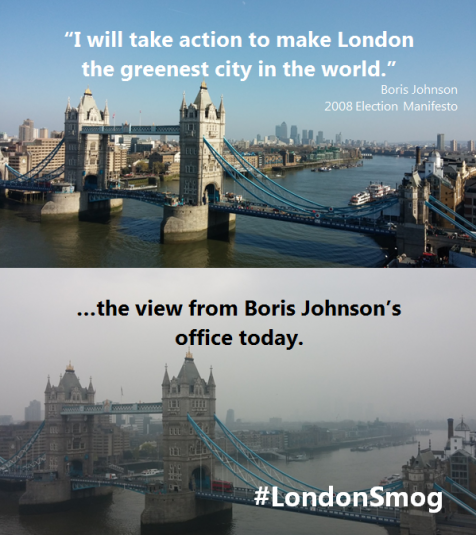
Mayor’s complacency can seriously damage your health

LondonSmog

Boris Johnson said yesterday during the smog over London  “I’m urging people just to have a little balance here, I cycled this morning and it seemed perfectly fine to me”. Not surprisingly he is being criticised for failing to take the current smog episode seriously at all, this when the Prime Minster of the day David Cameroon himself complained he could not jog early in the morning because of the smog.  

It has been confirmed by Defra that London is experiencing ‘Level 10’ air pollution – which is the worst possible, and as a result the Mayor’s comments are “dangerously complacent”.

Each year poor air quality kills over 4,000 Londoners, yet the Mayor’s Ultra Low Emission Zone will not be introduced until after he has left City Hall in 2020. The Mayor also prioritised purchasing a few hundred of his new ‘RouteMaster’ buses, rather than retrofitting the entire fleet of over 8,000 London buses to make them less polluting.

Only today the London Ambulance Service has seen a 14% increase in people calling them with breathing problems. In 2008 Boris promised to make London the greenest city in the world. Instead, we’ve seen wasted opportunities and wasted money. Instead of retro-fitting the entire fleet of over 8,000 London buses to make them less polluting, he has bought just a few hundred new ‘RouteMasters’. Boris might be alright, but London’s’ asthmatics are suffering.

This latest smog episode should act as a wake up call to our Mayor, whilst sand blown in from the Sahara is a contributing factor, Boris has not taken decisive action to tackle local air pollution. Boris needs to take action and show real leadership on this issue. He needs to play his part in tackling our city’s silent killer which causes over 4,000 deaths a year. He should bring forward his Ultra Low Emission Zone and retro-fit the entire London bus fleet to make them less polluting.

The Mayor’s own Air Quality Strategy states that buses contribute significantly to pollution in London. During this year’s City Hall budget setting process, the Mayor was presented with a fully costed plan to establish a £25m fund to make London’s entire bus fleet less polluting and meet the Euro VI standard. This programme would have seen the fleet retrofitted by December 2015, however, the Mayor rejected this plan. By the time his Ultra Low Emission Zone is introduced in 2020, approximately 51,000 Londoners would have died as a result of air pollution since he was elected in 2008.


Silent Killer Must Be Tackled

Air pollution

In the midst of London’s latest smog episode, the Mayor of London has been criticised for failing to act on the city’s silent killer. Each year poor air quality kills over 4,000 Londoners, yet the Mayor’s Ultra Low Emission Zone will not be introduced until after he has left City Hall. The Mayor also prioritised purchasing a few hundred of his new ‘RouteMaster’ buses, rather than retrofitting the entire fleet of over 8,000 London buses to make them less polluting. 

The Mayor’s own Air Quality Strategy states that buses contribute significantly to pollution in London. During this year’s City Hall budget setting process, the Mayor was presented with a fully costed plan to establish a £25m fund to make London’s entire bus fleet less polluting and meet the Euro VI standard. This programme would have seen the fleet retrofitted by December 2015, however, the Mayor rejected this plan. By the time his Ultra Low Emission Zone is introduced in 2020, approximately 51,000 Londoners would have died as a result of air pollution since he was elected in 2008. 

Murad Qureshi AM, London Assembly Labour Group Environment spokesperson, said:

“This latest smog episode should act as a wake up call to our Mayor, whilst sand blown in from the Sahara is a contributing factor, the fact is Boris has not taken decisive action to tackle local air pollution. In the last six years he has prioritised cars over public transport, and where he has invested he has wasted money on his new RouteMaster instead of cleaning up the entire bus fleet.

“A major factor contributing to London’s air pollution is particulate matter from diesel engines. Boris needs to take action and show real leadership on this issue, that is what Mayors are there for. He needs to play his part in tackling our city’s silent killer which causes over 4,000 deaths a year. He should bring forward his Ultra Low Emission Zone and retro-fit the entire London bus fleet to make them less polluting.”

Ends

Notes

  1. Murad Qureshi is a Labour member of the London Assembly.
  2. Calculated estimated deaths from 2008-2020 based on 4,267 figure here.
  3. The Mayor’s Air Quality Strategy says: “Across Greater London, buses are estimated to contribute 21 per cent of road transport emissions in 2008, and just under 30 per cent in 2015. However, when looking at road transport emissions within central London, buses become the most significant source of NOx emissions at around 40 per cent in 2008, growing to just below 50 per cent in 2015.” (The Mayor’s Air Quality Strategy p.44)
  4. In November 2013, the Department for Health published the Public Health Indicator for the fraction of mortality attributable to human-made dangerous airborne particles PM2.5 in 2011. The research which was publicised by the Clean Air in London Campaign noted that PM2.5 killed more people in 15 London boroughs in 2011 than 2010 and far more than 10 times the number dying from road traffic accidents Latest National and Local Death Rates for Air Pollution.

How to save your local pub!

Local community comming out along Linhope St to save theri local pub

Local community comming out along Linhope St to save theri local pub

After my recent column in the West End Extra Forum slot under the header of  ” The pub’s a hub and worth cherishing”  l am glad to see its been of immediate use to campaigners trying to stop another pub closing in NW1, the Swan & Edgar Public House, formerly known as the Feathers Public House.

Indeed if l had not been away l would have attended their public meeting on the 17th of March where over 30 people locally decided to form a group to nominate the Linhope Street Public House for listing as an Asset of Community Value. Please find the link to the Asset of Community Value Nomination Form made to the City of Westminster. It clearly shows how to get one’s local public house listed as an asset of community value under the Localism Act, which then gives the pub extra protection if its put up for sale.

The council has already considered the application for change of use and alterations on the 11th of Feb 2014, and refused it on the grounds that the loss of the public house would result in the loss of a valued social and community resource to the detriment of the local community & the character of the Conservation Area.

I just hope now that the Mayor has seen a motion passed by the London Assembly and is mindful of campaigns like the Save the Linhope Street Local, can see fit to use his present exercise of Further Alterations to the London Plan to include new guidance to give greater protection to pubs in London. The campaign to get it listed as as Asset of Community Value shows as all how to go about saving your local public house and other campaigns can certainly learn from it. Just remember a pub is a hub worth cherishing and that it is worth preserving.

Latest figures: 463 Police Officers cut in Westminster

6

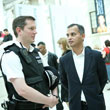
Latest figures released by the Mayor of London show that 463 police officers have been cut in Westminster, a drop of 28% since May 2010. The latest figures show that despite the Mayor’s pledge to increase police numbers, the opposite is happening on his watch.  The cut in police officers comes after criticism of the Mayor’s new Local Policing Model which Murad Qureshi AM argues is eroding neighbourhood policing in the borough.

The number of borough-based police officers in Westminster has dropped from 1628 in May 2010 to 1165 in January 2014.  Across London, the number of police officers has declined by 3,111 (9%). 

Murad Qureshi AM, London wide Assembly, said:

“Despite promising us there would be one thousand more police officers in London, the truth is the Mayor has failed to deliver. We have lost over 3,000 police officers in London.  In Westminster we have lost 463 police officers and 292 PCSOs.  The Mayor has already admitted that there may be flaws in his new community policing plan; the HMIC has reported that the Met now has the third lowest visibility of officers in the country. The Mayor needs to act on his promise and get officers into our neighbourhoods.”

Ends 

Notes

  1. Murad Qureshi AM is a Labour London wide Assembly Member.
  2. The statistics for policewere taken from the Mayor’s datastore, see http://data.london.gov.uk/datastore/package/metropolitan-police-service-recorded-crime-figures-and-associated-data
  3. At a policing plenary on 5th March, the Mayor admitted that ‘there may be unintended consequences of the Local Policing Model that are leading to problems on borough boundaries’.  At the same meeting, the Metropolitan Police Commissioner Bernard Hogan-Howe confirmed that he would be reviewing the model in the coming months.  The transcript can be found on page 12 here.

Calling time on pub closures

Closed: the former Marquis of Anglesey

Closed: the former Marquis of Anglesey

A DRINK at your local pub is probably one of the defining pastimes of British life.

It sets us apart from, say, the Americans who are more accustomed to hanging out in local bars and from the “mainstream” Europeans who have long enjoyed the surroundings of coffee shops before they swamped our high streets.

In the UK the local pub has long been the hub of the community, not only as a place to relax, socialise and participate in community social events like the “quiz night” but they are increasingly a popular eatery as well as a place to host public meetings, say, in a back room as well as providing a convenient home for local football and cricket teams to meet.

Unfortunately the demise of the local is an increasing phenomenon.

In my own postcode of NW1, numerous pubs have closed down.

The smoking ban, economic downturn and the prevalence of chain pubs have undoubtedly had a profound effect on the business viability of the local pub and therefore, their economic vulnerability in the last few years have made them an obvious target for developers with luxury housing in mind.

Not only are they sited in local residential neighbourhoods, they also tend to be buildings of character and charm with space to develop into luxury residences and even hotels.

My fear is that these community hubs will disappear before our eyes and what we have taken for granted as the bastion of our local neighbourhood will be lost for ever and with it one of the defining customs of Britishness.

This is why at the last meeting of the London Assembly on March 5, I proposed a motion urging the Mayor of London to use his planning strategy to give greater protection to pubs in London.

The motion was agreed unanimously by the assembly which called on the mayor to revise his London Plan to include new guidance for local authorities to promote pubs and protect them from unnecessary changes of use.

Here’s what the motion said: “Public houses are the hubs of communities where locals gather with friends and families to socialise and they are currently under threat across London.

“A great number of pubs in the capital have closed down and this is detrimental to the communities they once served.

“The mayor should strengthen the London Plan so that local authorities have the ability to protect these community pillars.”

Assembly members were in agreement and following some debate the full text of the amended motion agreed read as follows:

“This assembly recognises that public houses are important community assets that cater to a broad clientele with a diverse range of needs.

“They are hubs of communities where people gather with friends, enjoy a family lunch at the weekend, and run into neighbours for a chat. Pubs also often provide affordable community space where community groups meet and otherwise act as anchors of the local community.

“Yet these stalwarts of the high street are under threat. Across the country, pubs are closing at a rate of 26 a week, with London’s public houses being among the hardest hit.

“This assembly therefore welcomes the guidance in the draft London Plan alterations which recognises for the first time ‘the important role that London’s public houses can play in the social fabric of communities’ and encourages local authorities to adopt policies to maintain, manage, and enhance public houses, as well as the new policy wording which encourages boroughs to develop polices to prevent their loss.

“However, the London Plan must be strengthened further if local authorities are to be given the additional tools to protect threatened pubs through their own local planning policies.

“The plan must include additional policies which set out a clear inclination to retain pubs, such as a presumption against change of use where a developer is unable to meet strict criteria for the marketing and viability of the site.

“This assembly therefore calls on the Mayor of London to revise his Further Alterations to the London Plan to include further guidance for local authorities to promote and protect pubs.”

Need I say more?

I applaud the assembly for supporting my motion; it demonstrates recognition of the role pubs play in promoting community cohesion particularly in London where it is not unheard of for neighbours to be strangers.

If you happen not to know your neighbour, you may still bump into them down your local pub and even be part of the same quiz team!

They are one of the few establishments on the British high street where you don’t need to pay to enter and you don’t need to fit a certain profile to visit and yet people from all walks of life can relax and participate in social events together.

Now that’s worth preserving.

So let us see what the mayor is going to do about it.

Read article in the West End Extra

HS2 – Calculating the environmental cost to London

This is what HS2 sent out as the Environment Statement!

This is what HS2 sent out as the Environment Statement!

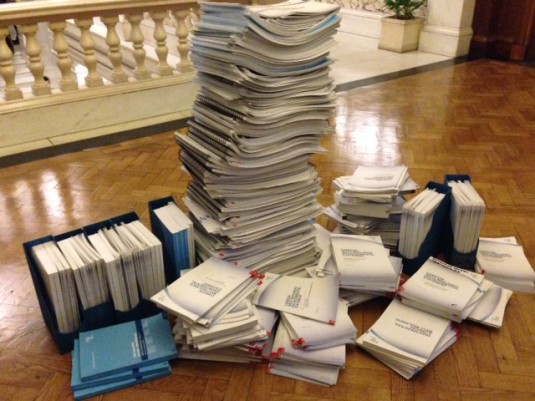
Now that the HS2 Environmental Statement submission deadline for responses has passed, the wait begins for any further news about additional environmental compensation.  At the very least, an attempt should be made to quantify the environmental and health impacts – as so many questions still remain unanswered.

According to the Collins English Dictionary, cost:benefit analysis is an accounting noun that describes the analysis that takes into account the costs of a project and its benefits to society, as well as the revenue it generates.

However, when it comes to the mammoth construction job that is HS2, there is no mention of a cost:benefit analysis for London, as we asked for a regional breakdown at the outset.  Ok, so we would get to Birmingham 30 minutes faster but from what we’ve seen so far, the government’s cost:benefit analysis does not cover, or does not cover adequately, a number of environmental issues – most of which will add up to considerably more than currently predicted and may well overturn the low cost-benefit ratio of 1:1.5 for the project anyway.

Some impacts can be costed – some cannot, as they fall into the indirect cost box – difficult to place a monetary value on. But to inform the decisions of HS2, they must be costed in order to guarantee a realistic and accountable summary of the impacts of this sprawling construction.

Central London locations like Euston already has some of the worst air pollution in Europe – it appears the extra deaths and health effects of this added pollution have been ignored. DEFRA well know this already, but does not appear to be talking to their colleagues in DfT, instead promoting HS2 despite the threat of legal action against the UK government by the EU.  As for noise, in the draft Environmental Statement, it assesses average noise levels over a period of time, yet several consultees have said this is misleading because of the impact of peak noise levels; when a high speed train goes past, peak noise levels will be considerably higher.

What about the destruction of homes, city parks, ancient woodland and wildlife habitat? You only have to look at the impact of outer London surface track of HS2 going through Hillingdon, where the viaduct in the Colne River Valley would pass through a site of special scientific interest (SSSI), including sites of national importance for bird conservation.  This stretch of track alone would destroy parts of the borough with valuable stocks of wildlife, including bats, breeding birds, terrestrial invertebrates and great crested newts. During the construction process, 0.2 hectares of ancient woodland in the SSSI including power lines and 12 hectares of vegetation from a site of metropolitan importance for Nature Conservation will be destroyed.

As for compensation for the destruction of homes, it is both unjust and obscene that far higher levels of compensation are being offered to households where HS2 will run down the bottom of long gardens in the Chilterns then the hundreds of residential homes in the Regents Park Estate, immediately West of the Euston terminus where the project will tear through the front rooms.

It may be relatively simple to calculate the value of land and homes purchased for the project, but London has a severe housing shortage!  What comparative value has been applied to reducing London’s housing stock in exchange for cutting 30 minutes off the time it takes to get to or from Birmingham?  And just as importantly, where will people whose homes have been demolished, find new homes? Private renters look set to lose their homes without help or compensation.

The loss of green and open space in central London will also be keenly felt as the area is already heavily urbanised. HS2 Ltd values the loss of urban open space at a standard £54,000 per hectare but, with the lack of other local green space and the high land values in the area, Camden Council estimates that it would cost up to £82 million to re-provide a site like St James’s Gardens and Euston Square. HS2 Ltd acknowledges that its valuation lacks robustness – it is therefore excluded from the main business case, and covered only in separate value-for-money advice provided by the Department for Transport (DfT). Parliament should be aware of this unquantified cost.

Think of the cost to local small businesses like the renowned row of restaurants to the west side of Euston, on Drummond Street, who will suffer the disruption of a construction site on their doorstep for years.  Will they be able to rebuild their clientele once the dust has settled, or will they shut up shop and walk away?

The government has not adequately added up these sums, or accounted for these costs in the final bill for HS2 and it certainly hasn’t shown enough of its working out to us. Who judges if they’ve added them up correctly?  The complexities of getting this cost:benefit analysis right are worse than a quadratic equation.

They must do the sums properly and prove that the cost:benefit analysis justifies going against the widespread public disapproval of this divisive project.

If you consider the environment cost to London alone, l suspect it would at least tip HS2 away from Euston and terminate it at Old Oak Common. Perhaps that would explain why it is that HS2 have not been forthcoming with the environmental cost figures in the first place, as the environmental sums just don’t add-up.


Dangerous crossing gets green light for change

photo 2 - croppedA long standing campaign by residents to persuade TFL and the Mayor to install pedestrian traffic lights at a dangerous junction between Farringdon Road and Charterhouse Street has finally succeeded thanks to a 500 strong petition presented by Labour London Assembly Member Murad Qureshi AM. 
The news about plans to improve the crossing was sent to Murad Qureshi in a letter from the Mayor which confirmed that  “as part of the his proposed north-south cycle superhighway route, this junction is currently being studied by [the Mayor’s] engineers who intend to provide signalled crossings as part of the design”

The junction between Charterhouse Street and the A201 Farringdon Road/Farringdon Street is on the boundary of three boroughs – Camden, Islington and the City of London and in a letter to the Chair of the Assembly, the City of London confirmed its support for calls by the petitioners for pedestrian facilities stating that it had “lobbied for pedestrian facilities to be included at this junction for many years”

Rosey Taylor who championed the petition has said “This is fantastic news for this neglected corner of Smithfield. A proper crossing here will improve things greatly for the thousands of people who use the area. It is very encouraging to know that a campaign like this can be successful in bringing about change. At a time when pedestrian safety is hardly a fashionable topic I am very grateful to Murad Qureshi for championing my cause”

Murad Qureshi AM who presented the petition to the Mayor at the Plenary meeting on the 15th of January said:

“I’m delighted that the Mayor has decided to finally listen to local residents and improve this dangerous crossing. I want to say a big thank you to local residents for signing and to Rosey Taylor for organising this petition, and I was honoured to present it to the Mayor.  This crossing has been neglected because it straddles three different boroughs and so it was clear to me that this was a junction which required action by the Mayor. This is a horrendous junction to negotiate and is an accident waiting to happen.   I just hope that TFL can now get the design details right.” 

Ends 

Notes 

  1. Murad Qureshi AM is a Labour London wide Assembly Member
  2. A copy of the petition with 540 signatories is attached
  3. A copy of the letter referred to from  the City of London and the Mayor are also attached.
  4. Minutes of the meeting on the 15th of January 2014 can be found here: http://www.london.gov.uk/moderngov/documents/s32362/petitions.pdf
  5. Photo of Murad Qureshi with resident Rosey Taylor who championed the petition.


London rents to be over £1,600 by end of Mayor’s term

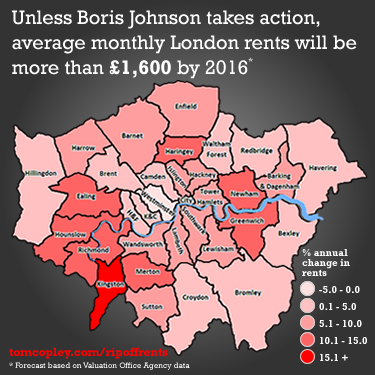
Rent Rise by 2016New research on private sector rent levels shows that, at the current rate of rent inflation, average London rents will be £1,625 a month by April 2016, and for Westminster this will be £1,950.00. The forecasts, compiled by Tom Copley AM, are based on an average of rent rises between October 2011 and October 2013 as recorded by the Valuation Office Agency. For outer London average rents will rise to £1,350, and for inner London average rents will rise to £1,805.

The analysis shows that, should the current level of rent inflation continue, high rents will become a significant problem in outer-London, where rents have tended to be lower than inner London (see map below). London rents are forecast to rise at five times the England average.

Murad Qureshi AM is backing calls for the Mayor to launch an investigation into unsustainable rent increases and establish proposals for a mechanism to stabilise rents in London. Mr Copley argues that the current rate of rent inflation is sucking demand out of the economy, and making London ever more unaffordable for people who work in the capital, which could impact on its economic growth.

Murad Qureshi, Labour London wide Assembly Member, said:
“These figures are a shocking foretaste of what residents in Westminster and across our city can expect to pay in rent by the end of Boris Johnson’s mayoralty. The current rate of rent inflation is making London unaffordable for people to live here, even those on ‘good’ salaries. With home-ownership an ever distant dream for many, it is time Boris Johnson used his position and launched an investigation into unsustainable rent rises and possible mechanisms for tackling them.

“Britain has one of the least regulated private rented markets in Europe. When more and more people have no choice but to rent we have to ensure that renting is a stable option, particularly for the growing number of families who live in this sector. There are good landlords who do right by their tenants, but there are an increasing number who do not. So far the Mayor has only adopted trivial voluntary schemes to improve standards, it is time he treated this issue with the seriousness it deserves. There are over 800,000 private rented households in London. If he doesn’t act these people will continue to be squeezed, quality of life will decline and London’s economy will be held back.”

Projected private rent increases in April 2016, (darker shade of red indicates higher increase):

Projected rent rises for London against the England average:

Ends

Notes

1. Murad Qureshi AM is a Labour London wide member of the London Assembly.
2. Full data tables for projected rent rises are attached.