PEDALLING FOR THE FUTURE

age-of-stupid-oxfam

Last week I had an opportunity to pedal for the future when Oxfam held a screening of The Age of Stupid at the Laban Centre off Deptford Road, as our cycling was used to generate power for the film.

The evening kicked off with a short speech by the local MP and Minister of State for Energy and Climate Change, Joan Ruddock, followed immediately by the film itself. This was the second time I have seen the movie, and I was still struck by its opening imagery of central London flooded. Its clear message is that we can collectively do something about climate change, not dissimilar to the campaigns in the last century to win suffrage for women and working men and the ending of apartheid in South Africa. So, while looking at what lies in store for us if we continue with our present way of life, the film does leave you with a sense of hope.

The Q&A session that followed the movie was the first I’ve done after 10 o’clock in the evening! And I was pleasantly surprised at the numbers willing to stay to discuss both the movie itself and climate change issues. The other panellists were Martin Kirk, Head of UK Campaigns at Oxfam International, and Daniel Vockins, Campaign Coordinator of The Age of Stupid, and the session was chaired by Lucy Aitken-Read from Oxfam. We had a number of very informed questions from the floor, which got us all thinking.

On returning from a very wet Lewisham that night I could see a new social trend beginning, where we go to the cinema and have some of the audience pedalling to power the showing of the film. Who says we can’t do some hard labour in today’s comfortable society, in order to reduce our carbon footprint?

President Obama should order fines paid

Londonwide Assembly Member Murad Qureshi has written to President Obama requesting a Presidential Decree to ensure the US Embassy in London pays its backlog of congestion charge fines.

Transport for London have given up trying to recover parking and congestion charge fines from foreign embassies and have passed the problem to the Foreign Office to sort out.

Foreign Embassies now owe a total of £28 million in unpaid fines and the US Embassy is by far the worst offender, with over £3 million pounds owing in congestion charge fines alone.

Murad Qureshi said: "At a time when Londoners are having to tighten their belts it is very unfair that foreign diplomats are simply refusing to pay their way.  Transport for London has a funding gap yet the US Embassy owes London millions in unpaid fines."

Murad said: "Diplomats the world over are granted many special privileges in their host country, but these charges and fines are not covered under any such arrangement. The US Embassy should set an example by acting responsibly and coughing up like everyone else."

Ends.

Notes

1. Murad Qureshi AM is a Londonwide Assembly Member. He is Labour’s spokesperson on the environment.

2. The Foreign Office has taken over the collection of unpaid congestion charges and parking fines by overseas embassies in London which now stand at £28 million.

3. The American embassy owes £3 million in outstanding fines, followed by the Russian at £2.6 million, the Japanese owe £2.3 million, and the Germans, £2.12 million.

4. The total has more than doubled from £12 million in the last 12 months according to figures obtained under the Freedom of Information Act.

5. None of the embassies are entitled to exemptions from the congestion charges or parking fines although the American embassy has consistently objected to the requirement.

6. Murad has previously asked formal questions of the Mayor on this:
http://www.london.gov.uk/mqt/public/question.do?id=26632

7. Murad Qureshi wrote to President Obama on 7th July 2009 thus:

Dear President Obama

US Embassy’s non-payment of Congestion Charge in London

I feel it is only right to bring to your attention a matter which has cast an unnecessary shadow over relations between the US Embassy to Britain and the people of London since 2003, in the hope that you will reverse a mean-spirited decision taken under your predecessor’s administration by the former US Ambassador to the UK, not to honour the Embassy’s financial obligations to their host city with regard to the cost of driving in central London.

In response to rising pollution levels and near-gridlock levels of congestion in Central London, the previous Mayor of London, Ken Livingstone, bravely introduced a radical, controversial and highly successful daily congestion charge for cars entering a specified Central London zone.  The Mayor did not seek to bar cars from London, merely to discourage their use in the most congested and most polluted area of the city.  This charge was set initially at £5 per vehicle per day and was later increased to £8 in order to maintain its deterrent effect. 

Thanks to our good public transport system, many Londoners choose not to own a car, and indeed for many there is simply no need – especially for those whose main journey is a commute from the suburbs into central London.

Mr Tuttle steadfastly refused to pay London’s congestion charge, wrongly claiming it to be a tax from which foreign diplomats are exempt.  Many here feel this was an ignoble attitude from the Ambassador of the wealthiest country on earth, and one which has set an unfortunate tone, and a poor example for other Embassies to follow.

As at 3rd June 2009, the US Embassy owes the Mayor’s transport department, Transport for London,  £3,478,200 in unpaid charges and late payment fines, and is by far the worst offender for non-payment.  This sum is considerably higher than the amounts other Embassies of far lower status than the USA owe to Londoners.

I know you are seeking to introduce new era of international relations with your Presidency, one based on decency and mutual respect, and in that spirit I respectfully ask you to advise the new Ambassador to London of the longer benefits of adopting a more honourable stance with regard to complying with local expectations.  Please issue a Presidential decree that the new Ambassador should reverse Mr Tuttle’s decision and ensure that the US Embassy in London pays the congestion charge in future, and repays the outstanding charges to make good the errors of the past.

Yours sincerely

Murad Qureshi AM
LONDON ASSEMBLY MEMBER

Murad slams Mayor’s paltry eco-fund

London Assembly Member, Murad Qureshi, has criticised the Mayor’s latest move to win over the green lobby by offering a £4 million fund supposed to kick-start innovative energy efficiency measures. 

Murad said: "Last year the Mayor’s London Development Agency underspent by £12.9 million on its climate change programmes yet now he puts up less than a third of that amount and expects to sort out the economy and solve climate change – a pretty tall order.

"Boris has repeatedly said he doesn’t want to back winners as he wants the market to decide them, and yet by setting up this fund he’s acknowledging it’s both necessary and legitimate to give certain projects a helping hand to protect the environment."

Murad continued: "The LDA should be talking with other parts of the Mayor’s group to fund these projects.  When you consider that the Mayor’s Waste Board – that he chairs – has a budget of £84 million for just this sort of thing and the LDA has a budget of nearly half a billion, you can see just what a paltry gesture this is."

BLACK CABS: THEY’LL BE THE DEATH OF US

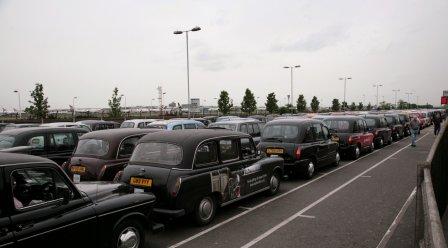
black-cabs-at-heathrow

The black cab is one of London’s most famous icons. Along with Piccadilly Circus, Trafalgar Square and the Routemaster bus, it regularly features in stock footage for films set in the capital and retains a nostalgic appeal for many people, particularly visitors to London.

However, figures from Transport for London show a different side to the story. They reveal that, in 2007-8, the 21,000 black cabs in London produced almost the same amount of carbon dioxide (the main greenhouse gas) as the capital’s 46,000 private hire vehicles (PHVs) and even more of the emissions (PM10 and NOx) that are responsible for air pollution. So it is quite clear that black cabs have an adverse environmental impact, both on climate change and air quality, out of proportion to their numbers.

When Ken Livingstone was Mayor of London the annual licensing inspection for cabs was tightened up and in October 2007 an additional mid-year test was introduced. Nearly 40 per cent of cabs failed the test, with excess emissions a major factor. Despite this, Ken’s successor, Boris Johnson, has scrapped the mid-year inspection for black cabs – while retaining them for the less-polluting PHVs.

When I raised the issue of the pollution caused by black cabs at Mayor’s Question Time this month, Boris admitted that emissions of small particulates (PM10) were especially problematic for Londoners suffering from respiratory illnesses and said this issue needed to be “addressed”. But he refused to consider reinstating the twice-yearly checks.

The reason is not hard to find. Some of Boris’ most effective allies during his mayoral campaign were black cab drivers. According to his campaign office, they distributed over seven million receipts with the slogan “Back Boris” to their passengers – a figure equivalent to the entire population of London. In exchange, Boris made a number of promises to the cabbies, including the abolition of the six-monthly test.

It was not as though Ken had treated black cab drivers badly. He gave them exemption from the congestion charge, the right to use central London bus lanes and an increased night-rate tariff. But, unlike Livingstone, Johnson appears happy to sacrifice Londoners’ health and the struggle against climate change for short-term political gain.

Black cabs are a permanent and necessary part of London’s transport network and no one  is proposing to replace them with PHVs. However, as things stand, for the eco-conscious Londoner who needs to use a taxi service, a licensed private hire minicab is the greener option. Black cabs need to clean up their act. The Mayor should take a lead on this crucial issue and do everything he can to reduce emissions – rather than pander to drivers’ convenience in pursuit of electoral advantage.

Published in Tribune, 31 July 2009

CHINA IS STILL BOOMING

shanghai3

During my recent trip to China to attend a conference on air quality in Shanghai it became quite clear to me that, while the first phase of the recession has not yet come to a close in the UK, with possible further economic gloom still ahead, along its east coast China is still booming. That is not surprising given that China’s annual GDP growth rate stands at 6-8 per cent while our economy is undergoing potentially a 4 per cent contraction.

From what I saw during my brief stay there, street life in the evenings in Shanghai seemed very lively, and the confidence in evidence on the street was also expressed by the politicians l met on the trip. They pointed out how we had been forced to bail out our banks when they did not have to, despite years of western complaints about the lack of transparency in China’s banking system. This is a clear sign that the world is moving away from the Washington consensus to a new paradigm of development where state intervention is more acceptable.

But what does China’s boom mean for London? Clearly Shanghai is a serious challenger to our status as a global financial centre and will be even more so after the Shanghai Expo, which will take place between May and October 2010. Some 70 million people are expected to attend this event, which is being promoted around the theme of “Better City and Better Life”.

The sad thing is that the UK is not part of China’s boom nor are we likely to be, a reflection of the global shift in economic power from the West to the East (see Anthony Hilton’s recent article in the Evening Standard). We certainly need to be out there promoting ourselves during the Shanghai Expo at the very least. We also have to be prepared to learn from China, as l did on the environmental front from their use of electronic street signs to inform the public about levels of noise and air pollution. This is something l hope we can duplicate on the streets of London.

BORIS’S ENVIRONMENTAL POLICIES: A THREAT TO THE 2012 OLYMPICS

client-earth

Today at the launch of Client Earth outside City Hall, I expressed concern that London’s hosting of the 2012 Olympics may have been undermined by Boris Johnson’s regressive environmental decisions.

The International Olympic Committee’s evaluation of London’s bid (pdf here) expressed concern about London’s “increasing levels of ozone pollution” but said that “legislation and actions now in place, such as the ‘low emission zone’ and ‘congestion charge’, are aimed at correcting that trend and ensuring all air pollutants are within World Health Organisation and EU target levels by 2010”.

Since this evaluation was made, Boris Johnson has been elected Mayor, and London’s measures to tackle its poor air quality and ozone pollution have been rolled back. The Congestion Charge Zone will be halved in size and the third phase of the Low Emission Zone, which was due to prevent the most polluting vehicles from entering Greater London, has been indefinitely suspended.

A recent London Assembly report into the city’s air quality, Every Breath You Take (pdf here), found that it could be responsible for up to 3,500 premature deaths and 12,000 children being hospitalised for respiratory failure. It has been reported that the Government is considering countermanding the Mayor because his actions may have undermined their fight against a possible fine of £300 million for failure to meet EU standards on air quality.

It’s bad enough that over three thousand Londoners have their lives cut short each year because of the state of our air. The last thing we want is for this still to be an issue when the world comes here in three years time – as it was in Beijing and Athens. If the Mayor continues down this road, that sadly could well be the case. At the least, the Mayor should now reverse his short-sighted decision to cancel the next phase of the Low Emission Zone.

Have the Mayor’s actions on air quality undermined Olympic bid?

Speaking three years before the Olympics come to London, Murad Qureshi, Labour’s environment spokesman on the London Assembly, has expressed concern that the city’s bid may have been undermined by Boris Johnson’s regressive environmental decisions.

The International Olympic Committee’s evaluation of London’s bid expressed concern about London’s "increasing levels of ozone pollution" but said that "legislation and actions now in place, such as the ‘low emission zone’ and ‘congestion charge’, are aimed at correcting that trend and ensuring all air pollutants are within World Health Organisation and EU target levels by 2010".1

Since this evaluation was made, and Boris Johnson was elected Mayor, London’s measures to tackle its poor air quality and ozone pollution have been rolled back. The Congestion Charge Zone will be halved in size and the third phase of the Low Emission Zone, which was due to prevent the most polluting vehicles from entering Greater London, has been indefinitely suspended.

Murad Qureshi, Labour’s environment spokesman on the London Assembly, said: "It’s bad enough that over 3,000 Londoners die prematurely every year because of the state of our air. The last thing we want is for this still to be an issue when the world comes here in three years time – as we saw in Beijing and Athens. If the Mayor continues along the road down which he has started, this sadly could well be the case. The Mayor should now reverse his short-sighted decision to cancel the next phase of the Low Emission Zone."

A recent London Assembly report into the city’s air quality found that it could be responsible for up to 3,500 premature deaths and 12,000 children being hospitalised for respitory failure.2 It has been reported that the Government is considering countermanding the Mayor because his actions may have undermined their fight against an EU fine of £300 million for its poor air quality.3

Ends

Notes

1. The IOC’s evaluation of London’s bid can be found here: http://multimedia.olympic.org/pdf/en_report_946.pdf. The section on London’s air quality is on page 67/68.

2. The London Assembly’s report in the state of London’s air, Every Breath You Take, can be found here: http://www.london.gov.uk/assembly/reports/environment/air-quality-report-200904.pdf

3. It was reported in April that the Government was considering over-turning the Mayor’s decision to suspend the third phase of the Low Emission Zone: http://www.guardian.co.uk/politics/2009/apr/14/boris-johnson-london-air-quality

Mayor admits black cabs need to clean up their act – but won’t reinstate six-monthly checks

In response to questions from Labour’s environment spokesperson on the London Assembly, Murad Qureshi, the Mayor admitted this week that emissions of small particulates – especially problematic for Londoners suffering from respiratory illnesses – needed to be "addressed". But the Mayor denied the need to reinstate the twice-yearly inspections of black cabs which he has abolished – and which nearly 40% of cabs were failing, with excess emissions a major factor.

Speaking after the Assembly Plenary meeting at City Hall on Wednesday, which discussed the Mayor’s strategies, Murad said:

"The Mayor cannot deny the fact that the 21,000 black cab vehicles in London cause the same amount of pollution as the city’s 46,000 private hire vehicles. These kinds of particulates are especially harmful, particularly if you have asthma or other respiratory problems, and they need to be reduced.

"An easy way for eco-conscious Londoners to be greener if they need to use a taxi service is therefore to use a private hire minicab instead."

Murad also made the point that the main cause of emissions from black cabs is from brake and tyre wear rather than engines and added:

"The Mayor used the word ‘trivial’ to describe these emissions, but it is not ‘trivial’ if you are the parent of an asthmatic child suffering from London’s poor air quality. The Mayor needs to take a lead on this crucial issue and do everything he can to reduce emissions – rather than pander to drivers’ convenience.

"These vehicles should be regularly monitored, and the decision to abolish twice-yearly checks was irresponsible. Along with the suspension of Phase 3 of the Low Emission Zone, this clearly shows that Boris’s commitment to our environment is lacklustre at best."

Notes

  • Murad Qureshi AM is the Labour Group environment spokesperson on the London Assembly and Chair of the Assembly Environment Committee.
  • The London Assembly Plenary session to discuss Mayoral Strategies took place on Wednesday 22nd July 2009 at 11am at City Hall.

BORIS ON THE ENVIRONMENT: CHARM, BLUSTER AND HOT AIR

hot-air-borisOn a number of fronts, it has become all too clear what the environment strategy Boris Johnson is offering to Londoners actually consists of: a bit of charm with a lot of hot air, bluster and the hope that no one looks too closely at the details.

At a recent conference on eco-vehicles, London’s Tory Mayor declared that the capital’s car owners had responded enthusiastically to his personal appeal to “go electric”. In reality, many had already committed themselves to the introduction of electric vehicles in response to the congestion charge and the low emission zone, which penalise polluting lorries and vans. Both these initiatives were introduced by Johnson’s Labour predecessor, Ken Livingstone.

Next it was revealed that a report Boris commissioned from consultants Ernst & Young on the potential of London’s low-carbon economy had cost £85,000. This expensive report says nothing new. It is no more than a re-hash of information already in the public domain. It could easily have been produced in-house by the Mayor’s environment team – which he is now proposing to cut by half. Evidently, Boris prefers outsourcing to private companies, irrespective of the additional cost to Londoners.

This was followed by the publication of the Mayor’s Annual Report for 2008-9, in which he confirmed what many had suspected was his motive for suspending the third phase of the low emission zone, despite the disastrous impact of this on Londoners’ health. In his view, it was an “onerous environmental regulation” on small vans and businesses – in other words, on “white van man” in the London suburbs and the core supporters of Boris Johnson.

Then came the results of an investigation by the London Assembly into the Mayor’s environmental spending. This found that less than a third of the total will be spent on tackling climate change and less than 4 per cent on reducing waste. Most of the money will be used to fund initiatives which Boris claims will “make London a greener and more pleasant city”. Unfortunately, the environmental benefits of these initiatives are questionable.

For example, the Mayor’s cycling programme has a budget of £111 million and accounts for half of the Greater London Authority’s total environmental spending. Yet the scheme is likely to have only a minimal effect on car usage and consequently carbon dioxide emissions and air pollution levels.

Boris was in his element at the Green500 awards, where even Chelsea Football Club received recognition for its environment efforts. The Mayor charmed his audience with warm words about “London’s top organisations truly grasping the nettle to become greener”. This easy-going affability is one of Boris’s great skills as a politician. But problems as profound as those concerning the urban and global environment require something more serious. Such “greenstanding” at an awards ceremony is no substitute for an effective programme aimed at combating poor air quality and climate change.

First published in Tribune, 3rd July 2009

TWENTY20 FOR LONDON OLYMPICS 2012?

lords-t20-final

Last Sunday, on a glorious evening at Lords, with its new floodlights and its immediate neighbourhood brought alive in manner that is not customary in St John’s Wood, we saw the successful conclusion of the ICC Twenty20 cricket World Cup, with Pakistan beating the Sri Lankans. Half of the tournament had been staged in London, with matches divided between the Oval and Lords, and it was fitting that it should close at the ground where it had opened less than three weeks earlier, with the unexpected victory of Holland over England in a dramatic final over.

That opening match boded well for the events that would unfold over the next few weeks. The tournament featured fielding and catching that was routinely breathtaking; umpires who got most things right; the example of Ireland giving encouragement to amateur cricketers all around the world; and England’s victory in the parallel women’s tournament. Completed in less than 18 days, the competition left the fans wanting more.

Quality was the key, and we saw the return of traditional skills like wicket keeping and spin bowling in all its variations, as teams realised that the biff-bang approach doesn’t always work. And London showed what an excellent sporting venue it is, with fans of every nation embracing and enjoying Twenty20 – rather more so than some of the more conservative MCC members, it must be said.

London is the historic home of cricket, and the “spirit of the game” now enshrined in the official rules by the MCC embodies the Olympic ideal of fair play. So hosting the Olympic Games in 2012 can provide the capital with an ideal opportunity to showcase cricket, allowing it to reach a much wider global audience, while in return increasing the appeal of the Olympics amongst cricketing nations that don’t engage as fully with traditional athletics.

Leading cricketers such as Gilchrist, Waugh, Dravid and others have been promoting the inclusion of Twenty20 cricket as a “full” Olympic sport in the 2020 Olympics, under the catchy slogan “Twenty20 for 2020”. As a prelude to that it would be useful if cricket were part of the Games in London 2012 in some form.

In the past, the host Olympic nation has introduced a “demonstration” sport as part of the Games, with the aim that this should become an official Olympic sport in future years. This changed with the removal of demonstration sports at the Beijing Olympics, so host cities are now showcasing local sports as part of the “Cultural Olympiad”.

During the Beijing Olympics “Wushu”, an exhibition and full contact sport derived from traditional Chinese martial arts, was incorporated into the Cultural Olympiad. So if the Chinese can have Wushu, l can’t see why we shouldn’t have cricket in its Twenty20 version incorporated into the London Olympics, given that it is our summer cultural game.

Cricket has been part of the Games in the past – it was last played at the 1900 Olympics, when Great Britain beat France. So with a successful Twenty20 World Cup concluded last Sunday, isn’t it time to think about having cricket returning to the Olympics for 2012?

First published in West End Extra, 26 June 2009