Author Archives: Murad

BORIS: PROGRESSIVE IMAGE IS JUST SPIN

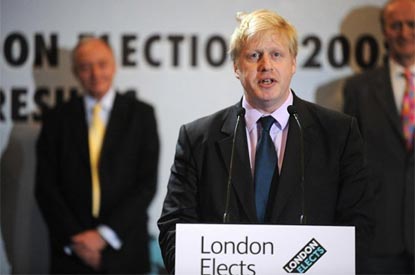
boris-johnson-election-2008

During last year’s London mayoral election, Ken Livingstone argued that underneath Boris Johnson’s affable, buffoonish persona there was a hardline right-winger. Johnson’s writings for the Tory press over the years certainly provided material to substantiate that charge.

Here was a man whose response to the emerging environmental crisis was to applaud George Bush’s refusal to sign the Kyoto Protocol, assert that there was “no evidence that the planet is suffering from the extreme weather patterns associated with climate change” and dismiss concerns over global warming as the modern equivalent of “a Stone Age religion”.

One of the few politicians since Enoch Powell to regard “piccaninnies” as an acceptable term, Johnson attacked the Macpherson inquiry into Stephen Lawrence’s murder as “Orwellian”, reacted to the July 7 bombings with the provocative and divisive comment that “the problem is Islam” and denounced multiculturalism for undermining “Britishness”. The fascist British National Party found sufficient common ground with Johnson to urge its supporters to cast a second-preference vote for him at the 2008 mayoral election.

Since taking office last May, he has changed his tune. Like Groucho Marx, Boris has his principles and if you don’t like them, he has others. As a journalist on the Daily Telegraph and the Spectator, he was happy to cater to the reactionary prejudices of his readers. As London Mayor, he now presents himself as an enthusiast for the capital’s multi-ethnic diversity and a born-again environmentalist. This is in line with David Cameron’s strategy of rebranding the Tories as progressives who have renounced bigotry and embraced green issues.

However, with a few exceptions, notably his backing for the London living wage and support for an amnesty for irregular migrants, Boris’ conversion to progressive politics remains on the level of rhetoric. His political practice is very different.

Nowhere is this clearer than on the environment. Despite his election pledge to “take action to make London the greenest city in the world”, his decisions in office point to someone who is more concerned about the rights of private vehicle drivers than the environmental damage they cause. Despite the fact that 1,000 people die prematurely in London each year because of poor air quality, he has suspended the third phase of the Low Emission Zone, scrapped Ken Livingstone’s £25 congestion charge on gas-guzzling vehicles and intends to halve the size of the Congestion Charge Zone. His plan for “restructuring” City Hall, which proposes the deletion of more than 140 posts, will reduce the environment team by half. And while Johnson uses his own enthusiasm for cycling to advertise his green credentials, this hasn’t prevented him from cutting the budget for cycle lanes by £10 million.

Johnson’s proclaimed admiration for multi-ethnic London has also proved at odds with his actions. The Rise music festival was stripped of its anti-racist message in 2008, and this year the Mayor’s office announced that the event would be abolished entirely. Further, another consequence of his proposed restructuring is that the stakeholders team who liaise between the Mayor and London’s minority communities will be restructured out of existence.

When we come to Johnson’s transport policies, we find that he has raised fares, wasted money and abandoned essential infrastructure projects.

In January, tube and bus passengers saw their fares rise by an average of 6 per cent and for some by a whopping 11 per cent. Johnson has made much of his decision to freeze the Greater London Authority element of London council tax in this year’s budget, which will save the average household in the capital just £6 a year. At the same time, thanks to his fare increases, the average Londoner will be between £100 and £300 a year worse off.

He has pressed ahead with his expensive and counterproductive plan to phase out articulated buses. Transport for London figures show that converting the first three bendy bus routes to double and single-deckers will cost over £3 million extra per year. The number of buses required to maintain current capacity on these routes will increase from 47 to 76 during peak hours, meaning longer journey times, more congestion and more pollution.

Johnson has also dropped support for the Thames Gateway Bridge, the Docklands Light Railway extension to Barking and Dagenham, the Greenwich Waterfront Transit and the Brixton to Camden Cross River Tram – all projects that would have helped poorer parts of London.

Johnson’s housing programme is equally regressive and there is little chance of his stated objective of 50,000 new affordable homes by 2011 being achieved. He has scrapped Ken Livingstone’s target for 50 per cent of all new housing to be affordable, and is instead negotiating individual borough targets which allow Tory councils to evade their obligation to provide sufficient numbers of new affordable homes. In addition, Johnson has shifted the emphasis from social rented housing towards part-buy part-rent schemes aimed at middle-income families. This is at a time when a third of a million households are already on the social rented waiting list – a figure which will inevitably rise even higher during the recession.

As an unabashed free-market enthusiast who dismisses criticism of the bankers or proposals for tighter controls over the financial sector as “neo-socialist claptrap”, Johnson has failed to develop an interventionist response to the economic downturn. His “Economic Recovery Action Plan” consists of little more than re-announcements of old initiatives, mostly those of his predecessor, and support for the work of central government and others. He has been criticised by major retailers, including Marks & Spencer, Selfridges and John Lewis, for not acting quickly enough to help business through the recession. And he has axed nearly £6 million of funding to projects working to give vulnerable Londoners the necessary skills to find employment when the economy revives.

Johnson has tried to cover up his real politics with gimmicks and spin, but Londoners are beginning to see through this. His attempt to promote himself as a defender of women’s rights at the recent launch of his domestic violence strategy fell flat when critics pointed out that his election promise to provide £744,000 to fund four rape crisis centres had been ditched, with only £233,000 being pledged – not even enough to keep London’s one existing centre open.

In short, if we look behind Boris’ new “progressive” image, what we see at City Hall is very much a traditional right-wing Tory administration. When it comes to social provision or economic regulation Johnson adheres to the Thatcherite view that the least government is the best government and he pursues a cost-cutting agenda without concern for its impact on services or the environment, while at the same time penalising the poorest sections of society. One year of Boris Johnson gives us an indication of what we can expect from four years of David Cameron, if the Tories win the next general election.

Published in Tribune, 1 May 2009
10 Low Carbon Zones – a good start but not enough to tackle climate change

Murad Qureshi AM, Labour’s environment spokesman on the London Assembly, has welcomed the Mayor of London’s new "Low Carbon Zones" but has expressed concern that the policy needs to reach out further to Londoners.

Murad said: "Low Carbon Zones are a good idea, so I welcome the Mayor’s announcement, which comes in the same week that the Assembly’s environment committee released a report raising concerns that poor air quality in the capital may have contributed to up to 3,000 premature deaths a year. But this scheme will only involve ten new zones, which can be as small as just two streets or 1,000 buildings. That means that only around 10,000 buildings or 20 streets will be made more efficient – out of a city of 7 million people. It’s a start but I think we need some strategic thinking on how the impact of this can be maximised and the scheme rolled out further."

The 10 new zones, which will be funded by London Development Agency money, will be instigated by London boroughs in partnership with local service providers and aim to bring together communities to bring down their carbon emissions. Measures to be put in place in the zones will include home insulation schemes, smart meters to regulate energy use, retrofit packages for public buildings and decentralised energy.

As next year’s Chair of the Assembly Environment Committee, Murad added: "I’m sure the committee will be taking an interest in how the scheme progresses, looking at local impact of the zones and will be looking at how any positive effects can be extended. This is not a new idea – I’m glad the Mayor is taking it up, but given the LDA’s £13 million underspend on environment projects in 2008/09, I wonder if they will even be able to deliver this much within their climate change programme."

‘Every Breath You Take’ report � Murad Qureshi calls for clean air by 2012

Murad Qureshi AM, vice-chair of the London Assembly Environment Committee has set the Mayor a challenge � to ensure London�s air is clean in time for the 2012 Olympics.  

Speaking on the day the Assembly launched its critical report of London�s air quality, Murad said:

"So far we’ve only seen backward steps from Boris on this. Behind all his charm and bluster, he has been actively dismantling measures to reduce pollution in London. He claims to be supporting 90,000 van drivers by cancelling the next phase of the Low Emission Zone, but what about the 107,000 people made ill in London each year by our pollution levels?"

Murad went on to say: "I want to see proper information available to people, in real time, advising just how dangerous our air is at given points in London � along with a real reduction in pollution levels. The Committee’s report has also highlighted the need for better intelligence gathering in London. We know our air is reducing life expectancy in London, but we need to know for sure just how many people are affected and by how much."

He added: "Air quality was an issue at both the last two Olympic Games, in Athens and Beijing. I don’t want to see foreign athletes putting on protective masks when they touch down at Heathrow because they’re afraid to breath our air � what would that say to the world?"

"Cleaning up London’s air is to everyone’s benefit � from the top flight athlete down to the most wheezy amongst us. It would even benefit the drivers of those 90,000 vans."

ENDS

Notes:

Murad Qureshi is Labour’s spokesperson for Environment and is Vice Chair of the Assembly�s Environment Committee.

The Environment Committee’s evidence sessions into air quality took place at on 4th February 2009 and Thursday 5th March at City Hall. 

The Committee heard evidence from:
 
February
Professor Frank Kelly, Kings College London
Sean Beevers, Kings College London
Gary Fuller, Kings College London
Sheila Keating, Energy Savings Trust
Simon Birkett, Campaign for Clean Air London
Dr Iarla Kilbane-Dawe, AEA consultancy
Gwyn Jones, AEA consultancy

March
Isabel Dedring, Director of Environmental Policy (Mayor’s office)
Peter Daw, Strategy Manager ï¿½ Air Quality, Energy, and Climate Change
Martin Williams, Air and Environment Quality Division, Department for Environment, Food and Rural Affairs
Professor John Whitelegg, Stockholm Environment Institute, University of York
Nick Fairholme, Head of the London Low Emission Zone, Transport for London,
Nichola Cheetham Head of Environment, Surface Transport, Transport for London
Charles Buckingham, Impacts Monitoring Manager, Transport for London
Ruth Calderwood, Environmental Policy Officer, City of London
Mike LeRoy, Environment Policy Manager, Westminster City Council

Defra figures estimate that ill health due to poor air quality costs the UK economy between �9billion and �20billion a year and poor air quality causes at least 1,000 premature deaths a year in London.
  
Some emerging research suggests the number of deaths in London from poor air quality could be as high as 3,500

The Assembly�s report "Every Breath You Take � An Investigation into Air Quality in London" can be found at: http://www.london.gov.uk/assembly/reports/environment.jsp

For further information please contact or Alison Marcroft on 020 7983 4400. 

Freight less fraught for Thames’ ‘forgotten highway’

Allowing commuter services and Oyster Pre-Pay on the Thames may be an attractive and interesting idea to promote the use of river transport but the rethink should not stop there, according to Labour’s London Assembly environment spokesman.

Following the launch of the new express commuter Thames Clipper rush hour service between London Bridge and Canary Wharf earlier this month, Murad Qureshi, who is due to take over as Chair of the Assembly’s Environment Committee next month, said:

‘I think it’s right to say the Thames could play more of a part in the capital’s transport network, and the new Thames Clipper express route is an interesting development. But given the tidal nature of the river, it’s less reliable for journey times so commuter transport might not be the right way to go. However, I’ll wait and see how many people are tempted away from the Jubilee Line, which is likely to remain a quicker and more reliable journey’.

Murad added: ‘Historically, the Thames has been more suitable for the transport of freight, and I think this is an area where we aren’t necessarily using the river to its best advantage – if more freight were carried by river, it could reduce the number of HGVs in London. I hope that the Olympic planners will think of the waterways when looking at the logistics of the Games.

‘The Thames could be a great way of showcasing London while transporting spectators between the Olympic sites at Stratford, Greenwich and the 02 arena’, he concluded.

INDIAN ELECTION 2009

india-election1

The Indian election will be an impressive spectacle, with 543 parliamentary seats and 4,145 assembly seats being contested in a rolling poll over four weeks from the 16th of April to early May. India has 28 states many of which are the size of a large European nation, with 20 official languages and a demography that covers seven major religions and more than three thousand social groups. This makes the Indian election not only the biggest but also the most diverse exercise in democracy in the world. Furthermore, for the first time, the polls will be all-electronic affair, with the deployment of 1.36 million advanced voting machines which is attracting interest abroad including in the US and Europe.

Now that’s just the process. If we look at the forces in play during the election, the major ones include regionalism, the caste system and finally the internal threat from Maoist guerrillas.

The reality is that the country has only two national parties – Congress and the Hindu revivalist Bharatiya Janata Party (BJP) – which can only come to power on the back of coalitions with regional parties. For example the governing Congress heads a coalition of 13 parties which at the last election replaced a 23-party coalition led by the BJP. This makes government at the centre incredibly difficult, as the compromises required to maintain the ruling coalition can paralyse government from Delhi, leaving the regional parties to rule their fiefdoms much as they desire.

Then we have casteism. A large part of the explanation of the loss of appeal of the national pan-Indian parties is explained by the existence of the thousands of social groups whose political allegiances are reflected in parties that represent their particular social interests. The best example of this is the Bahujan Samaj Party which represents the Dalits who form the “untouchables” at the bottom of India’s caste system, particularly in South India. Their leader is the populist Mayawati who is set to play the kingmaker in this year’s election, and she invariably backs the party at the centre that looks the easiest to blackmail.

And finally we have the threat posed to the elections by the Maoist guerrillas, otherwise known as the Naxalites, who operate in 13 out of the 28 states of India and have control of large swathes of the country. They pose a major security threat, to the extent that India will not be hosting their lucrative IPL Twenty20 cricket tournament as the government can not provide enough security to cover both that event and the month-long general election campaign. The actions of the Naxalites, who are violently opposed to the election, will affect the turnouts in the states in which they operate.

This all makes for an interesting time over the coming month. Watch this space, as we will no doubt see many twists and turns during the election, and unpredictable events during the four weeks from the 16th of April can influence the eventual outcome.

POLICING AT THE G20 LONDON SUMMIT

put-people-first-2

It was good to see London acting as a venue and host on the international stage to world leaders at the G20 London Summit, which marked the latest stage in the emergence of a new economic order in which western domination is being challenged by rising powers like China – something l’ve spent time studying since my student days.

But, for most Londoners, the Summit is probably going to be remembered for the way the Met policed the demonstrations and the circumstances surrounding the tragic death of Ian Tomlinson. l myself went on the “Put People First” demonstration on the Saturday before the Summit, and as someone who has been to similar demos over the years l have noticed that the Met’s policing of events has got much heavier, both in terms of numbers and tactics, to the extent that some feel it is threatening people’s cherished right to assemble and protest.

Not surprisingly, l have received a number of communications criticising the methods adopted by the police. The Labour Group on the London Assembly have called for a full and open debate on the legitimacy and appropriateness of the tactics used. The police have a duty to explain and justify their actions and we have called for a full report to be made to the Metropolitan Police Authority, where our representatives (Jennette Arnold, John Biggs and Joanne McCartney) will be able to question the police.

The next MPA meeting is on 30 April, giving them ample time to give an account of their actions, and in the meantime we will see how the police deal with the Tamil protesters in London in the wake of the G20 controversy.

The 8 April statement by the London Assembly Labour Group on the death of Ian Tomlinson can be read here.

SRI LANKA: ONLY A POLITICAL SOLUTION CAN BRING PEACE

stop-genocide-of-tamils1The protests by Tamil demonstrators at Parliament Square this week have had the effect of at last drawing the media’s attention to the appalling plight of Tamil civilians caught behind the lines in the war in Sri Lanka.

By contrast, in January a massive 100,000-strong march in London by the Tamil community demanding a ceasefire attracted virtually no media coverage at all. It is depressing to think that the killing of innocent people in Sri Lanka becomes newsworthy here in the UK only when it results in the disruption of traffic across Westminster Bridge.

Tens of thousands of civilians are now trapped by the fighting between the Sri Lankan army and the Liberation Tigers of Tamil Eelam, who launched an armed struggle for an independent Tamil homeland more than a quarter of a century ago.

According to the United Nations, over the last two months more than 2,800 civilians have been killed and 7,000 injured. The army continues to shell the small coastal area still held by the Tigers, apparently without regard for the fate of non-combatants.

Only yesterday it was reported that 22 people, including an 18-month-old child, were killed and 283 injured after shells landed near two health facilities, one of them a mother and baby clinic where 500 people were queuing for milk powder and food rations.

If the Sri Lankan government insists on continuing with its military campaign until the LTTE forces have been destroyed, the number of civilian casualties does not bear thinking about.

Perhaps Sri Lankan president Mahinda Rajapakse calculates that a crushing military victory over the Tigers will enhance the standing of his Sri Lanka Freedom Party among the Sinhalese majority population, thus ensuring a comfortable victory in the parliamentary elections due early next year.

If so, this is not only immoral but extraordinarily short-sighted. The military defeat of the Tigers, accomplished at the cost of so much bloodshed, will only pile up yet more bitterness among the Tamil population and inevitably produce further armed conflicts in the future.

Without an immediate ceasefire, followed by a political solution addressing the long history of oppression suffered by the Tamil minority that is the root cause of the war, Sri Lanka will remain locked in bloody conflict for generations to come.

I am pleased to see that David Miliband has called for a ceasefire and I fully support the proposal by Keith Vaz that the crisis should be debated as a matter of urgency by the United Nations Security Council.

The text of a letter I sent to the Sri Lankan High Commissioner on 18 March can be consulted here.

LONDON IN MULTIPLE IDENTITIES

I have commented on the issue of identities before on this blog, for example in connection with Sikh girl Sarika Watkins-Singh’s successful court case over her right to wear a Sikh bangle to school, which I related to Amartya Sen’s writings on multiple identities. So I thought I should go on record about my own experience of the issue, in a video shot on the Middle East street of London, Edgware Road, in my own neighbourhood. I hope it is of interest to you all.

Produced by Progressive British Muslims and Dog Eared Films

G20 LONDON SUMMIT: WORKING FOR THE YANKEE DOLLAR

greenback

In my last blog l suggested that the most important meeting to be held during the G20 London Summit would be the G2 meeting for the first time between US President Barack Obama and the Chinese President Hu Jintao, a point also made by the Economist.

Now, what do you think is uppermost in the minds of the Chinese? Well, it is not the regulation of global finance, particularly hedge funds, as it is for the French and the Germans. It is not a continued fiscal stimulus to the global economy, as it is for the United States and United Kingdom. Nor is it how the G20 can prevent a retreat into protectionism and promote free trade, in circumstances where many economic historians point out the parallels with the 1930s. Nor is it how the IMF will need more money to bail out countries going bust like Iceland, Hungary and Ukraine – since the Chinese have already agreed to help as long as the IMF is reformed and China has more say. Nor is it a clampdown on offshore tax havens, as governments desperately attempt to bring as much revenue as possible back onshore to boost state coffers. Nor is it environmental and development concerns, as the Chinese are starting to pursue a low carbon future and have already become a major source of funds to the developing world.

No, it’s China’s plan to end the dollar era. In China it appears to be a debate between the likes of Zhou Xiaochuan, governor of China’s central bank, who has put forward a credible proposal for a reserve currency to rival the greenback (Financial Times, 24 March), and the likes of Professor Yu Qiao of Tsinghua University discussing how Asia can protect itself from a dollar default (Financial Times, 1 April). The latter response is not surprising given that the Chinese are the largest holder of US dollar financial assets and they express the same anxiety as savers who fear a run on a bank. So it is understandable that China wants to replace its mountain of dollar assets with heaps of other currencies. It would be in China’s interest to have another safe reserve currency and take an active role in the reshaping the world monetary economy.

So while the focus during the next day or so will be on all the other issues mentioned above, in the long run the G20 London summit is going to be remembered as the beginning of a process, possibly taking up to 20-odd years, to replace the greenback and a world economy working for the Yankee dollar.

G20 LONDON SUMMIT: JOBS, JUSTICE AND CLIMATE, NOT NEO-LIBERALISM

g20

Boris Johnson demonstrated his neo-liberal credentials once again in his latest Daily Telegraph column by suggesting that the slogan for the G20 protestors (or “the G20 mob” as he prefers to call them) should be “What do we want? Free trade!” My response would be “Jobs, justice and climate” – the banner under which tomorrow’s G20 demonstration in London has been organised.

The dual challenge for the G20 Summit, the main thrust of which is a major fiscal stimulus and banking reform to counter the global recession, is to promote economic recovery without further damaging the environment and to limit the impact of the economic crisis on the developing world.

It is crucial that development assistance should be maintained, at a time when aid and Foreign Direct Investment have fallen and the populations of developing states increasingly rely on money transfers from migrants in the developed world.

Also, the developed world must keep to its commitments made at the 2007 Bali conference on climate change, in preparation for the negotiations over the post-Kyoto agreement in Copenhagen at the end of this year – that is, to trim our own lifestyles while allowing poorer countries to develop without strings and conditions, and assisting them with technology transfer and innovative finance.

As Nicholas Stern and his colleagues have recently pointed out (in An outline of the case for a ‘green’ stimulus), in the developed world the best way to boost employment during a recession while at the same time reducing carbon emissions is to invest in new green industries like renewable energy projects. We should put more money into energy efficiency rather than exporting our waste to the developing world.

Examples already exist. In the USA, Obama’s economic package proposes to put billions of dollars into green jobs. A third of China’s recovery programme is in creating green jobs. And Germany is directing 19 per cent of its recovery expenditure into new green industries.

London needs to show that we can do this as well. With just over 50 per cent of humanity now living in cities, which are responsible for 75 per cent of CO2 emissions, we could make a real difference. The commitment of our current Mayor to the ideology of neo-liberalism is of course a major obstacle here.

That said, the main show at the G20 will be Obama’s first meeting with the Chinese premier. At the end of the day, it’s the G2 who will determine what really happens to the world economy.