Author Archives: Murad

POLICING AT THE G20 LONDON SUMMIT

put-people-first-2

It was good to see London acting as a venue and host on the international stage to world leaders at the G20 London Summit, which marked the latest stage in the emergence of a new economic order in which western domination is being challenged by rising powers like China – something l’ve spent time studying since my student days.

But, for most Londoners, the Summit is probably going to be remembered for the way the Met policed the demonstrations and the circumstances surrounding the tragic death of Ian Tomlinson. l myself went on the “Put People First” demonstration on the Saturday before the Summit, and as someone who has been to similar demos over the years l have noticed that the Met’s policing of events has got much heavier, both in terms of numbers and tactics, to the extent that some feel it is threatening people’s cherished right to assemble and protest.

Not surprisingly, l have received a number of communications criticising the methods adopted by the police. The Labour Group on the London Assembly have called for a full and open debate on the legitimacy and appropriateness of the tactics used. The police have a duty to explain and justify their actions and we have called for a full report to be made to the Metropolitan Police Authority, where our representatives (Jennette Arnold, John Biggs and Joanne McCartney) will be able to question the police.

The next MPA meeting is on 30 April, giving them ample time to give an account of their actions, and in the meantime we will see how the police deal with the Tamil protesters in London in the wake of the G20 controversy.

The 8 April statement by the London Assembly Labour Group on the death of Ian Tomlinson can be read here.

SRI LANKA: ONLY A POLITICAL SOLUTION CAN BRING PEACE

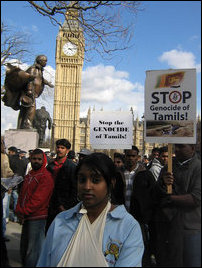
stop-genocide-of-tamils1The protests by Tamil demonstrators at Parliament Square this week have had the effect of at last drawing the media’s attention to the appalling plight of Tamil civilians caught behind the lines in the war in Sri Lanka.

By contrast, in January a massive 100,000-strong march in London by the Tamil community demanding a ceasefire attracted virtually no media coverage at all. It is depressing to think that the killing of innocent people in Sri Lanka becomes newsworthy here in the UK only when it results in the disruption of traffic across Westminster Bridge.

Tens of thousands of civilians are now trapped by the fighting between the Sri Lankan army and the Liberation Tigers of Tamil Eelam, who launched an armed struggle for an independent Tamil homeland more than a quarter of a century ago.

According to the United Nations, over the last two months more than 2,800 civilians have been killed and 7,000 injured. The army continues to shell the small coastal area still held by the Tigers, apparently without regard for the fate of non-combatants.

Only yesterday it was reported that 22 people, including an 18-month-old child, were killed and 283 injured after shells landed near two health facilities, one of them a mother and baby clinic where 500 people were queuing for milk powder and food rations.

If the Sri Lankan government insists on continuing with its military campaign until the LTTE forces have been destroyed, the number of civilian casualties does not bear thinking about.

Perhaps Sri Lankan president Mahinda Rajapakse calculates that a crushing military victory over the Tigers will enhance the standing of his Sri Lanka Freedom Party among the Sinhalese majority population, thus ensuring a comfortable victory in the parliamentary elections due early next year.

If so, this is not only immoral but extraordinarily short-sighted. The military defeat of the Tigers, accomplished at the cost of so much bloodshed, will only pile up yet more bitterness among the Tamil population and inevitably produce further armed conflicts in the future.

Without an immediate ceasefire, followed by a political solution addressing the long history of oppression suffered by the Tamil minority that is the root cause of the war, Sri Lanka will remain locked in bloody conflict for generations to come.

I am pleased to see that David Miliband has called for a ceasefire and I fully support the proposal by Keith Vaz that the crisis should be debated as a matter of urgency by the United Nations Security Council.

The text of a letter I sent to the Sri Lankan High Commissioner on 18 March can be consulted here.

LONDON IN MULTIPLE IDENTITIES

I have commented on the issue of identities before on this blog, for example in connection with Sikh girl Sarika Watkins-Singh’s successful court case over her right to wear a Sikh bangle to school, which I related to Amartya Sen’s writings on multiple identities. So I thought I should go on record about my own experience of the issue, in a video shot on the Middle East street of London, Edgware Road, in my own neighbourhood. I hope it is of interest to you all.

Produced by Progressive British Muslims and Dog Eared Films

G20 LONDON SUMMIT: WORKING FOR THE YANKEE DOLLAR

greenback

In my last blog l suggested that the most important meeting to be held during the G20 London Summit would be the G2 meeting for the first time between US President Barack Obama and the Chinese President Hu Jintao, a point also made by the Economist.

Now, what do you think is uppermost in the minds of the Chinese? Well, it is not the regulation of global finance, particularly hedge funds, as it is for the French and the Germans. It is not a continued fiscal stimulus to the global economy, as it is for the United States and United Kingdom. Nor is it how the G20 can prevent a retreat into protectionism and promote free trade, in circumstances where many economic historians point out the parallels with the 1930s. Nor is it how the IMF will need more money to bail out countries going bust like Iceland, Hungary and Ukraine – since the Chinese have already agreed to help as long as the IMF is reformed and China has more say. Nor is it a clampdown on offshore tax havens, as governments desperately attempt to bring as much revenue as possible back onshore to boost state coffers. Nor is it environmental and development concerns, as the Chinese are starting to pursue a low carbon future and have already become a major source of funds to the developing world.

No, it’s China’s plan to end the dollar era. In China it appears to be a debate between the likes of Zhou Xiaochuan, governor of China’s central bank, who has put forward a credible proposal for a reserve currency to rival the greenback (Financial Times, 24 March), and the likes of Professor Yu Qiao of Tsinghua University discussing how Asia can protect itself from a dollar default (Financial Times, 1 April). The latter response is not surprising given that the Chinese are the largest holder of US dollar financial assets and they express the same anxiety as savers who fear a run on a bank. So it is understandable that China wants to replace its mountain of dollar assets with heaps of other currencies. It would be in China’s interest to have another safe reserve currency and take an active role in the reshaping the world monetary economy.

So while the focus during the next day or so will be on all the other issues mentioned above, in the long run the G20 London summit is going to be remembered as the beginning of a process, possibly taking up to 20-odd years, to replace the greenback and a world economy working for the Yankee dollar.

G20 LONDON SUMMIT: JOBS, JUSTICE AND CLIMATE, NOT NEO-LIBERALISM

g20

Boris Johnson demonstrated his neo-liberal credentials once again in his latest Daily Telegraph column by suggesting that the slogan for the G20 protestors (or “the G20 mob” as he prefers to call them) should be “What do we want? Free trade!” My response would be “Jobs, justice and climate” – the banner under which tomorrow’s G20 demonstration in London has been organised.

The dual challenge for the G20 Summit, the main thrust of which is a major fiscal stimulus and banking reform to counter the global recession, is to promote economic recovery without further damaging the environment and to limit the impact of the economic crisis on the developing world.

It is crucial that development assistance should be maintained, at a time when aid and Foreign Direct Investment have fallen and the populations of developing states increasingly rely on money transfers from migrants in the developed world.

Also, the developed world must keep to its commitments made at the 2007 Bali conference on climate change, in preparation for the negotiations over the post-Kyoto agreement in Copenhagen at the end of this year – that is, to trim our own lifestyles while allowing poorer countries to develop without strings and conditions, and assisting them with technology transfer and innovative finance.

As Nicholas Stern and his colleagues have recently pointed out (in An outline of the case for a ‘green’ stimulus), in the developed world the best way to boost employment during a recession while at the same time reducing carbon emissions is to invest in new green industries like renewable energy projects. We should put more money into energy efficiency rather than exporting our waste to the developing world.

Examples already exist. In the USA, Obama’s economic package proposes to put billions of dollars into green jobs. A third of China’s recovery programme is in creating green jobs. And Germany is directing 19 per cent of its recovery expenditure into new green industries.

London needs to show that we can do this as well. With just over 50 per cent of humanity now living in cities, which are responsible for 75 per cent of CO2 emissions, we could make a real difference. The commitment of our current Mayor to the ideology of neo-liberalism is of course a major obstacle here.

That said, the main show at the G20 will be Obama’s first meeting with the Chinese premier. At the end of the day, it’s the G2 who will determine what really happens to the world economy.

Mayor’s attitude to the environment – slash and burn, then slash some more

Londonwide Assembly Member Murad Qureshi, has slammed the Mayor’s decision to all but halve his Environment team at City Hall – thus undermining the Authority’s strategic role in combating climate change.   

Murad said:  "Today’s announcement shows the level of contempt with which the Mayor treats environmental issues.  He had his henchmen freeze recruitment last May, but now they’re making those cuts permanent – and deeper.  The Mayor has a legal duty to co-ordinate Londonwide measures to improve life for Londoners – that’s what he was elected to do, but he seems to think he can do it on the cheap by getting rid of his experts and farming out the difficult bits to consultants.

“He’s due to produce no fewer than five environment strategies this year, but with half the staff gone and the other half demoralised I have serious doubts that he’ll be able to fulfil that requirement.  Ken spent years getting the best people around him – City Hall was highly regarded by national government and internationally, but Boris is chasing his best people away.

“This is on top of the £12.9 million under-spend on LDA carbon reduction budgets that he’s decided to un-prioritise.”

Murad added: “Climate change is a huge ticking time-bomb – it’s the biggest problem facing the human race and London should be taking a lead in finding ways to deal with this, but Boris knows full well he’ll have moved on before the tsunami hits London and he is showing his true blue environmental colours – by leaving a bigger mess for someone else to clean up.”

Cricket boost to London tourism

Murad Qureshi, London’s Assembly Member argues that London has the venues and the capacity to support this key celebration in the world of cricket.

"While it is sad that it has been decided the games have to be moved this is a splendid opportunity for London to show that it is a great sports location, a great host and a centre for passionate cricket supporters.

"This would also play a significant part in relieving some of the economic pressures on London’s tourist industry, fill up hotel places, increase restaurant bookings and swell visits to other exciting destinations.

"This would be a substantial boost for London and a fabulous opportunity for our communities to welcome cricket enthusiasts and to celebrate the game."

INDIAN PREMIER LEAGUE COMING TO LONDON?

ipl

Because of security concerns following the terror attack against the Sir Lankan cricket team in Lahore last month, one of the most lucrative sports franchises, the Indian Premier League (IPL) for Twenty20 cricket, is having to go abroad for this year’s competition. And the choice is a straight one between England or South Africa.

I am pretty certain that, for most of the viewing public in the Indian sub-continent, there can only be one place to host the event – and that is England, the home of cricket. Many of them will have grown up dreaming of playing or even just watching a game at Lords or the Oval. So, if this new form of league cricket taken from the street game has to go anywhere, it should be here in the United Kingdom.

In addition, we already have the facilities, organisational manpower and a passionate fan base that will generate a huge amount of interest here too.

With 59 matches scheduled between 10 April and 24 May, hosting the IPL would also greatly help the economy in London in the present downturn, by bringing in cricket fans to take up empty hotel rooms, increasing restaurant bookings and boosting visits to other tourist destinations. It would also enhance London’s status as a great sports location for future events. So hopefully a package can be offered to the IPL to make them feel happy to come over to England.

THE AGE OF STUPID: A FILM FOR OUR TIME

age-of-stupid

Last night l attended a showing of The Age of Stupid at the Tricycle Theatre, Kilburn. The film comes out at an important time – before the G20 Summit in London next month and the Copenhagen meeting of the post-Kyoto negotiations of the UN on climate change in December. It’s certainly worth seeing.

The Age of Stupid is very much in keeping with the times, with its lack of faith in markets and capitalism in its present form. It links its climate change analysis with political events in the Middle East. And it has some useful graphics of how London would look if it was flooded by the Thames (see below).

Because of its subject matter and its documentary format, there is an obvious comparison with An Inconvenient Truth. But The Age of Stupid is a much better film, as it gives far more emphasis to the role of people power rather than key individuals like Al Gore in changing the world.

We shouldn’t forget that for all his green talk, Gore failed to get the US to ratify the Kyoto agreement while getting the rest of the world to accept some tough medicine like tradable permits. So much for ecotoffs! This illustrates well that the campaign over climate change is not that dissimilar to the fight for universal suffrage or against apartheid. To be successful it requires a struggle organised at grassroots level.

london-flooded

Unhealthy private airport monopoly ended around London

Londonwide Assembly Member and London Assembly representative on the Heathrow Airport Consultative Committee (HACC) Murad Qureshi, has welcomed today’s announcement from the Competition Commission compelling BAA to sell off both Gatwick and Stansted airports to different purchasers, as well as either Edinburgh or Glasgow, thus breaking up an unhealthy private monopoly.

Murad said:  "Today’s announcement ending BAA’s monopoly on airports in and around London is long overdue.  BAA have been focussing their efforts on growing Heathrow for far too long – with disastrous consequences – but this will open up some healthy competition between airports and I believe we’ll see better service at London airports in the future as a result.

"BAA’s monopoly has till now effectively stifled any competition between the airports in the South East, and this has not been in the best interests of passengers or of Heathrow’s neighbours.

"Forcing BAA to sell off both Gatwick and Stansted airports will inevitably lead to passengers getting a better service at all our airports and to the people of west London getting a more responsive neighbour and I think this is good news for everyone.  Let’s hope whoever takes over Gatwick and Stansted give BAA a run for their money."