I buy the tunnel vision for West London but does the Mayor?

 gbu_wlr_flyover_2.jpg

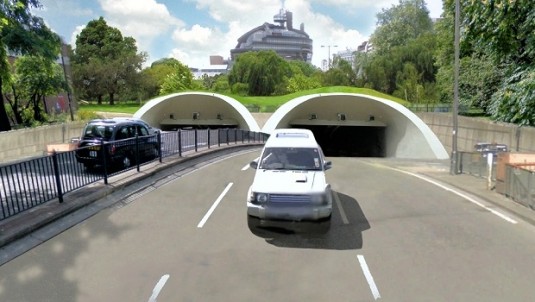
Last week l was at Hammersmith Town Hall for an exhibition of the proposed tunnel to replace the Hammersmith flyover. This brochure illustrates well the tunnel vision derived from a collection of architectural practises in Hammersmith with contributions from the Halcrow Group & the local Business Improvement District (BID). 

Interestingly the tunnelling will begin from the West in Chiswick, Hounslow (after the Hogarth roundabout). So Hounslow Council clearly need to take a view on the matter.  I’m pretty sure the residents of Chiswick will have their own views as well.  It will end East of the Hammersmith flyover in Earls Court, which falls in the Royal Borough of Kensington & Chelsea, so clearly residents and the council there will also need to have a say.  A major bonus is that it would open up the Thames again to residents of both Hammersmith & Chiswick, though this will need to be reflected in some way in any feasibility study undertaken as well as unlocking a substantial amount of land above the tunnel itself.

Once feasibility is actually undertaken by Hammersmith & Fulham council, l would like to see a session of the Transport Committee at the London Assembly examine the “Tunnel Vision for West London.”   The plans will have implications for not just the replacement of the Hammersmith flyover but also the Westway in Paddington & North Kensington as well as the elevated M4 in Brentford.  This will be the case even more if the effect of Cross rail, once operational, is to take off the road, traffic along the A4 & M4 particularly from Heathrow.

Sadly in the history of building transport infrastructure in London, West London during the 1950 & 60’s got lumbered with a number of flyovers and elevated highways dividing communities geographically, such as the ones in Paddington & Brentford built when other parts of London were saved from this fate! You can blame the cross party consensus in the GLC for this.

But, finally, what’s most relevant is what the Mayor thinks of all of this? I have asked him before and had this  response.  I thought it was rather a cold and bureaucratic reply.  Methinks it is time to ask him again and try and get him to feel more enthusiastic about it all.

Support our Crown Post Offices in London

Petition against closure of Post Office in Lupus Street

Petition against closure of Post Office in Lupus Street

Yesterday morning l started the day by joining campaigners trying to stop the closure of a Crown Post Office in Pimlico on Lupus Street. We got an amazing response to the petition from users of the post office itself and people passing by along Lupus St.

London is being hit disproportionately by the government’s decision to cut 20 per cent of the Crown Post Office network, as six of the seven Crown Post Offices identified for outright closure are located in London including Lupus St, Holloway Rd, Sutton High St, Kennington Park Road, Stockwell and Broadgate.

Despite only representing 3 per cent of the Postal Network, Crown Post Offices employ 5,000 people and are responsible for 20 per cent of all Post Office business. In London, not only do local residents like pensioners rely on them but these Post Offices also process 40 per cent of financial services mail and are therefore a crucial component of London’s economy.  

Not surprisingly we are having a public meeting in Pimlico about the closure of the Crown Post Office on Lupus street on the 29th of May @6.30pm in Churchill Gardens Community Hall chaired by Sue Walsh, Chair of the Churchill Gardens Estates Residents Association.   So, please, do come along and let us together, try and stop the proposed closure of the much loved and much used local Crown Post Office.

Fire brigade statistics blow hole in Mayor’s case for fire cuts

The information was quietly released onto the London Fire Brigade’s website late yesterday (Tuesday). So far 11 boroughs have had their formal consultation meetings with the Fire Brigade, despite the fact they were not provided with these detailed figures which for the first time reveal the full impact of the Mayor’s cuts.

The details show that residents in an additional 41 wards in London will fall outside of the target response time of six minutes for the first fire engine. This is on top of the 267 already falling outside the target.

Londonwide Labour Assembly Member Murad Qureshi AM said:

“These figures clearly show that the Mayor has been misleading Londoners, his cuts will mean that people across our city will have to wait significantly longer for a fire engine to arrive in the event of an emergency. In Warwick the increase is from 4.34 to 7.16 minutes, Vincent Square will increase from 3.54 to 6.14 minutes and Tachbrook increases from 4.29 minutes to 6.33. These increases are all more than 2 minutes.  This might not sound a lot but a fire can quadruple in intensity every two minutes. These increases are truly scandalous; no wonder they didn’t release this information sooner. This completely blows a hole in the Mayor’s plans for fire cuts; he must abandon them now and adopt our fully costed plan to keep them all open.

“This shows how flawed the Mayor’s Draft Fire Plan is, the borough response times in the plan hide these local increases, which are disgraceful. The Mayor’s plans to cut 12 fire stations, 18 fire engines and 520 firefighters are unacceptable. We presented him with a fully costed plan to keep them all, instead he has chosen to cut council tax by one penny a day. While a small amount to individual Londoners, across our city this adds up and will lead to a huge cut in our valued fire service. It is more urgent than ever that Londoners respond to the Mayor’s consultation and tell him what they think. Boris must take Londoners for complete fools if he thinks he can get away with this.”

The full list of increases across London is set out below:

Bromley: Plaistow & Sunridge (5.33 ““ 6.06) 33seconds increase

Camden: Belsize (4.37 ““ 7.59) 3.22mins increase; Camden Town with Primrose Hill (5.23 ““ 6.27) 1.04mins increase; Gospel Oak (5.27 ““ 6.11) 44 seconds increase; Hampstead Town (5.07 ““ 6.46) 1.39mins increase; Haverstock (5.15-6.16) 1.01 mins increase; Swiss Cottage (5.19-6.45) 1.26mins increase

City of London: Aldersgate (5.22-6.03) 41secs increase; Castle Baynard (5.35-6.17) 42secs increase; Cheap (5.56-6.15) 19secs increase; Farringdon without (5.10 ““ 6.08) 58secs increase

Greenwich: Woolwich Common (5.32 ““ 6.36) 1.04mins increase; Woolwich Riverside (4.57 ““ 7.26) 2.29mins increase

Hackney: Dalston (5.18 ““ 6.59) 1.41mins increase; De Beauvoir (4.24 ““ 7.37) 3.13mins increase; New River (5.56 ““ 6.01) 5secs increase; Queensbridge (5.00 ““ 6.43) 1.43mins increase

Islington:  Clerkenwell (4.19 ““ 6.26) 2.07mins increase; Mildmay (5.44-6.41) 57secs increase

Kensington & Chelsea: Brompton (4.37 ““ 6.27) 1.50mins increase

Lambeth: Clapham Common (4.50-7.47) 2.57mins increase; Clapham Town (3.56-7.53) 3.57mins increase

Lewisham: Catford South (5.29-6.13) 44secs increase; Downham (5.54-7.38) 1.44mins increase; Grove Park (5.10-6.27) 1.17mins increase; Telegraph Hill (5.15-7.24) 2.09mins increase; Whitefoot (5.08-7.57) 2.49mins increase

Newham: Canning Town North (5.58-6.11) 13secs increase; Canning Town South (5.29-6.11) 42secs increase; Royal Docks (5.27-8.39) 3.12mins increase

Tower Hamlets: Bow East (4.09-7.20) 3.11mins increase; Bow West (4.41-6.39) 1.58mins increase; Bromley-by-Bow (5.45-6.10) 25secs increase; Mile End East (5.26-6.18) 52secs increase

Wandsworth: Queenstown (5.25-6.45) 1.20mins increase

Westminster: Abbey Road (5.58 ““ 6.36) 38secs increase; Churchill (5.27-6.51) 1.24mins increase; Tachbrook (4.29-6.33) 2.04mins increase; Vincent Square (3.54-6.14) 2.20mins increase; Warwick (4.34-7.16) 2.42mins increase; West End (5.44-6.16) 32secs increase

Ends

Notes

1.    Murad Qureshi AM is a Londonwide Labour London Assembly Member

2.    A ward breakdown can be found here: http://www.london-fire.gov.uk/Documents/ward-impacts.pdf

Fire brigade statistics blow hole in Mayor’s case for fire cuts

The information was quietly released onto the London Fire Brigade’s website late yesterday (Tuesday). So far 11 boroughs have had their formal consultation meetings with the Fire Brigade, despite the fact they were not provided with these detailed figures which for the first time reveal the full impact of the Mayor’s cuts.

The details show that residents in an additional 41 wards in London will fall outside of the target response time of six minutes for the first fire engine. This is on top of the 267 already falling outside the target.

Londonwide Labour Assembly Member Murad Qureshi AM said:

“These figures clearly show that the Mayor has been misleading Londoners, his cuts will mean that people across our city will have to wait significantly longer for a fire engine to arrive in the event of an emergency. In Warwick the increase is from 4.34 to 7.16 minutes, Vincent Square will increase from 3.54 to 6.14 minutes and Tachbrook increases from 4.29 minutes to 6.33. These increases are all more than 2 minutes.  This might not sound a lot but a fire can quadruple in intensity every two minutes. These increases are truly scandalous; no wonder they didn’t release this information sooner. This completely blows a hole in the Mayor’s plans for fire cuts; he must abandon them now and adopt our fully costed plan to keep them all open.

“This shows how flawed the Mayor’s Draft Fire Plan is, the borough response times in the plan hide these local increases, which are disgraceful. The Mayor’s plans to cut 12 fire stations, 18 fire engines and 520 firefighters are unacceptable. We presented him with a fully costed plan to keep them all, instead he has chosen to cut council tax by one penny a day. While a small amount to individual Londoners, across our city this adds up and will lead to a huge cut in our valued fire service. It is more urgent than ever that Londoners respond to the Mayor’s consultation and tell him what they think. Boris must take Londoners for complete fools if he thinks he can get away with this.”

The full list of increases across London is set out below:

Bromley: Plaistow & Sunridge (5.33 ““ 6.06) 33seconds increase

Camden: Belsize (4.37 ““ 7.59) 3.22mins increase; Camden Town with Primrose Hill (5.23 ““ 6.27) 1.04mins increase; Gospel Oak (5.27 ““ 6.11) 44 seconds increase; Hampstead Town (5.07 ““ 6.46) 1.39mins increase; Haverstock (5.15-6.16) 1.01 mins increase; Swiss Cottage (5.19-6.45) 1.26mins increase

City of London: Aldersgate (5.22-6.03) 41secs increase; Castle Baynard (5.35-6.17) 42secs increase; Cheap (5.56-6.15) 19secs increase; Farringdon without (5.10 ““ 6.08) 58secs increase

Greenwich: Woolwich Common (5.32 ““ 6.36) 1.04mins increase; Woolwich Riverside (4.57 ““ 7.26) 2.29mins increase

Hackney: Dalston (5.18 ““ 6.59) 1.41mins increase; De Beauvoir (4.24 ““ 7.37) 3.13mins increase; New River (5.56 ““ 6.01) 5secs increase; Queensbridge (5.00 ““ 6.43) 1.43mins increase

Islington:  Clerkenwell (4.19 ““ 6.26) 2.07mins increase; Mildmay (5.44-6.41) 57secs increase

Kensington & Chelsea: Brompton (4.37 ““ 6.27) 1.50mins increase

Lambeth: Clapham Common (4.50-7.47) 2.57mins increase; Clapham Town (3.56-7.53) 3.57mins increase

Lewisham: Catford South (5.29-6.13) 44secs increase; Downham (5.54-7.38) 1.44mins increase; Grove Park (5.10-6.27) 1.17mins increase; Telegraph Hill (5.15-7.24) 2.09mins increase; Whitefoot (5.08-7.57) 2.49mins increase

Newham: Canning Town North (5.58-6.11) 13secs increase; Canning Town South (5.29-6.11) 42secs increase; Royal Docks (5.27-8.39) 3.12mins increase

Tower Hamlets: Bow East (4.09-7.20) 3.11mins increase; Bow West (4.41-6.39) 1.58mins increase; Bromley-by-Bow (5.45-6.10) 25secs increase; Mile End East (5.26-6.18) 52secs increase

Wandsworth: Queenstown (5.25-6.45) 1.20mins increase

Westminster: Abbey Road (5.58 ““ 6.36) 38secs increase; Churchill (5.27-6.51) 1.24mins increase; Tachbrook (4.29-6.33) 2.04mins increase; Vincent Square (3.54-6.14) 2.20mins increase; Warwick (4.34-7.16) 2.42mins increase; West End (5.44-6.16) 32secs increase

Ends

Notes

1.    Murad Qureshi AM is a Londonwide Labour London Assembly Member

2.    A ward breakdown can be found here: http://www.london-fire.gov.uk/Documents/ward-impacts.pdf

Public meeting to discuss fire service cuts in London

The Draft Fifth London Safety Plan was launched at the beginning of March. Residents can also contribute to the consultation through the Fire Authority website, where more details are available: http://london-fire.gov.uk/lsp5.

Londonwide Labour London Assembly Member Murad Qureshi AM said:

“It is vital that residents take part in this consultation about the proposal to close 12 fire stations across London and make sure that their voice is heard.  I am disappointed that the consultation for Ealing and Hounslow has been lumped together.  Residents in Hounslow deserve a separate consultation of their own.  The meeting next week will be held in Ealing which won’t afford Hounslow residents the best opportunity to engage with the consultation”

“We are deeply concerned that the cuts will jeopardise the safety and security of Londoners, all for the dubious benefit of a penny a day off the Council Tax. But we want to hear from Londoners about their views during this consultation and what they think. I strongly urge residents, including those living in Hounslow to attend the meeting on the 13th of May at Ealing Town Hall and I look forward to seeing them there.”

Ends

Notes

1.    Murad Qureshi AM is a Londonwide Assembly Member.

2.    The consultation on the Draft Fifth London Safety Plan will begin on Monday 4 March 2013 and continue for 12 weeks, ending at 5pm on Tuesday 28 May 2013. Members of the public can have their say by visiting www.london-fire.gov.uk/lsp5, calling 0800 9888 569, by writing to the London Fire Brigade at 169 Union Street, London, SE1 0LL or by attending public meetings in London Boroughs, details of which will soon be available.

3.    The fire stations listed for closure are: Belsize in Camden; Bow in Tower Hamlets; Clapham in Lambeth; Clerkenwell in Islington; Downham in Lewisham; Kingsland in Hackney; Knightsbridge in Kensington & Chelsea; New Cross in Lewisham; Silvertown in Newham; Southwark; Westminster; and Woolwich in Greenwich.

4.    The following stations will lose one of their two fire engines: Chelsea, Chingford, Hayes, Leyton, Leytonstone, Peckham and Whitechapel.

·         Barnet, Enfield and Haringey, Thursday, 18 April 7-9pm at Haringey Council Chamber, Haringey Civic Centre, High Road, Wood Green, N22 8LE

·         Bexley, Bromley and Croydon, Thursday, 23 May 7-9pm at Bromley Central Library, High Street, Bromley BR1 1EX

·         Brent and Harrow, Tuesday, 16 April 7-9pm at Harrow Civic Centre, Station Road, Harrow HA1 2XY

·         Camden, Thursday, 30 May 7-9pm at McNamara Suite, London Irish Centre, 50-52 Camden Square, London NW1 9XB

·         City of London, Thursday, 9 May 7-9pm, The Main Hall at St Albans Centre, Leigh Place, Baldwins Gardens, Holborn, London EC1N 7AB

·         Ealing and Hounslow, Monday, 13 May 7-9pm at The Victoria Hall, Ealing Town Hall, New Broadway, Ealing W5 2BY

·         Greenwich, Wednesday 29 May 7-9pm at Lecture Theatre 315, King William Building, University of Greenwich, 30 Park Row, Greenwich, London SE10 9LS

·         Hackney, Monday, 20 May 7-9pm at Hackney Assembly Hall, Stoke Newington Town Hall, Stoke Newington Church Street N16 0JR

·         Hammersmith and Fulham, Thursday, 28 March, 7-9pm at Hammersmith Assembly Hall,  King Street, Hammersmith, W6 9JU

·         Havering and Redbridge, Monday, 3 June, 7-9pm at Lambourne Room, Redbridge Town Hall, 128-142 High Road, Ilford, Essex IG1 1DD

·         Hillingdon, Tuesday, 2 April, 7-9pm at Hillingdon Town Hall,  Middlesex Suite, Hillingdon Civic Centre, High Street, Uxbridge, Middlesex, UB8 1UW

·         Islington, Tuesday, 28 May, 7-9pm in the Assembly Hall at Islington Town Hall, Upper Street, N1 2UD 

·         Kensington and Chelsea, Monday, 10 June, 7-9pm in the Kensington Small Hall, Hornton Street, W8 7NX

·         Kingston-upon-Thames and Richmond-upon-Thames, Tuesday 4 June, 7-9pm at Clarendon Hall, York House, Richmond Road, Twickenham TW1 3AA

·         Lambeth, Thursday, 16 May 7-9pm at Lambeth Assembly Hall, Lambeth Town Hall, Brixton Hill, London SW2 1RW

·         Lewisham, Wednesday, 22 May 7-9pm at Sydenham School, Dartmouth Road, London SE26 4RD 

·         Merton and Sutton, Tuesday 21 May 7-9pm at the Council Chamber, Merton Civic Centre, London Road, Morden SM4 5DX

·         Newham, Wednesday, 8 May, 7-9pm at Newham Town Hall, East Ham, Barking Road, E6 2RP

·         Southwark, Tuesday, 14 May 7-9pm at Committee Room 4 and 5, Greater London Authority, City Hall, The Queen’s Walk, London SE1 2AA  

·         Tower Hamlets, Tuesday, 7 May 7-9pm at Skeel Lecture Theatre, People’s Palace Building, Queen Mary University, Mile End Road, London E1 4NS 

·         Waltham Forest, Monday,15 April 7-9pm at Walthamstow Assembly Hall, Forest Road, Walthamstow E17 4JD

·         Wandsworth, Thursday, 4 April 7-9pm at The Open Door Community Centre, Keevil Drive, Beaumont Road, London, SW19 6TF

·         Westminster, Tuesday, 11 June 7-9pm at the Paker Morris Hall, The Abbey Centre, 34 Great Smith St, London SW1P 3BU
Supreme Court tells govt its failing on air quality

SupremeCourt 2

Poor air quality in the UK has led to the Supreme Court ruling last Wednesday that the Government is failing to meet EU air quality targets. This ruling came as no surprise as areas such as Heathrow and Central London suffer from an increase in poor air quality, particularly with Nitrogen Dioxide.

Environmental campaign group, ClientEarth took the Government to court over its failure to comply with EU air pollution limits of Nitrogen Dioxide. Poor air quality in London causes more than 4,000 deaths prematurely every year, that is early deaths. The Supreme Court ruled the Government has breached its EU air pollution limit and that the European Commission should be able to take legal action against the UK.

The decision should be a wakeup call for the government and the Mayor. It is unacceptable that while 4,000 Londoners die prematurely each year because of air pollution, Boris Johnson’s response has been to kick serious action that would tackle the problem down the line for a future Mayor to deal with.

Around Heathrow, the two pollutants that are of particular concern are Nitrogen dioxide (NO2) and particulate matter with a diameter of ten microns or smaller (PM10 and PM2.5). NO2 is one of two main pollutants that make up oxides of nitrogen emissions (NOx) in London. The other is nitric oxide (NO). Of the two, NO2 is of most concern due to its impact on health. NO easily converts to NO2 in the air – so to reduce concentrations of NO2 it is essential to control emissions of NOx.

The latest reports on poor air quality around Heathrow can be seen in the London Heathrow Air Quality Group report and the London Assembly’s Environment Committee report on Heathrow Air & Noise Pollution.

Air pollution is the second biggest public health risk in the capital. That London will not meet legal limits on NO2 pollution until 2025 shows exactly how much of a priority the Mayor gave the issue during his first term.


Bangladesh factory building collapse – Remember the dead,fight for the living


savar2

As the rescue efforts in Savar, on the outstrits of Dhaka, Bangladesh has come to an end the figures on the collapse of the 8 storey building are stark – some 380 killed, 2044 rescued with over 1000 injured amongst them and still over another 1,000 unaccounted for at all. So the death toll will certainly go up as the rubble is removed from the site. Some estimates in the local press in Dhaka suggest it could be upwards of  a thousand killed by the end of the week.  

As the President of National Garment Workers Federation, Amriul Haque Amin has said concisely ” the death of these workers could have been avoided if multinational corporations, government and factory owners took workers protection seriously “

Multi-national corporations operationally globally with their relentless push on driving prices down undoubtedly played its part in all this but they could clearly take up workers protection by signing up on the Bangladesh Fire & Building Safety Agreement to prevent such future tragedies along with labour rights like a decent minimum wage.  Such standards would still secure their supplies without making a huge inraod on their profit margins.

The garment industry appears to be wrapped in a culture of impunity, as its treated as the sacred cow of Bangladesh’s economy. Not surprising as it employees 4 million workers most of whom are women and accounts for 80 per cent of the country’s export earnings. Its industrial body, the Bangladesh Garments Manufactures & Exporters Association (BGMEA) has shown callous indifference of such mass industrial slaughter, following so soon after a fire killed more then 100 workers in another garment town recently. Moreover a number of factory owners have gone into politics and are reputed to be some of the most generous financiers of political parties. You would think with such a high death toll and the criminial negligence that caused it would make it hard for the government to ignore it critically in election year. Both the major parties will be slugging it out soon, so will they respond to public outrage and finally bring negligent factory and building owners to book.  Or will it be just another garment factory tragedy and its business as usual.

Of course prevention is better then dealing with the aftermath of such horrific events but don’t think we here in the UK can be complacent about workers protection. In the previous week the House of Lords voted to change the law so that in future, even though an employer may have breached health & safety regulations specificially designed to protect workers, the injured worker can not rely on that breach as evidence of neglience in any claim for compensation.  So in future the worker will have to prove what the employer knew or ought to have known about like when we have a faulty machine, leaking roof or an obstructed corridor. Fundamentally the burden of prove on who caused an accident falls on the injured worker and their representatives rather then the employer.

So with Workers Memorial Day and  May Day as well just passed since the Dhaka collapse, let us not forget the dead and fight for the living.

Murad Qureshi Criticises Boris’ New Policing Model

In Boris’s new Local Policing Model, wards will have one dedicated PC and one PCSO, with a named sergeant. Currently, each SNT has three PCSOs, two PCs and one sergeant. Boris says he believes that it’s “bobbies before buildings” but as we can see, this obviously isn’t the case when it comes to protecting local SNTs.

The Mayor is cutting sergeants as well as PCSOs, both of which will have a detrimental effect on public confidence. The ethnic mix of PCSOs reflects London’s diversity. The loss of sergeants will see the Met having the lowest supervisory ratios in the country. 

This is a fundamental shift away from Neighbourhood Policing to Response Policing, the result of which will be less community engagement, a lack of local knowledge and severely overstretched staff.

The Metropolitan Police’s Safer Neighbourhood Teams work hard across the capital to build confidence in their communities and reduce crime by working with local residents. I fear this will go to waste and we are seeing the end of community policing, which has been the key to tackling anti-social behaviour, reducing crime levels and working with local communities to be effective in fighting crime.

Click here to view article

Can l have my funeral on the state as well?


Thatcher had her funeral on the state, why not the rest of us as well?

Thatcher had her funeral on the state, why not the rest of us as well?

Now that it’s been established that Margaret Thatcher funeral cost the state £3.6 million, can l request that my funeral is paid for by the state along with other UK citizens?

As a humble councillor at my surgery l regularly used to get elderly constituents visiting me who were anxious about their own funeral arrangements. That’s not surprising as it is one of two certainties in life we have! (The other being taxation of course) and with the burden of student loans, rising housing costs and lower job prospects which now beset out population, it’s no wonder there’ll be no money left at the end to pay for a funeral at the end of it all.   Seriously, l’ve seen it cause no end of grief, though some of the more practical amongst us make arrangements via the co-op, but this is not the case for the vast majority.  It’s clear that Maggie Thatcher had at least consulted two British PMs about her funeral arrangements and therefore had no need to involve her local councillor in such matters.

According to the Sun Life’s Direct’s Cost of Dying Report 2012, the average cost of a funeral  in the UK in 2012 stood at £3,284, a financial burden often borne by those nearest & dearest to the decreased at a time of grief.  That works out to about a thousandth of the cost of Margaret Thatcher’s. In reality many don’t make any arrangements and in these difficult times it might even have to be a whip round at the local pub or other local community hub in order to raise funds.  I say, all British Citizens should have our funeral paid for by the state as Maggie Thatcher did.  State funded funerals could be legacy which unifies all sides of the Maggie Thatcher camps and a tribute to her passing.

Ironically, her passing illustrates the importance and reliance we have on the state, even at the time of death.  Of course a more fitting tribute would have been for her funeral to have been run more as a private enterprise with say G4S providing the security instead of the Met police.  Just a thought.

MMR scepticism unhelpful during measles outbreak

untitled

The measles outbreak in Swansea has rightly received much media attention and has highlighted the risk of measles outbreaks in other parts of the UK.   Thankfully, the advice from Public Health England is there is no imminent risk of an outbreak in London.  In 2012, there were 137 confirmed cases of measles in London and these were predominantly contained to family groups by the work of the Health Protection Agency (now part of Public Health England) who investigate every case and vaccinate the people around the patient to stop it spreading further.  There are pockets of populations where vaccination rates are particularly low, and where small outbreaks can and do occur, Public Health England will continue to do the work that they have been doing for years – monitoring all cases, investigating and vaccinating to contain any outbreaks.

The announcement by The Department of Health (DOH) to run a national catch-up campaign is most welcome.  It plans to run over the course of the summer identifying those, particularly teenagers that are not vaccinated and encourage them to be vaccinated.

What hinders programmes like these are commentaries which still exist online and which serve to stoke the fire of debate surrounding the doubt about the safety of the vaccine, particularly, when precursored with the title “The Truth”.  In a classic Melanie Phillips article on the subject, dating back to 2003, but still on-line on the Daily Mail web site, she highlights a 2nd Wakefield study which focuses on the booster MMR jabs, the claim being that those given the booster jabs experienced deterioration in health.  Articles like this, which are likely to be repeated in the current climate, are dangerous, because inevitably, they’re designed to shock and sensationalise and by their nature do not mention all the facts.  For example, the 2003 article doesn’t mention that the Wakefield study focused on tests carried out on just 12 children.  Nor does it mention the size of the “new” study referred to.

My hope during this next phase of debate about the MMR is that the language of speculation and suggestion is curtailed.  What we need to know now are the facts, which are in approx 1 in every 15 cases, Measles can be severe and causes more complex problems needing hospitalisation, and can cause death.  In a very small number it can cause brain inflammation and lead to lasting brain damage. Worldwide it is one of the biggest killers of children.  We should not lose sight of this reality.