Author Archives: Murad

BNP-JAMAAT SMASHED IN BANGLADESH POLLS, AS ELECTORATE VOTES FOR SECULARISM

queues-at-polling-station

A source of major embarrassment for me since my election to the London Assembly in 2004 has been that the government in my ancestral home was a right-wing alliance between the Bangladesh Nationalist Party (BNP) and the Islamist political party Jamaat-e-Islami. So it was with much trepidation that l sent off over the Xmas break to assist the opposition in the general election there on the 29th of December. Little did l expect to see the landslide that resulted against this right-wing alliance, as Bangladeshis voted in their millions for the progressive secularism offered by the Awami League.

The election had been delayed by two years after the BNP-Jamaat alliance had attempted to rig the elections with a false electoral roll, providing an opening for the military to intervene and impose their caretaking government of technocrats. So there was great enthusiasm for a return to democratic rule. On the morning of the 29th of December, even before the polling stations opened at 8.00 am, people were queuing up to cast their vote. By the end of the day over 80 per cent of the Bangladeshi electorate had voted in what turned out to be one of the most peaceful elections in the country’s history, when people had feared much worse.

The BNP-Jamaat alliance tried to garner votes with their campaign to “save Islam“ but the electorate overwhelmingly rejected the claim that Islam was under threat. They turned instead to the Awami League, who promised to counter militancy and religious extremism and establish a liberal democratic society. This was particularly evident among the first-time voters who made up 30 per cent of the electorate. They were a key element in the political tidal wave that swept away the BNP-Jamaat bloc, with the Awami League and its allies winning 263 of the 299 seats in the Jatiya Sangsad, the Bangladesh parliament.

I spent polling day in Sylhet, the area of the country that most Bangladeshis in the UK come from. The district has 19 seats and the crucial battle was in Sylhet I with a contest between two former finance ministers, Saifur Rahman of the BNP and Abdul Muhith of the Awami League. On the morning of election day the Awami League were confident that they would win 12 seats, but when the results were announced in the evening they had taken all of 17. The real bonus was the election of Shafiqur Chowdhury of the Awami League, an NRB (non-resident Bangladeshi) from London, in the Sylhet II constituency, where he defeated a BNP “tough guy” by a majority of over 3,000. The Sylhet results proved to be no isolated victory, as at the same time news came through that we had won all 20 seats in the capital, Dhaka.

The voters had also overwhelmingly rejected alleged war criminals like Nizami and Saeedi, who contested the election on the BNP-Jamaat ticket. This was the result of successful campaigns in the vibrant civil society of Dhaka. These defeats brought the loudest cheer of the evening when the results were announced in the Hafiz Centre, Sylhet Town. Some will say that the trial of these war criminals is the first step to the recovery of a wounded nation and expectations are high that the government will finally deal with this albatross around the neck of the nation, once and for all.

The Bangladeshi electorate has left no one in any doubt what their choice is here, giving a near fatal blow to the Islamist political parties. Plainly put, this is an overwhelming mandate against religious fundamentalism in Bangladesh. The “Talibanisation” of the country, which some commentators aboard had identified as a threat in the past few years, is hardly a realistic prospect now, if it ever was. This is not to deny that the political assassinations that were attempted, such as the August 2004 grenade attack on a rally addressed by Awami League leader Sheikh Hasina, were dark chapters in the life of the previous government, but it would take a lot more than that to Talibanise the Bangladeshi democratic spirit.

The shift towards secularism will clearly have some impact on politics within the Bangladeshi community in the UK, which have for some years taken a predominantly conservative-religious form. This is now badly out of kilter with politics “back home”, which are represented by those of us from a secular-progressive background. Policy wonks in government at local, regional and central level should take note of this development urgently and not be taken for a ride by those supposedly representing the community.

Overall, the Bangladesh general election was a resounding endorsement of democracy and an emphatic victory for pluralism in the world’s second largest Muslim-majority country. Thus, for some, the vote was as historic as the vote in December 1970, which led to the liberation of Bangladesh from Pakistan. That was the election l watched as a small kid when my parents attempted to settle back in our ancestral home. So politics in Bangladesh have now come the full circle, back to where we should be, with the political optimism that greeted the formation of a new state nearly four decades ago now reborn in the 21st century.
cheering-election-results
Awami League supporters cheer election results

IMPROVING AIR QUALITY IN ASIA’S CITIES

murad-in-bangkok

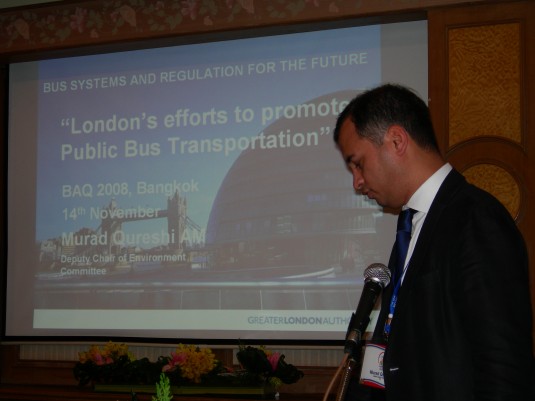
Last month the Better Air Quality in Asia (BAQ) biennial conference was held in Bangkok. It highlighted one of the most pressing issues for the mega cities of Asia – the need to improve air quality while urbanisation increases apace and along with it energy consumption and vehicle growth. Air quality in Asia is certainly improving but is still far above World Health Organisation limits. Particulate matter (dust) is the main pollutant of concern while ozone is increasingly becoming a problem.

While the BAQ conference was taking place, one particular Asian capital faced some very severe air pollution problems – Delhi with its winter “fog”, which came early this year. One of the first things that strikes visitors to India is the low-lying soup that hangs over its capital, as the early morning moisture mingles with fumes and dust to form a cloud that lasts all day. As a result, Delhi has been ranked as one of the worst polluted cities by the World Bank.

This fog often delays flights at the Indira Gandhi International Airport because of the poor visibility, which at the peak of winter falls to just 50 metres. Hospitals are also recording an increase in patients with respiratory problems, with doctors prescribing oxygen nebulisers for young children suffering “bad air” asthma attacks. We even find professional Delhites leaving the city to spare their children from pollution-related illnesses.

India’s fast expanding economy and growing prosperity have led to an increase in the number of cars that clog Delhi’s roads. Delhi is now estimated to have 5.5 million cars, an increase of over 57% in eight years. This steep rise in car use has rolled back the gains achieved by introducing compressed natural gas (CNG) vehicles, particularly among buses and motorised rickshaws. The problem also faces cities like Kolkata and Dhaka, where similar gains from CNG have been made, only to be negated by the huge growth in car ownership.

The Central Pollution Control Board of Delhi has suggested two explanations for what it calls “the smoke phenomenon”. While it maintains that levels of sulphur dioxide and carbon monoxide have fallen considerably over the past eight years (though the latter is still above the prescribed level), it argues that adverse meteorological conditions mean pollution is not dispersed and collects at lower levels. Secondly it suggests that a rise in  particulate matter has been registered, put down largely to construction work for the Commonwealth Games and Delhi Metro.

We in London have faced similar problems. It is over half a century since the Clean Air Act of 1956 cleared London skies of smog. Faced with major air pollution – and in particular, the Great Smog of 1952, which killed some 4,000 people in London – the government of the day applied mandatory Smokeless Zones to British cities. Within just three years, the use of coal disappeared from our larger cities and Londoners breathed more easily. So effective legislation can make a big difference.

Asian cities have two central challenges to be considered. First, how can cities realise their economic and social development goals while at the same time minimising the use of fossil fuels, directly associated with air pollution? And if fossil fuels are used in the future, how can their combustion be carried out in the most clean and efficient manner? Moreover, we need the right mix of technology and demand management in reducing air pollution.

Advances have been made in technologies like fuel economy, energy efficiency and the use of cleaner (low sulphur) fuels in the last 20 years, which allow for considerable reductions in air pollution levels. But there is a danger that reductions achieved through these cleaner technologies will be offset by the rapid growth in the number of emission sources, as we have already noted is the case in some south Asian cities. Cleaner technologies will need to be combined with non-technological, demandmanagement approaches of which the most obvious is investment in public transport.

Murad Qureshi AM
Deputy Chair of Environment Committee
London Assembly
London

Published in the Economic & Political Weekly, India’s premier journal for comment on social affairs and research in social sciences (pdf here) and in China Daily.

BORIS ‘KILLJOY’ JOHNSON?

One of the first things Boris Johnson did in May, as the new mayor of London, was to ban the drinking of alcohol on public transport, particularly on the Underground. Previously this had not been an issue much raised by Londoners in my experience, but the ban – and along with it the authority of the mayor – may well come up against its biggest challenge on New Year’s Eve when free travel will be offered on the tubes and buses of London for all the revellers.

It’s a time of year which attracts and encourages a lot of drinking including in public and often on our transport system. So how is Boris going to enforce his ban? Extra police cells could be appropriate, as I suggested in jest at the last Mayor’s Question Time on the 17th of December. Maybe we have time enough for an one-evening amnesty to be put in place. Now this could be a real test of Boris’s mettle and his libertarian credentials, both at the same time!

Mayor Boris Johnson cuts half a million from environment budget

The Labour group on the London Assembly today expressed horror as the Mayor slashed almost half a million pounds from his environmental budget. The cuts come on the same day Boris tried to shake-off his negative environmental image in a speech to the Environment Agency.

Labour’s environment spokesman, Murad Qureshi, said: "On the very same day Boris tries to re-invent himself as pro-green and pro-environment, the reality at City Hall is true blue. He has decimated the environmental department and slashed their budget. Boris’ anti-climate change views are well known, he is a Johnny come lately to environmental matters. It wasn’t so long ago he was siding with George W Bush on Kyoto and likening belief in climate change to a stone-age religion. His actions in office suggest he hasn’t changed his mind – whatever he says to the Environment Agency today.

"It appears Boris can only see projects in terms of the cost on a balance sheet. He can see the cost of everything, but the value of nothing. How does he expect us to believe he has any real vision for London when he can only see as far as the next budget cut and until he wanted to get elected in London was a borderline climate change denier. Londoners will see through his cynical Damascene conversion."

BORIS MUST STAND UP TO FREELOADING DIPLOMATS!

murad-and-cczIt remains a continuing scandal that, nearly six years after it was first introduced, many embassies in London are still refusing to pay the Congestion Charge. Their justification for this stance – that the Vienna Convention on diplomatic relations frees them from the obligation to pay taxes – is an entirely spurious argument, since the CC clearly qualifies as a user charge rather than a tax. Refusing to pay it is no different from refusing to pay the charge for driving across a toll bridge, for example, and no embassy anywhere is claiming they are exempt from that.

The precise cost of this Congestion Charge evasion to Londoners was unclear, so I tabled a question at Mayor’s Question Time in November asking for a breakdown of the amounts owed by the various London embassies. The report (Word document here) supplied by Transport for London contains some shocking statistics.

Top of the non-payment league is the US embassy. Its diplomats have driven through the Congestion Charge Zone 26,165 times without paying. The embassy owes £209,320 in unpaid charges and a staggering £2,735,245 in unpaid fines.

The total figures for money owed by payment-dodging embassies are even more eye-watering. Altogether, diplomatic staff have made 220,540 journeys through the CCZ without paying, resulting in £1,764,320 in unpaid charges and £23,120,389 in unpaid fines.

This situation is totally unacceptable. It is not for embassies to pick and choose which rules they obey and which they don’t. While we are belt-tightening during these difficult economic times, Londoners are having to carry these skinflint diplomats on their backs.

The Mayor needs to stand up to these freeloaders, and insist that they begin paying the Congestion Charge and clear their outstanding debts. It’s not on to have such large sums of money being lost to TfL, particularly at a time when fares are being increased above inflation by the Mayor and transport projects cut.

(See also reports in the Guardian and the Times.)

Assembly calls for Twenty20 cricket at 2012 Olympics

The London Assembly has called for Twenty20 cricket to be included as a showcase sport at the 2012 Olympic Games.

The text of the motion, which was proposed by Murad Qureshi and seconded by Navin Shah, is as follows:

“The London Assembly urges the London Organising Committee of the Olympic Games and Paralympic Games to work with International Cricket Council and International Olympic Committee to include Twenty20 cricket as a showcase sport at the 2012 Olympics.”

See London Assembly press release, 19 November 2008

WHAT’S IN A NAME? PLENTY

obama-headlinesLast night’s landslide victory for President Barack Hussein Obama was not only a victory for people of colour but also for people with foreign-sounding names.

Obama had faced ugly innuendos from some Republican campaigners who used his middle name to associate him with Islam – as if that automatically disqualified him from the presidency. It was indeed this very whispering campaign by senior Republicans – “Well, you know that Obama is a Muslim” – which led Colin Powell to intervene during the election. While some answered factually by stating that Obama is actually a Christian, for Colin Powell the response should have been – what if he is a Muslim? And thank god for such principled interventions.

We should applaud the American people for seeing through all that, and coming out in their millions to vote for Obama and for change in the USA. It has restored my faith in the human race and, although I’m not generally an admirer of the Sun, today’s front-page headline – “one giant leap for mankind” – summed it up exactly. Maybe it’s time for me to go back to NYC for the first time since the 11th of September 2001.

LONDON’S REAL MARKETS

murad-and-rosie-boycottWhile all the focus in recent times has been on financial markets and bailing them out, at City Hall on the 23rd of October I chaired a meeting of the London Markets Symposium, looking at the future for London’s street and wholesale markets. We had over 200 attendees and the newly appointed Chair of London Food, Rosie Boycott, on the platform, stimulating a very thorough discussion of the issues.

Rosie Boycott kicked off the morning with the keynote speech, giving us plenty of “food for thought” at the start of her reign as the Chair of London Food. The next speaker, Krys Zasada, gave us the national market perspective, suggesting there was a lack of leadership and not enough market champions. Mike McGill illustrated how Islington was regenerating its streets through its markets. Mike Brook from Wandsworth then gave us some market fundamentals and even some historical references to Adam Smith. And finally we had a stallholder’s perspective from Gary Marshall of the Covent Garden Tenants Association, bringing us back down to earth in our discussions by embracing markets with a direct “touching, smelling and bartering” relationship with their customers.

All this prompted many questions from the floor, ranging from security concerns and the issue of deregulation of street markets to whether we could have a London-wide street license permit system for stallholders.   

It all highlighted the vital role our markets play in the provision of London’s food, with an ever increasing and more diverse population. Indeed these markets have a significant role in relation to health, the environment and sustainability issues and are an economically and socially important part of London’s culture.

While the financial markets are understandably the centre of attention, we should not neglect our actual street markets which are often the hub of our urban communities. The re-launching of the Association of London Markets (AOLM) at the meeting will hopefully go some way to raise the profile of this often neglected but genuine retail choice. With our supermarket chains engaged in price wars over the credit crunch, wholesale and street markets may well come into their own during this uncertain time.

DON’T BE FOOLED – BNP IS STILL RACIST AND FASCIST

people-like-you-voting-bnpHaving leafleted against the British National Party with Unite Against Fascism during the recent by-election campaign in Hampstead Town, I was pleased to see that the BNP candidate received a derisory 29 votes, a mere 1% of the poll. You might have thought that after this humiliation the BNP would have got the message that they are not welcome in north London, yet they are contesting the Kentish Town by-election on October 30 in another attempt to gain a foothold there.

Since the election of Richard Barnbrook last May we have had direct experience of the BNP on the London Assembly. It would be easy to dismiss Barnbrook as a joke figure, and his rambling, incoherent contributions at Mayor’s Question Time have certainly reduced him to an object of ridicule. However, London Assembly members have also witnessed the poisonous, divisive politics of the BNP at first hand.

In a recent intervention, for example, Barnbrook called for the abolition of the Notting Hill Carnival, one of the most popular annual events in London, which attracted an estimated 2.5 million people this year from across our city’s diverse communities. But what else can you expect from a party whose constitution states that it is “wholly opposed to any form of racial integration between British and non-European peoples”?

In recent years the BNP has tried to hide its fascist politics from voters and fool them into thinking it is now a more moderate, mainstream party. The skinhead bootboys have been kept out of public view, to be replaced by “respectable” figures in suits. However, the adoption of a more voter-friendly image hasn’t changed the BNP’s fundamental character. In terms of its leadership, core membership, political ideology and ultimate objectives, the BNP remains the racist, fascist organisation it has always been.

One of the leaflets the BNP has been distributing in north London illustrates this point. It features a photograph of a wholesome-looking white family accompanied by the slogan “People like you voting BNP”. The smiling couple in the picture are unlikely to be voting in the Kentish Town by-election as they live in Kirklees, West Yorkshire. But if they were on the electoral register in London NW5 they would undoubtedly give their support to the BNP, because they are two of the party’s longstanding activists – Nick and Suzy Cass.

Both of the Casses appeared earlier this year in the television documentary BNP Wives. In one revealing scene Suzy Cass argued that in order to restore racial purity white people should have more children, while a “birth limit” should be imposed on non-white families. How the latter policy was to be implemented – forcible sterilisation? infanticide? – she didn’t say.

In another scene Nick Cass proudly revealed a “tree of life” tattoo prominently displayed on his right arm. The anti-fascist magazine Searchlight commented:

“This symbol, also known as the life rune, is a favourite among nazi groups worldwide, several of which have adopted it as their logo. Under Hitler it was the symbol of the SS Lebensborn project, which encouraged SS troopers to have children out of wedlock with ‘Aryan’ mothers and kidnapped children of Aryan appearance from the countries of occupied Europe to raise as Germans. To white supremacists today the tree of life signifies the future of the ‘white race’. “

Nothing could better demonstrate the BNP’s cynical political methods than this fraudulent attempt to pass off two of its own hardline members as a normal family who just happen to vote BNP.

Resistance to the BNP transcends party politics. Supporters of the Labour Party, the Liberal Democrats, the Conservative Party and the Greens, whatever our other political differences, are at one in rejecting the racist ideology of the far right. It is crucial that this anti-fascist majority turns out to vote in Kentish Town on October 30, in order to ensure that the BNP once again receives a percentage of the vote that accurately represents their minuscule support in Camden.

The infliction of another humiliating defeat on the BNP will hopefully discourage them from making any further attempts to import their vile politics into the borough.