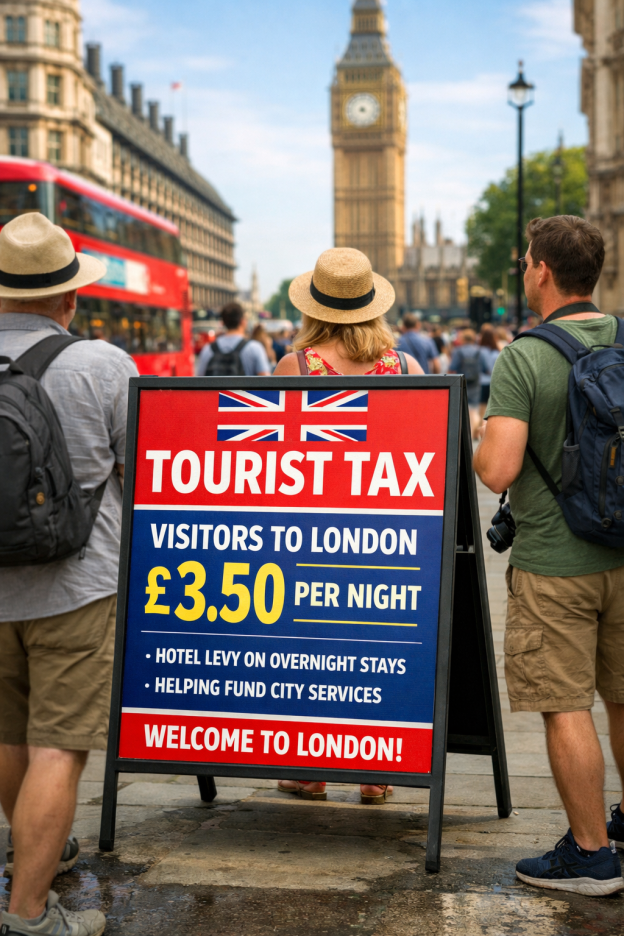
The debate over who should receive the largest share of a London tourist tax—formally known as an overnight visitor levy— will be one of the most contentious issues in the capital’s 2026 political landscape.
With current estimates suggesting a 3–5% levy could raise between £240 million and £350 million per year, there are three primary groups making a play for the “lion’s share.”
1. The Local Boroughs: “The Mitigation Argument”
Central London boroughs—particularly Westminster, Camden, and Kensington & Chelsea—argue they should keep at least 50% to 100% of the revenue generated within their borders. The Logic begin that these councils bear the direct “wear and tear” of tourism. They pay for street cleaning, waste management, and public safety in high-traffic areas like Leicester Square and Soho as well as its impact on the local housing market based on hotel stays and particularly short term lets.
They perspective is that their residents shouldn’t have to subsidise the services tourists use. Westminster alone could generate over £95 million annually; local leaders argue this money should be ring-fenced for local improvements rather than disappearing into a central pot.
2. City Hall (GLA): “The Infrastructure Argument”
The Mayor’s office and the Greater London Authority (GLA) are pushing for a model where the majority (potentially two-thirds) goes to the center.
Their logic is that tourism is a city-wide phenomenon. Most visitors don’t stay in just one borough; they use the Tube, visit museums across London, and benefit from city-wide policing.
Revenue from tourist tax also be could be the “silver bullet” for stalled infrastructure projects, such as the Bakerloo Line extension or the DLR extension to Thamesmead.
It would thus follows the “Paris Model,” where the regional authority uses visitor taxes to fund the massive transport network that makes tourism viable in the first place.
3. The Tourism & Hospitality Sector: “The Reinvestment Argument”
While industry bodies and Business Improvement Districts (BIDs) argue that if a tax is collected, it should be ring-fenced for the industry itself. Their logic is a tourist tax increases the cost of a stay, which could make London less competitive compared to cities like Paris or Dubai.
So their counter-proposal is they want the largest share to go toward international marketing (via London & Partners) and securing major events (like the MTV Awards or the Brits) to ensure a steady stream of future visitors. This mirrors the “Manchester Model,” where the industry-led levy is spent specifically on boosting the “visitor economy.”
So some of the proposed shares, are as follows in the table below;
| Stakeholder | Suggested Share | Primary Use Case |
| Local Boroughs | 50% – 100% | Street cleaning, local policing, and public realm maintenance. |
| City Hall (GLA) | 66% (2/3) | TfL infrastructure, city-wide security, and strategic planning. |
| Cultural Sector | Targeted Grants | Subsidising free entry to museums and supporting fringe festivals. |
Finally we have the “Fairness” Dilemma. There is also a growing concern regarding geographic equity within London. If the tax is kept where it is collected, “rich” boroughs like Westminster will get even wealthier, while “outer” boroughs that may host tourists but have fewer hotels (like Brent or Hounslow) see very little benefit. This is why many economists suggest a hybrid model: A local portion to cover immediate council costs; a central portion for transport and finally a redistribution portion to help less-visited areas develop their own attractions.
Several global cities have implemented tourist taxes with distinct models for how the money is shared and spent. The distribution usually follows one of three patterns: a split with regional government, a direct “livability” fund, or a ring-fenced infrastructure budget.
1. The Regional Split: Barcelona & Paris
These cities share the revenue between the local municipality and the broader regional government.
- Barcelona: The tax is actually two separate fees. One is a regional tax (Catalonia) and the other is a city surcharge.
- Distribution: Barcelona keeps 100% of its local surcharge but only about 50% of the regional portion.
- Usage: The city’s share is explicitly used for local projects like improving escalators in hilly neighborhoods, cleaning public restrooms at beaches, and funding “Bus Barri” (neighborhood bus) services that locals use to avoid tourist-clogged routes.
- Paris: The Taxe de Séjour is split between the City of Paris, the Department, and the Île-de-France region.
- Distribution: Recently, a massive 200% surcharge was added specifically for the regional transport authority (Île-de-France Mobilités).
- Usage: While the base tax helps tourism promotion, the new surcharges are almost entirely dedicated to expanding and modernizing the regional Metro and rail networks to handle the influx of visitors (especially post-Olympics).
2. The General Fund & Buy-Back Model: Amsterdam
Amsterdam has one of the highest tourist taxes in the world, and it treats the revenue as a tool for “balance.”
- Distribution: The funds go into the city’s general budget, but the city is increasingly “hypothecating” (earmarking) it for resident-facing issues.
- Usage:
- City Center Livability: A portion of the revenue is used for a “property fund” where the city buys back buildings in the Red Light District to prevent them from becoming more tourist shops or “budget” hotels, converting them back into housing or artisanal shops for locals.
- Public Services: Large sums are diverted to street cleaning, youth care services, and “green” infrastructure like the IJ waterway cycle bridge.
3. The Heritage & Entry Model: Venice
Venice is unique because it taxes both overnight guests (via hotel tax) and “hit-and-run” day-trippers (via the new entry fee).
- Distribution: Managed almost entirely at the municipal level.
- Usage: The revenue is heavily focused on the physical preservation of the city. It funds the maintenance of historic landmarks like St. Mark’s Basilica and the cleaning of canals. It also covers the high cost of waste collection in a city where everything must be moved by boat.
London is currently debating its own model, and the “distribution” question is the biggest sticking point. The Conflict is principally between Central boroughs like Westminster, Kensington & Chelsea and Camden argue they should keep at least 50% with Westminster City Council taking up the bulk of the revenue because they host the vast majority of hotels and suffer the most “wear and tear.” Within the counter-argument: from the Mayor’s office for a more “city-wide” distribution to fund the transport network (TfL) that brings tourists into those central areas from the outskirts.